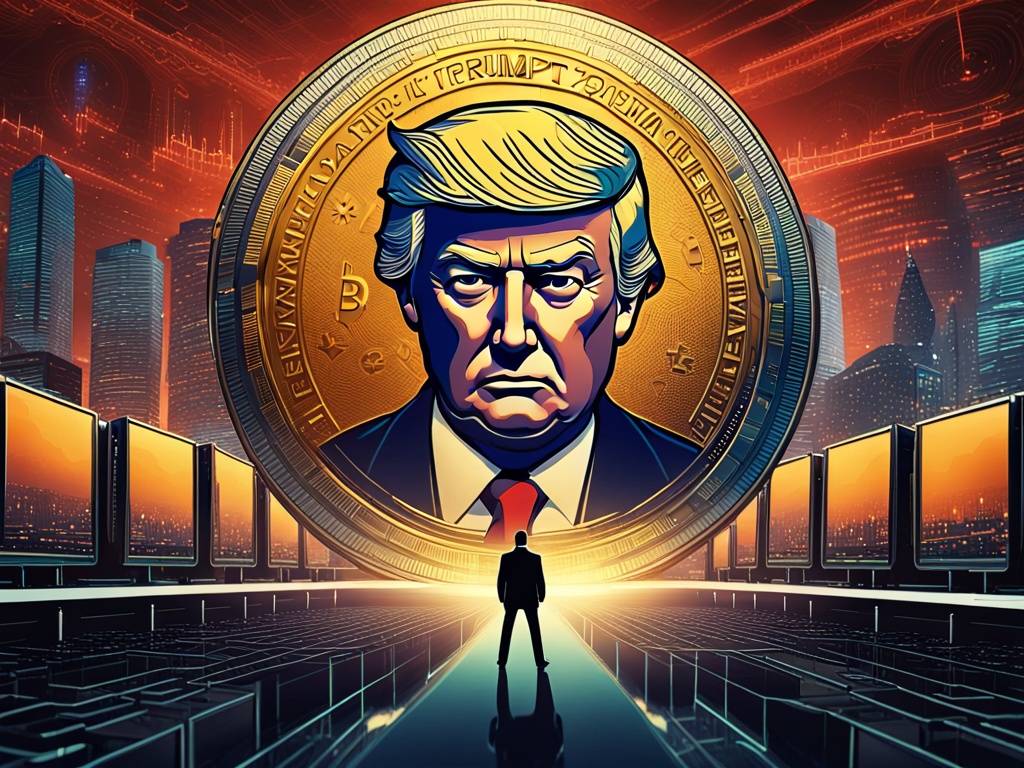
Impact of Recent Tariff Decisions on Cryptocurrency Markets ?
This article examines the repercussions of President Trump’s recent tariff announcements on the overall cryptocurrency market. The market’s dynamics are shifting, reflecting the influence of macroeconomic policies on digital assets. As we navigate this year, understanding these developments can provide clarity on the evolving landscape of cryptocurrency trading.
Market Reaction to Tariff Announcements ?
The cryptocurrency market experienced a notable decline of 3% following President Donald Trump’s announcement regarding a new 25% tariff on imports of steel and aluminum. This announcement adds to the existing tariffs and signifies a continuation of Trump’s trade policy adjustments.
Subscribe to our Social Media for Exclusive Crypto News and Insights 24/7!
While addressing journalists on his way to the NFL Super Bowl, Trump disclosed that the forthcoming tariffs would target all nations, potentially impacting trading relationships. The president also highlighted that reciprocal tariffs would be announced soon, with immediate implementation, thereby introducing further volatility into the markets.
In the wake of this announcement, Bitcoin dropped to approximately $94,700 before recovering to the $97,000 mark. Altcoins also faced significant declines, with Ethereum, for instance, falling by 1.5% to reach around $2,627. Furthermore, notable falls were observed in other cryptocurrencies, including a 4.2% drop for both Cardano and XRP, with their prices now around $2.39 and $0.2486, respectively.
Shifting Trading Volumes ?

Recent analysis from 10X Research indicates that trading volumes in the crypto market have plummeted to levels not seen since before Trump’s election. This decline in trading activity may result in extended periods of uncertainty surrounding Bitcoin’s Strategic Reserve announcement, potentially lasting up to six months.
During these shifting market conditions, informed traders are increasingly concentrating on Bitcoin, maintaining its dominance above 60%. This pattern highlights a market rotation, where enthusiasm for altcoins and memecoins has diminished following the recent market dynamics.
Understanding Economic Slowdowns and Market Responses ️
James Toledano, COO at Unity Wallet, articulated the strong correlation between cryptocurrencies-particularly Bitcoin-and macroeconomic disturbances. He explained how announcements like tariffs could herald potential economic slowdowns, diminishing investors’ appetite for risk, which leads to significant sell-offs across both traditional and cryptocurrency markets.
Toledano emphasized that international policies are pivotal in influencing market sentiment, liquidity conditions, and investor behavior. In periods of uncertainty, market turbulence tends to escalate. Conversely, definitive policies, whether advantageous or detrimental, can provide stability to the market. He noted the pressing need for clarity in the current economic landscape.
“Reflecting on past events during Trump’s initial term, we see that the introduction of tariffs often leads to inflationary pressures due to the rise in import costs. Interestingly, while tariffs in 2018 and 2019 did not induce inflation, they significantly affected financial and crypto markets, particularly Bitcoin-illustrating analogous impacts to what we are observing presently.”
Moreover, analysts predict that Bitcoin could remain in its current price consolidation phase until a significant influencer alters market dynamics. Key catalysts for a potential breakthrough include major regulatory updates, technological improvements within the Bitcoin network, or broader economic shifts that might impact investor emotions.
Currently, the cryptocurrency market boasts a valuation of approximately $3.2 trillion. Reflecting on this year, it’s worth noting that Bitcoin was priced around $47,000 at the same time last year, indicating considerable market growth and development over the past months.
Hot Take ?
The effects of macroeconomic policy on cryptocurrency markets are profound, with tariffs creating ripples in both traditional and digital assets. As we delve deeper into this year, it’s essential to closely observe how these economic decisions will influence trading behaviors and market stability. Understanding the interplay between global policies and cryptocurrency dynamics can empower you to navigate this evolving landscape effectively.
For further examination of how recent economic scenarios affect crypto markets, consider reviewing these sources:
New tariffs on metals by Trump