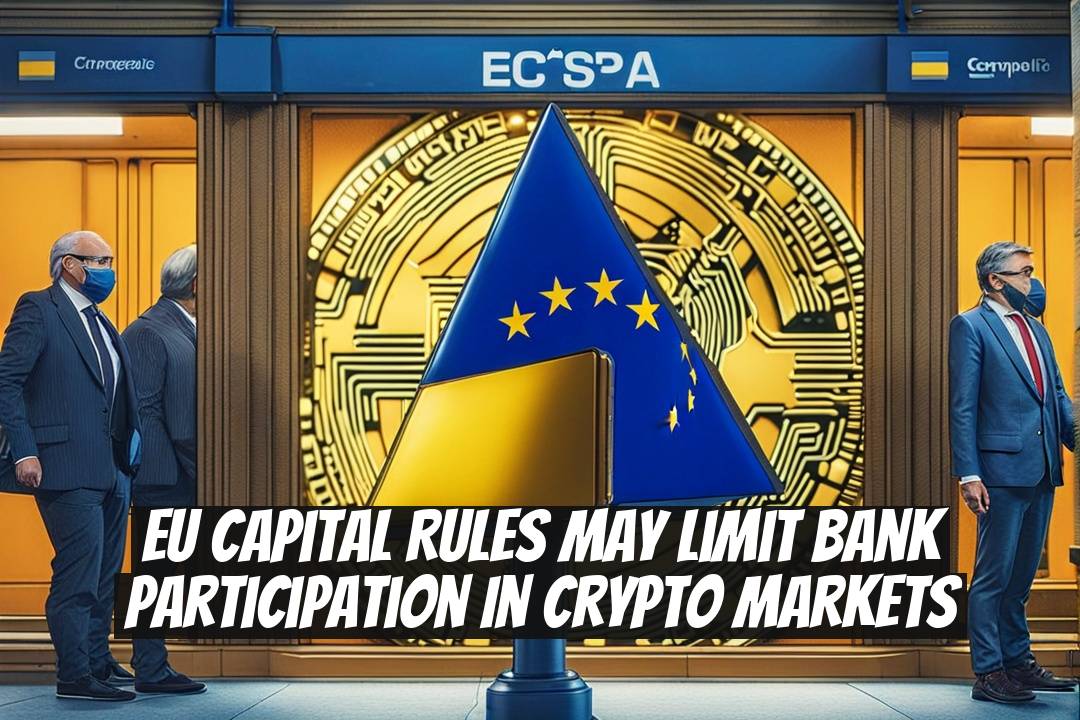
When EU Capital Rules Throw a Wrench in Banks’ Crypto Game
If you thought banks diving into crypto was about to become the norm, think again. The European Union’s new capital requirements regulations are about to put a heavy damper on banks’ participation in crypto markets - and honestly, it’s looking like a painful squeeze. The EU’s Capital Requirements Regulation III (CRR III) slapped a staggering 1,250% risk weight on banks’ exposures to unbacked crypto assets - yep, like Bitcoin and Ethereum[1][3]. What does that mean? Well, banks now have to park €12.5 million in capital for every €1 million worth of, say, BTC they hold. It’s basically a “crypto’s too hot for bankers” stamp. While the U.S. and Switzerland take a more chill stance, Europe’s playing the strict parent, making it darn near impossible for banks to jump in without ringing alarm bells.
Key Takeaways
- EU’s CRR III regulation enforces 1,250% capital charges on unbacked crypto assets, forcing banks to hold huge capital buffers that increase the cost of crypto exposure.
- This framework disproportionately affects small and medium-sized banks, curtailing crypto liquidity from traditional financial sources.
- Tokenized traditional assets get a favorable treatment compared to unbacked cryptos, making EU a potential hub for tokenization - but not for unbacked crypto.
- The move aligns with the EU’s larger strategy to prioritize financial stability, economic sovereignty, and to encourage Central Bank Digital Currency (CBDC) adoption over wild west crypto speculation.
- Market mechanics, like dominance cycles and liquidation cascades, may intensify volatility as banks scale back their participation.
Subscribe to our Social Media for Exclusive Crypto News and Insights 24/7!
Alright, let’s peel this onion and see what’s really cooking under the European hood.
? Why That 1,250% Risk Weight Feels Like a Brick Wall
Imagine you’re a bank. You spot that shiny, unbacked crypto asset sitting there - tempting, right? But wait, the EU says, “Hold up! For every €1 million in Bitcoin you wanna hold, you gotta stash €12.5 million as capital.” That’s a 12.5x capital requirement, more than any sane bank’s risk appetite. According to a recent European Banking Authority (EBA) report, this is probably the highest capital charge globally for crypto exposures[1][3]. It’s like telling banks: “Crypto’s dangerous. We’ll make you pay through the nose if you play.”
This doesn’t just scare small-time banks; it’s a game changer for the whole market:
- Reduced liquidity: Banks will think twice before supporting crypto ventures.
- Price volatility: Less institutional backing means price swings get wilder.
- Innovation stifling: Smaller outfits driving tokenized innovation will find fewer institutional partners.
Meanwhile, tokenized securities, like tokenized bonds or equities, get a smooth pass. They fly under the capital radar, treated like traditional assets with no extra capital hits[4]. So the EU isn’t anti-tokenization-it’s specifically clamping down where it smells risk unfettered by real-world assets.
? How This Shapes Market Dynamics and Investor Psychology

Look, ventures into crypto aren’t new, and the market’s got a well-rehearsed dance of dominance cycles, wannabe breakouts, and brutal sell-offs. Take ETH’s notorious failure near $2,000 resistance earlier this year. The Average Directional Index (ADX), measuring trend strength, showed weakening momentum just before ETH swan-dived hard into support - triggering liquidation cascades among over-leveraged traders. A trader I spoke to said this looked eerily like 2021’s blow-off top - "same fakeout vibes, same pain"[personal insight].
With banks shy to hold unbacked crypto, these liquidity shocks get amplified. Since big players provide some cushion and market depth, their absence will make bouts of volatility feel like waves crashing on a flimsy sandcastle.
To put it bluntly: holding crypto in Europe just got a lot riskier for banks, which trickles down to retail and institutional traders alike. You’ve seen this before, right? BTC teasing breakout then faking out because the liquidity wasn’t there.
? EU’s Strategic Big Picture: Sovereignty Meets Stability

Now, this isn’t just about scaring banks off crypto for the fun of it. The EU’s rolling out this stiff regime alongside MiCAR (Markets in Crypto-Assets Regulation) and the ECB’s push for a digital euro[2]. They’re essentially betting on financial sovereignty - controlling payment rails and limiting exposure to wild, often US-dominated crypto markets.
The ECB’s December 2024 minutes spelled it out plainly - unbacked cryptos mined mainly outside Europe pose real risks to local financial stability[2]. So, yes, promoting a CBDC digital euro is a hedge against reckless crypto plays. If you’re thinking, “Geez, that sounds a bit like a digital fortress,” you’re not wrong.
? What Does This Mean for You, the Investor?

If you’re holding tokens like Bitcoin, Ethereum, ADA, or whatever’s hot this week, here’s the kicker:
- EU banks aren’t the cavalry charging into crypto markets anytime soon
- Your liquidity might tighten; price swings could get nastier
- Tokenized securities backed by real assets may boom - watch for digital bonds, equities, and assets with lower risk weights
- Innovation hubs might move towards jurisdictions with lighter rules (hello, U.S., Switzerland)
- Keep an eye on on-chain analytics-for instance, CoinMarketCap data shows shifting dominance cycles as institutional flows waver
- Use platforms like TradingView to monitor ADX and liquidation levels; volatile periods might become your friend or enemy in coming months
I’ll toss in a personal nugget: Back in 2022, I held ADA through a 60% dump. It was brutal. But that taught me one thing - volatility is your second-best teacher, just don’t get flattened. Now with banks mostly sidelined in the EU, brace for more lessons like that.
? Live Data Snapshot: Crypto Market Shifts in Real Time
Looking at live CoinMarketCap charts as of early August 2025:
- Bitcoin dominance hovering around 44% after dipping near 41% in June
- Ethereum dominance steady near 18%, but its relative ADX readings hint at waning trend strength
- Stablecoins maintain a firm 13% market share, helped by MiCAR’s clarity and regulatory treatability
- Tokenized assets volume up 30% YoY in EU-based exchanges reflecting the favorable capital treatment[4]
The whales ain’t sleeping, fam. They’re rotating.
? What’s Next? Watch for Regulatory Echoes & Market Repercussions
- The draft RTS (Regulatory Technical Standards) from EBA set to become permanent, tightening or loosening rules depending on political winds[3][5]
- Pressure on EU smaller banks to offload crypto holdings or risk blowing capital buffers
- Crypto innovation ecosystems might pivot towards tokenization over unbacked cryptos
- U.S. and other jurisdictions may attract capital with friendlier treatments, intensifying EU vs. US regulatory divergence[2]
Honestly, that move caught everyone off guard. You’d have thought banks would see crypto as a no-brainer side hustle. Instead, they’re getting the cold shoulder from Brussels.
If you’re navigating this shifting terrain and want to stay sharp, keep tabs on:
Crypto Capital Rules
Bank Participation in Crypto
EU Crypto Regulations
- https://www.eba.europa.eu/publications-and-media/press-releases/eba-publishes-draft-technical-standards-prudential-treatment-crypto-asset-exposures-under-capital
- https://www.atlanticcouncil.org/blogs/econographics/the-2025-crypto-policy-landscape-looming-eu-and-us-divergences/
- https://www.regulationtomorrow.com/de/crypto-assets-de/eba-final-report-draft-rts-on-the-calculation-and-aggregation-of-crypto-exposure-values-under-article-501d5-of-the-crr-3/
- https://www.ledgerinsights.com/eu-crypto-rules-for-banks-unlock-favorable-tokenization-treatment/