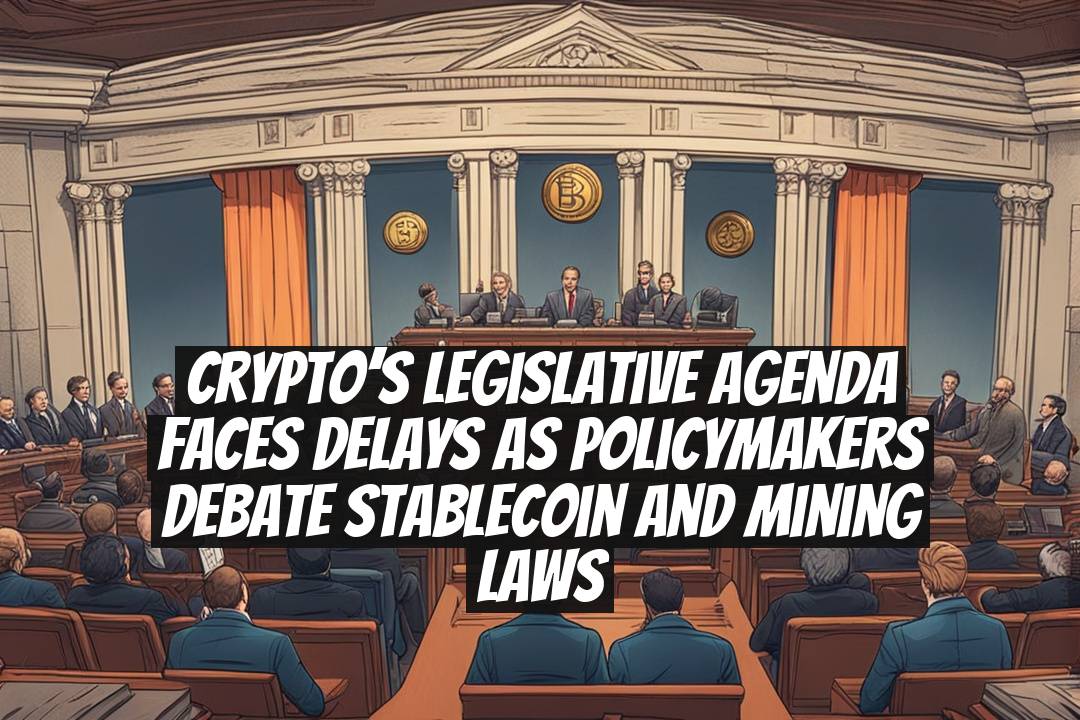
? Is the U.S. About to Miss Its Crypto Moment? The Legislative Gridlock Explained
We’ve all been hearing buzz about stablecoins, mining laws, and the endless “will-they-won’t-they” saga of U.S. crypto regulation. Policymakers are debating fiercely, yet progress is slow-some might say glacial-when it comes to passing a comprehensive legislative agenda. The keyword here is delays. And with each delay, the crypto market inhales sharply, holds its breath, and wonders what’s next.
Right now, the story isn’t just about politics-it’s about money, jobs, innovation, and the future of an industry built on code, not concrete. Stablecoin bills dangle in limbo. Mining legislation sparks heated Twitter threads. And the big, scary word “regulation” keeps popping up, sometimes as a sword, sometimes as a shield. For anyone with skin in the crypto game, these aren’t just headlines-they’re signals for when to buy, sell, or… just wait.
? Key Takeaways: What You Need to Know
Subscribe to our Social Media for Exclusive Crypto News and Insights 24/7!
- Stablecoin laws could be the first domino to fall, but progress is slower than expected-nobody’s sure when (or if) they’ll hit the President’s desk[5].
- Mining regulation is even murkier, with no real consensus in sight-some states are making their own rules, and the Feds are trailing behind.
- Bipartisan bickering is the new normal: Democrats and Republicans can’t agree on how to classify tokens, who should oversee what, or what counts as too much regulation[1][7].
- Industry leaders-Coinbase, Ripple, Galaxy, Kraken, Uniswap, and others-are meeting directly with lawmakers, but so far, the dialogue hasn’t broken the gridlock[2][3][7].
- Market impact: The longer the wait, the more uncertainty-investors get jittery, innovation slows, and competitors overseas sprint ahead.
- Personal insights: There’s a real risk that the U.S. could lose its edge in crypto if agencies and Congress keep dragging their feet-capital and talent flow where the rules are clear, not where they’re stuck in committee.
? Stablecoins, Mining, and More: A Policy Deadlock, Explained ?
Let’s talk stablecoins first-the digital dollars of the crypto world. Politicians and regulators have been flirting with stablecoin legislation for years, and the stablecoin law seems perpetually “almost there.” The recent GENIUS Act, signed by President Trump, was a rare breakthrough, but it’s more of a band-aid than a cure-all[5]. The real prize-a comprehensive federal framework-remains stuck in Senate debates, with no marked-up bill in sight[1]. Analysts reckon the wait could drag into the 2026 midterms, making stablecoin issuers, exchanges, and investors play a high-stakes waiting game[7].
Mining laws are even more of a patchwork. While some lawmakers are concerned about energy use and environmental impact, others champion the promise of jobs and economic growth. The result? A policy vacuum that leaves state governments to set their own rules, often at odds with each other (and with industry wishes). For mining companies, this uncertainty is a headache-nobody wants to invest in a state where laws might flip overnight.
Market structure legislation is the third elephant in the room. Both parties agree something needs to happen, but what exactly? Democrats want tougher rules to fight illicit finance, especially in Decentralized Finance (DeFi), while Republicans call for more innovation-friendly classifications that could help crypto ETF approvals[3]. Neither side looks ready to budge. The result: Congress is on pause, and the crypto industry is stuck in regulatory limbo[1].
As one industry executive put it, “It’s like watching your favorite show on pause, and the remote’s lost in the couch cushions.” Everyone knows the plot is moving-just not in Washington.
? How This Stalemate Impacts the Crypto Market-By the Numbers ?

Volatility is the word of the day. With policy headlines swinging like a crypto chart, prices follow suit. Regulatory uncertainty doesn’t just scare investors-it kills momentum. Why buy into Bitcoin or Ethereum if Congress could, in theory, kneecap the entire market with a single vote? This kind of doubt creates a “wait-and-see” culture, where big money stays on the sidelines and retail investors second-guess every trade.
Innovation also takes a hit. Developers and startups need clarity to build-otherwise, they’ll chase friendlier shores. Look at Europe, Asia, even the Middle East: jurisdictions are racing to attract crypto talent with clear rules and easy licenses. Meanwhile, U.S. entrepreneurs are left guessing, and some are packing their bags. That’s not just bad for crypto-it’s bad for America’s tech leadership.
ETFs are another casualty. The SEC and CFTC are hesitant to approve new crypto investment products without clear guidance from Congress. That means fewer options for everyday investors, and fewer chances for Wall Street to legitimize the industry[3]. It’s a classic chicken-and-egg problem: without laws, no approvals; without approvals, less mainstream adoption.
Consumer protection is a wildcard. Some argue that regulation would make crypto safer for newcomers-preventing scams, hacks, and Ponzi schemes. Others worry that too many rules will crush the very things that make crypto exciting: speed, privacy, and decentralization. For now, the debate is stuck on repeat.
? Industry and Lawmakers-Are They Even Speaking the Same Language? ?
Here’s the funny thing about crypto and politics: both sides want clarity, but they’re talking past each other. On one hand, you’ve got Coinbase, Kraken, Galaxy, and Ripple sitting down with Senators, waving spreadsheets and real-world examples[2][3][7]. On the other, you’ve got policymakers stuck in ancient arguments about whether a token is a “security” or a “commodity.” Sometimes it feels like they’re trying to regulate the internet with a fax machine.
Democrats are focused on curbing abuse-think money laundering, tax evasion, and fraud-especially in the DeFi world. Their leaked draft framework drew heat from both Republicans and the industry, who say it smothers innovation[7]. Republicans, meanwhile, are pushing for clearer lines between the SEC and CFTC, freeing up “ancillary assets” (i.e., stuff that’s not clearly a security) for growth[3]. The result? Both sides dig in, the Senate Banking Committee hits pause, and the whole process crawls at dial-up speed[1].
Public opinion is just as divided. Some Americans see crypto as the future-a way to opt out of a broken system. Others see it as a Wild West gamble, best left to the brave (or the reckless). That split is echoed in Congress, where every vote on crypto is a tightrope walk between innovation and caution.
?? My Take: What’s a Crypto Investor (or Builder) to Do? ?
Look, nobody likes uncertainty. But in crypto, it’s part of the job description. The best strategy? Stay informed, stay flexible, and don’t put all your eggs in one basket. Here’s how:
- Diversify: Don’t bet your rent money on any single crypto, especially with laws up in the air.
- Watch the states: While the Feds dither, some states are moving faster on mining, stablecoins, and even CBDCs.
- Keep an ear to the ground: When Coinbase and pals meet with Congress, pay attention. These talks could signal the next big move-or the next big nothingburger.
- Think global: If you’re building, consider jurisdictions with clearer rules-the EU’s MiCA, Singapore, even Dubai are rolling out the red carpet.
- Protect yourself: Without federal consumer protections, self-custody and cold wallets aren’t just for libertarians-they’re smart risk management.
- Stay patient: The best projects and investors know how to ride out the storm. Regulation will come-eventually.
And here’s a personal insight: The U.S. is at risk of losing its lead in crypto not because of technology, but because of bureaucracy. Capital and talent are liquid-they flow where the rules are clearest. Right now, too many brilliant minds and deep pockets are looking elsewhere. That’s not just bad for crypto-it’s bad for America’s economic future.
Are We Waiting for Nothing? A Thought to Ponder
So here’s the question I’ll leave you with-what happens if the U.S. never catches up? If Congress keeps kicking the can, will crypto simply move on without us? Or will some last-minute deal save the day, making the U.S. the promised land of digital assets once again? The answer probably lies somewhere in between, but one thing’s for sure: waiting isn’t a strategy, in markets or in policy.
Keyphrases for Further Reading
stablecoin law
crypto mining regulations
US crypto policy
Source Links
[1] https://www.skadden.com/insights/publications/2025/10/democratic-defi-proposal[2] https://markets.financialcontent.com/stocks/article/breakingcrypto-2025-10-20-us-crypto-policy-at-a-crossroads-executives-and-lawmakers-convene-amidst-regulatory-gridlock
[3] https://coincentral.com/ripple-coinbase-join-senate-talks-as-crypto-etf-rules-hang-in-balance/
[4] https://www.icij.org/news/2025/07/landmark-cryptocurrency-legislation-passes-u-s-house-to-be-signed-into-law-by-president-trump/
[5] https://www.whitehouse.gov/fact-sheets/2025/07/fact-sheet-president-donald-j-trump-signs-genius-act-into-law/
[6] https://www.trmlabs.com/reports-and-whitepapers/global-crypto-policy-review-outlook-2024-25-report
[7] https://www.fxstreet.com/cryptocurrencies/news/crypto-leaders-meet-senate-democrats-on-stalled-market-bill-202510201047