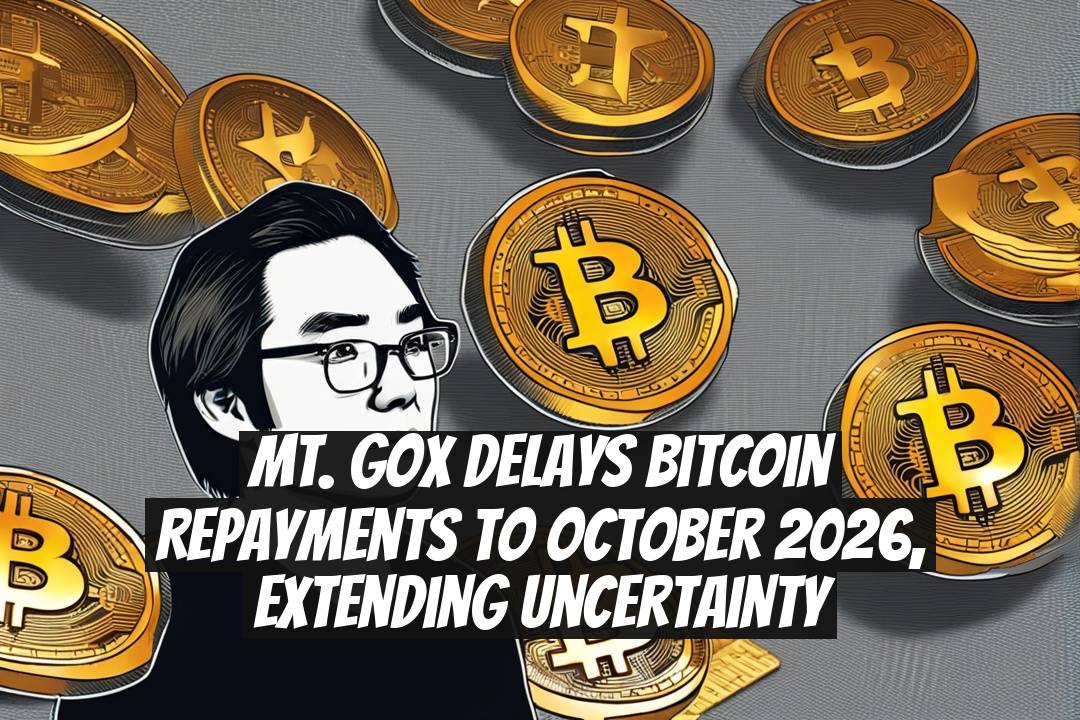
The Ghost in the Bitcoin Machine: Why Mt. Gox Still Haunts Your Portfolio in 2026?
If you’ve spent any time in crypto, you know that few stories resonate like Mt. Gox-the legendary collapse, the saga of the missing 850,000 BTC, and the seemingly endless wait for creditor repayments. Now, after nearly a dozen years of twists and turns, Mt. Gox has again pushed back its repayment deadline, this time to October 2026[1]. For thousands of creditors, this extension brings another year of uncertainty, anxiety, sighs, and-for crypto analysts like me-a fresh set of market puzzles to decode.
Key Takeaways: Why Mt. Gox’s Latest Delay Actually Matters
- Mt. Gox has delayed creditor repayments for the third time, now moving the last deadline to October 31, 2026[1][2][7].
- Around 34,689 BTC (worth roughly $3.98 billion) are still sitting in the Mt. Gox wallet, a major potential source of sell pressure if they ever hit exchanges[1][4].
- Nearly 19,500 creditors have been repaid, but thousands more remain stuck in procedural limbo-verification, anti-money laundering checks, and missing documents are major snags[1][3].
- The delay is actually bullish for Bitcoin in the short term, removing a near-term overhang of possible selling pressure[2][3].
- But the story is more nuanced-ETF flows, derivatives markets, and overall market sentiment now play a bigger role than Mt. Gox alone[5].
- If you’re a creditor, patience is a must. For traders, this is all about timing, psychology, and watching for early signals[1][6].
Subscribe to our Social Media for Exclusive Crypto News and Insights 24/7!
The Mt. Gox Repayment Delay: A Play-By-Play?
Let’s rewind a bit. Mt. Gox, once the world’s largest Bitcoin exchange, collapsed in 2014 after losing 850,000 BTC-a theft so colossal it’s still spoken of in hushed tones. Since then, the Japanese courts have been wrestling with how to repay victims, and the process has been about as smooth as a gravel road in a thunderstorm. The latest chapter? Another 12-month delay, just days before the previous October 2025 deadline[1][2][7].
The trustee overseeing the process-Nobuaki Kobayashi-explains that many creditors still haven’t completed their paperwork or cleared anti-money laundering (AML) checks. Some are waiting for documents; others have simply vanished. The trustee recently said that most “base, early lump-sum, and intermediate repayments” have been completed for those who’ve gotten their ducks in a row, but others remain in purgatory[1][3].
So, who’s left hanging? Well, as of early 2025, 19,500 creditors got their coins back, but thousands more are still waiting, their claims tangled in red tape, forgotten passwords, and the lost-keys hall of fame[1][3]. This matters, because every year, we’re reminded: Mt. Gox isn’t just history-it’s a live grenade with a very, very long fuse.
The Bitcoin Market: Why the Mt. Gox Delay Is Both Good and Bad News??
Here’s where things get spicy for traders and hodlers. About 34-35k BTC sit in the Mt. Gox wallet, a staggering sum by any measure[1][4]. If these were suddenly unleashed onto exchanges, the market would almost certainly choke-even briefly-on the sheer volume. But with the new 2026 deadline, that risk is mostly parked on a distant horizon, at least for now[2][3].
As a crypto analyst, this sort of delay is both fascinating and frustrating. On one hand, it removes immediate selling pressure, which is a sigh of relief for anyone bullish on Bitcoin. There’s a kind of grim irony in all this: the same creditors desperate to get their coins back are, in a roundabout way, propping up the price by not getting them yet[2][3]. Market analysts agree-this might even be a net positive short-term signal, giving the market room to breathe and grow without the Sword of Damocles of a Mt. Gox dump hanging overhead[4].
But here’s the counterpoint: the Mt. Gox delay isn’t a magic wand. Crypto is now a grown-up market, with deep-pocketed institutions, spot ETFs, and a derivatives sector so active it could have its own day-trading drama series[5]. BlackRock’s IBIT ETF alone holds nearly $89 billion in assets-several times the value of the remaining Mt. Gox coins[5]. This means that if (or when) the Mt. Gox coins finally return to circulation, the market has much more liquidity to absorb them than it did in 2021, let alone 2014[5].
So yes, Mt. Gox is still a factor, but it’s no longer the only show in town. ETFs, futures, options, and even tax windows are now part of the calculus, turning what once would have been a market-moving event into something more like a bump in the road-assuming it’s even a bump at all[5].
Practical Tips for Navigating the Mt. Gox Repayment Delay?

If you’re a creditor, you already know patience is required, but here are a few practical steps to keep in mind:
- Stay on top of correspondence: The trustee will send updates, so monitor your email and the official Mt. Gox rehabilitation site closely[1].
- Double-check all documents: Many delays are due to missing paperwork or failed verifications. Triple-check forms before submitting[1][3].
- Don’t panic if you’re still waiting: The process is arduous, but as long as you’ve submitted everything, you’re still in line. If you haven’t, now’s the time to act[1][3].
- Beware impersonators: Scams related to Mt. Gox are common. Only trust official channels and never share your private keys or credentials[1].
If you’re a trader or investor:
- Watch for on-chain movements: Arkham Intelligence and others will flag when Mt. Gox BTC moves. Big shifts could signal repayments or trustee activity[1][4].
- Monitor ETF flows: The rise of institutional products like the Bitcoin ETF means that market absorption dynamics have changed dramatically[5].
- Keep your emotions in check: With every Mt. Gox delay, there’s a temptation to overreact. Remember, the story is still unfolding, and the market is evolving even faster.
Personal Insights: What This Means for the Crypto Market (and Your Portfolio)?
I’ve been watching the Mt. Gox saga for years, and I’m still amazed at how much weight this story carries, even today. It’s a reminder that crypto is a young asset class-still wrestling with the ghosts of its past, still evolving in real time. The latest delay isn’t just about paperwork-it’s about psychology, about the collective memory of a market that’s more resilient than ever, but also more complex.
What strikes me most is how institutional adoption is changing the game. Back in the early 2010s, Mt. Gox was the market. Today, it’s just another voice in the chorus-albeit a loud one. The rise of ETFs, derivatives, and global liquidity means that even a giant coin dump can be absorbed, smoothed, and digested before it triggers panic[5].
That said, there’s still a poetic symbolism here. Mt. Gox is the ghost in the machine, a specter that reminds us how far we’ve come-and how much further there is to go. For investors, it’s a lesson in patience, adaptability, and the power of looking beyond the headlines.
Mt. Gox Coin Supply Risk: Does 35,000 BTC Still Matter in 2026??
Let’s be practical: $4 billion in BTC is a huge number for anyone’s balance sheet, but for the wider market, the number looks a bit less scary in context[1][4]. CME data shows that futures and options open interest is now in the tens of billions-market plumbing that didn’t exist even a few years ago[5]. This “plumbing” lets dealers, market makers, and big players hedge, arbitrage, and warehouse supply shocks with much greater ease.
Spot Bitcoin ETFs, massive players like BlackRock, and even the growing institutional appetite for crypto exposure mean that Mt. Gox’s coins, when they finally make it to market, are likely to get funneled into larger, deeper pools[5]. In other words, while 34,689 BTC would have caused a meltdown in 2014, today it’s a liquidity event, not a liquidity crisis-assuming the market keeps growing and evolving at its current pace.
But we shouldn’t get complacent. The timing of the release-now pushed into late 2026-means that traders will have to watch for other catalysts, like tax events, futures expiries, and macroeconomic shifts. The calendar has changed, but the risk hasn’t vanished-just delayed and diffused[5].
And let’s not forget Bitcoin Cash (BCH): Mt. Gox creditors also stand to get their coins back in that chain, but BCH markets are thinner and more volatile, so those payouts could make bigger ripples than BTC repayments at the same total dollar value[5]. Smart traders will keep an eye on both forks.
The Human Cost of Mt. Gox: Creditors’ Agony and the Long Road Back?
Most coverage focuses on market impact, but let’s not forget the people at the heart of this. For many creditors, this is an intensely personal story. Some lost life savings; others are still arguing over lost private keys or forgotten passwords. The delay, while expected, is another year of uncertainty, another year of waiting for closure. It’s the kind of patience that only a true stakeholder-or a cryptographer with a steel trap for a mind-could muster.
If you’re one of them, I’d say this: hang in there. The process is agonizingly slow, but it’s still moving forward. For everyone else, it’s a reminder of why crypto, for all its promise, remains a high-stakes experiment-one where patience and resilience often pay off, but only if you’re ready for the long game.
Looking Ahead-What If Mt. Gox Never Really Fades Away??
So here’s a question to wrap it all up: With each new Mt. Gox delay, the market seems to shrug and move on-but what happens when the story finally reaches its true ending? Will the coins find their way to patient creditors, to eager buyers, to ETFs, or to cold storage again? Will the market swallow it all in a single gulp, or will the ghosts of 2014 linger for years to come?
The truth is, nobody knows-and that’s part of the fun, and the madness, of being in crypto. Whatever happens, the market’s ability to absorb, adapt, and move forward is better than ever. But as always, the only real certainty is uncertainty. And maybe, just maybe, that’s the real lesson Mt. Gox keeps teaching us-over and over again.
Final Thought: Is the Ending of Mt. Gox Finally in Sight??
As we look toward the new October 2026 deadline, it’s worth asking: Would a full and final Mt. Gox closure make Bitcoin more “normal”? Or is the lingering uncertainty part of what keeps crypto so unpredictable, and so fascinating?
For those caught up in the story-creditors, traders, and hodlers alike-one thing’s clear: the road to resolution is still long, winding, and anything but smooth. But for the market as a whole, the message is clear: buckle up, stay alert, and get ready for the next act in this crypto odyssey.
Keyphrase Links
MtGoxBitcoinRepayment
BitcoinMarketUncertainty
CryptoCreditorDelays
- https://thecryptobasic.com/2025/10/27/mt-gox-again-delays-4b-bitcoin-repayment-to-creditors/
- https://coingape.com/mt-gox-delays-repayments-as-american-bitcoin-add-to-holdings/
- https://99bitcoins.com/news/bitcoin-btc/mt-gox-crypto-repayment-delayed-again-another-year-of-waiting-or-a-blessing-in-disguise-for-btc-price/
- https://finbold.com/ai-predicts-bitcoin-price-with-mt-gox-repayments-delayed-until-2026/
- https://cryptoslate.com/mt-gox-delayed-to-2026-does-selling-34700-btc-even-matter-anymore/
- https://coinpaper.com/11917/mt-gox-delays-repayments-again-until-october-2026
- https://www.coindesk.com/markets/2025/10/27/mt-gox-delays-creditor-repayment-to-october-2026
- https://www.thestreet.com/crypto/bankruptcy/chapter-15-bankrupt-exchange-delays-payments-again