
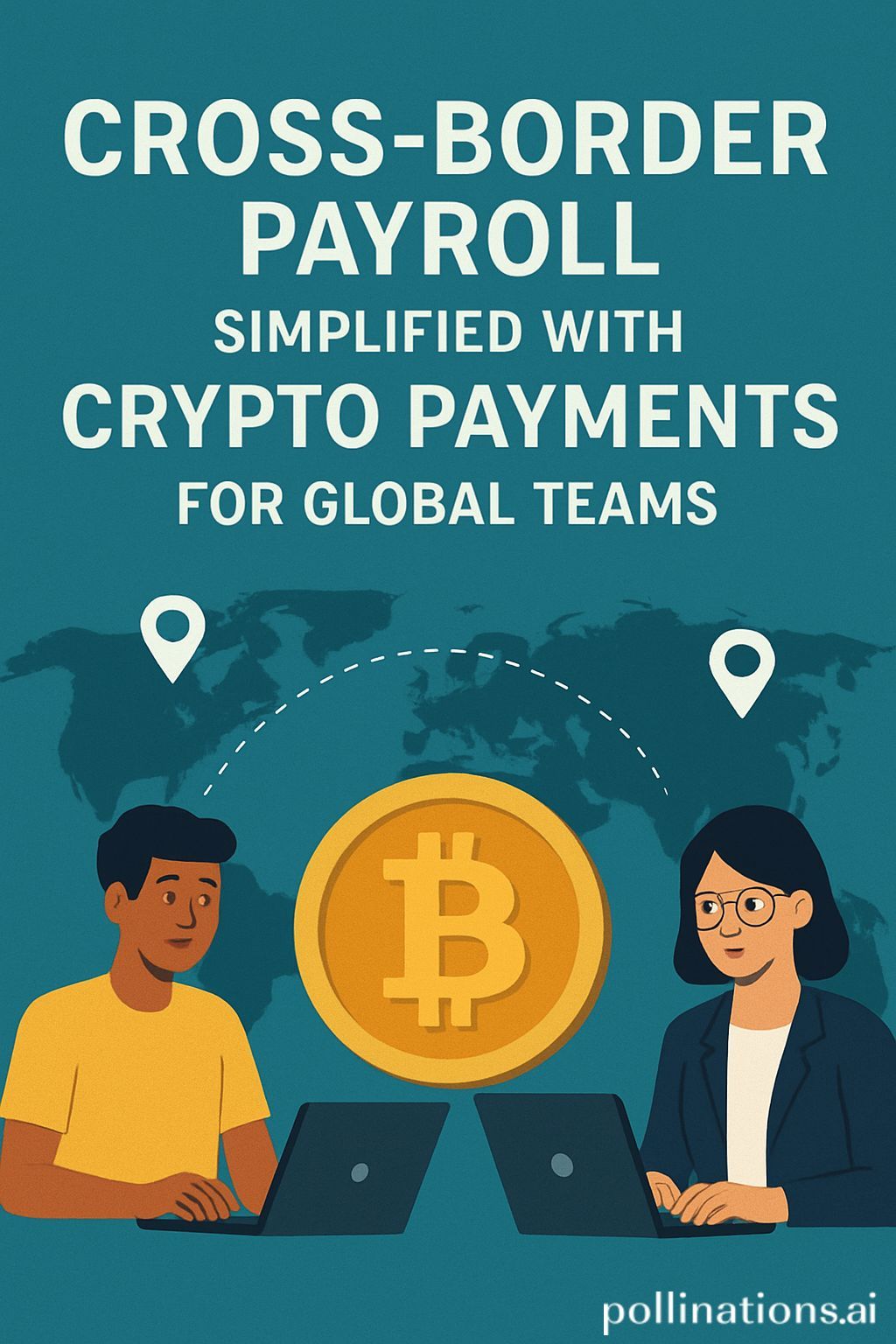
Why Paying Global Teams in Crypto Changes the Game
If you’ve ever wrangled with cross-border payroll, you know it’s about as fun as herding cats-tax rules, currency conversions, banking delays, and fees that feel like highway robbery. Now imagine slicing through that mess with crypto payments - instant, low-cost, transparent. Seriously, cross-border payroll simplified with crypto payments for global teams isn’t just buzz; it’s the future knocking hard at HR’s door.
Crypto payroll uses Bitcoin, Ethereum, or stablecoins to pay your crew worldwide, making those slow international bank wires seem like dial-up internet. The promise? Lightning-fast settlement, fewer middlemen draining your wallet, and compliance automation. But is it perfect? Not quite. Regulatory puzzles and volatility still lurk in the shadows.
Let’s unpack how this whole crypto payroll thing works, peek at real data trends, and hear from experts who’ve been in the trenches. Spoiler alert: if you’re managing global teams, this could save you millions - or at least a headache or two.
Subscribe to our Social Media for Exclusive Crypto News and Insights 24/7!
Key Takeaways
- Crypto payroll enables companies to pay employees globally using cryptocurrencies or stablecoins, reducing reliance on traditional banking networks and saving time and costs.
- Stablecoin transaction volumes have exploded - over $32 trillion in 2024 - fueling faster, cheaper cross-border payments.
- Regulatory uncertainty remains the biggest roadblock, with rules differing wildly country to country, but more businesses are adopting crypto payroll solutions anyway.
- Platforms like Bitwage and Rise handle compliance, tax reporting, and payout automation across nearly 200 countries.
- Historically, volatile crypto markets can spook payroll, but stablecoins provide a reliable medium of exchange with near-instant final settlement.
? Cross-Border Payroll: Why Crypto Is Not Just a Gimmick
Traditional global payroll? Feel free to groan. You’ve gotta juggle fluctuating forex rates, bank transfer delays (think 3-5 business days, minimum), and surprise fees that sneak in at every turn. It’s a nightmare for businesses aiming to reward talents spread across time zones.
Username oneSafe.io nailed it: crypto payroll slashes transaction times from days to minutes while trimming fees - and that’s just the start[2]. No more sweating whether your contractor in Nigeria got paid on time, or your European team’s salary isn’t eroded by conversion hit.
Blockchain settlements run 24/7 without a middleman taking a cut. Imagine sending $100,000 to Singapore on a Friday night and seeing it confirmed before you even hit the couch[4]. The stablecoin market cap - now north of $300 billion - backs this trust, proving that blockchain payments aren’t a flash in the pan.
? The Numbers Don’t Lie: Stablecoin Growth Is Insane

Pull up TradingView’s charts and CoinMarketCap’s stablecoin data - it’s a wild ride upward. From a modest $5 billion supply five years ago to a gargantuan $305 billion supply in stablecoins today, these digital dollars underpin the new payroll economy.
With payment-specific transaction volumes hitting an estimated $5.7 trillion in 2024, compared to traditional banking’s snail pace and price tags, crypto payroll is more than just a toy for crypto geeks - it’s a business imperative[4].
Just picture this: your ETH payroll isn’t just a number on a screen but a swift river of value flowing with little friction, even in volatile markets. And if that sounds like your fantasy, you’re not alone.
? Insider Scoop: Expert Takes & Real-World Tales
I caught up with a crypto analyst who’s seen the market twists firsthand. Their take? “Crypto payroll adoption spiked after volatility crashes proved stablecoins’ worth. Back in 2022, when ADA dumped 60%, payroll systems hooked to stablecoins didn’t blink. That gave businesses confidence to jump in.”
Another strategist pointed out, “The whales ain’t sleeping, fam. They’re rotating funds into enterprise-ready solutions. The projects they launched solidify global payroll infrastructure. Look at Bitwage - payments across almost 200 countries with same-day crypto transfers? That’s not hype; that’s power move.”
These platforms automate compliance too, which is a lifesaver. Tax reporting’s a nightmare without it - Rise, for example, automatically generates 1099s and aligns with local tax laws[3]. It’s complex, but pretty much the secret sauce for making crypto payroll manageable at scale.
⏳ Market Mechanics Behind the Magic

Let’s chew on some market dynamics to see how all this holds up under pressure.
You’ve seen this before, right? BTC teasing breakout then faking out, ETH swan-diving into support, dominance cycles shifting like tectonic plates. Crypto payroll platforms lean heavily on stablecoins precisely because they avoid volatility cascades and liquidation spirals - key risks in open crypto markets.
Look at the ADX indicator during crypto crashes. It spikes with volatility. Payroll systems linked to raw crypto would inherit that chaos, making salaries unpredictable. Stablecoins like USDC act like an anchor, keeping payouts stable while blockchain handles the transfer.
Fun fact: in March 2020, during the infamous crypto flash crash, traditional crypto payments saw value swings of over 40% within hours. Payrolls pegged to stablecoins were hardly rattled. That historical example shows why savvy CFOs prefer stablecoins in their cross-border payroll toolkit[1][4].
? How Crypto Payroll Platforms Tackle Regulation (And Why You Should Care)
If you think crypto payroll is just plug-and-play, hold your horses. The regulatory landscape is a beast - different countries have wildly different stances. Some demand wages be paid in local fiat currency, others allow crypto under conditions, and a few outright ban digital salary payments[2].
The smart platforms build legality into their DNA. Rise’s Agent of Record (AOR) model, for instance, reduces misclassification risks and protects businesses from surprises. They navigate international labor laws - a task that honestly would tie your head in knots without them[3].
Bottom line? If you want to pay across borders, partnering with compliant payroll providers is essential. They automate tax compliance, payroll reporting, and currency conversions - letting you focus on growing your global team, not wrestling legal snakes.
? Real Savings & Efficiency Gains: What’s In It For You?
When all’s said and done, crypto payroll’s crown jewel is cost-efficiency.
- Fewer intermediary fees - those pesky bank charges and forex costs gone
- Reduced cash flow gaps - instant settlements mean employees get paid on time, accelerating productivity
- Transparency and immutability - no chargebacks, fraud, or payment reversals
- Flexibility - pay in Bitcoin, Ethereum, or stablecoins based on employee preference
- Automation - tax docs, compliance, and payroll running like clockwork
Companies embracing this are noticing significant operational cost reductions. Deloitte estimates billions could be saved globally annually as blockchain payments ramp up[1].
? Snapshot of the Crypto Payroll Ecosystem in 2025
Below is a trending chart from CoinMarketCap showcasing stablecoin market cap growth since 2019 and surge in transaction volumes, visual proof that these digital paychecks are far from a small niche.
? The Road Ahead: What We’d’ve Expected vs. What’s Coming
Honestly, adoption ramping as fast as it has caught some folks off guard. We’d’ve expected more regulatory roadblocks slowing crypto payroll, but the market’s nimbleness surprised everyone. The reality now is businesses want efficiency, and they’re willing to navigate compliance to get it.
With innovations like asset-backed tokens and DeFi integrations, next-gen payroll will blend traditional finance’s stability with blockchain’s speed and transparency[2]. Imagine global payroll where your CFO clicks “pay,” and employees worldwide receive stable, on-chain payments within minutes - no stress, no surprises.
If you were smart enough to hold SOL through all its dips, you know the payoff of patience and innovation. The payroll world is no different.
? Cross-Border Payroll Simplified With Crypto Payments - Frequently Asked Questions You Can’t Miss
Q1: What exactly is crypto payroll and how does it work?
A1: Crypto payroll means paying employees or contractors using cryptocurrencies such as Bitcoin, Ethereum, or stablecoins instead of traditional money. Employers use specialized platforms to convert and send payments digitally, automating tax compliance and ensuring fast, transparent transfers across borders.
Q2: Why are stablecoins essential for crypto payroll?
A2: Stablecoins are pegged to assets like the US dollar, providing stability against crypto volatility. They enable predictable salaries and nearly instant settlement, avoiding the wild price swings that could disrupt payroll budgets or employees’ incomes.
Q3: What are the main regulatory challenges in implementing crypto payroll?
A3: Different countries have different rules-some restrict crypto wages, others require payments in local currency, and regulations often lack clarity. Companies need payroll providers that ensure compliance through automated tax and labor law reporting to avoid fines or legal trouble.
Q4: How much can companies save by switching to crypto payroll?
A4: By avoiding banking fees, cutting transaction times from days to minutes, and automating compliance, companies can save millions annually, especially if they manage large distributed teams. Deloitte projects blockchain-based payments could reduce cross-border processing costs by billions globally.
Q5: Are there risks with cryptocurrency payments for payroll?
A5: Yes, volatility is the biggest risk, but using stablecoins mitigates this significantly. There’s also regulatory uncertainty and the need for reliable infrastructure providers to ensure legal compliance and smooth operations.
crypto payroll solutions
stablecoins for payments
cross-border crypto payroll
- https://hellopebl.com/glossary/crypto-payroll/
- https://www.onesafe.io/blog/cross-border-crypto-payroll-global-compensation
- https://www.riseworks.io/blog/crypto-payroll-for-cpas
- https://bvnk.com/blog/blockchain-cross-border-payments
- https://www.request.finance/crypto-spend-management/top-crypto-payroll-solutions-compared
- https://bitwage.com/en-us






