
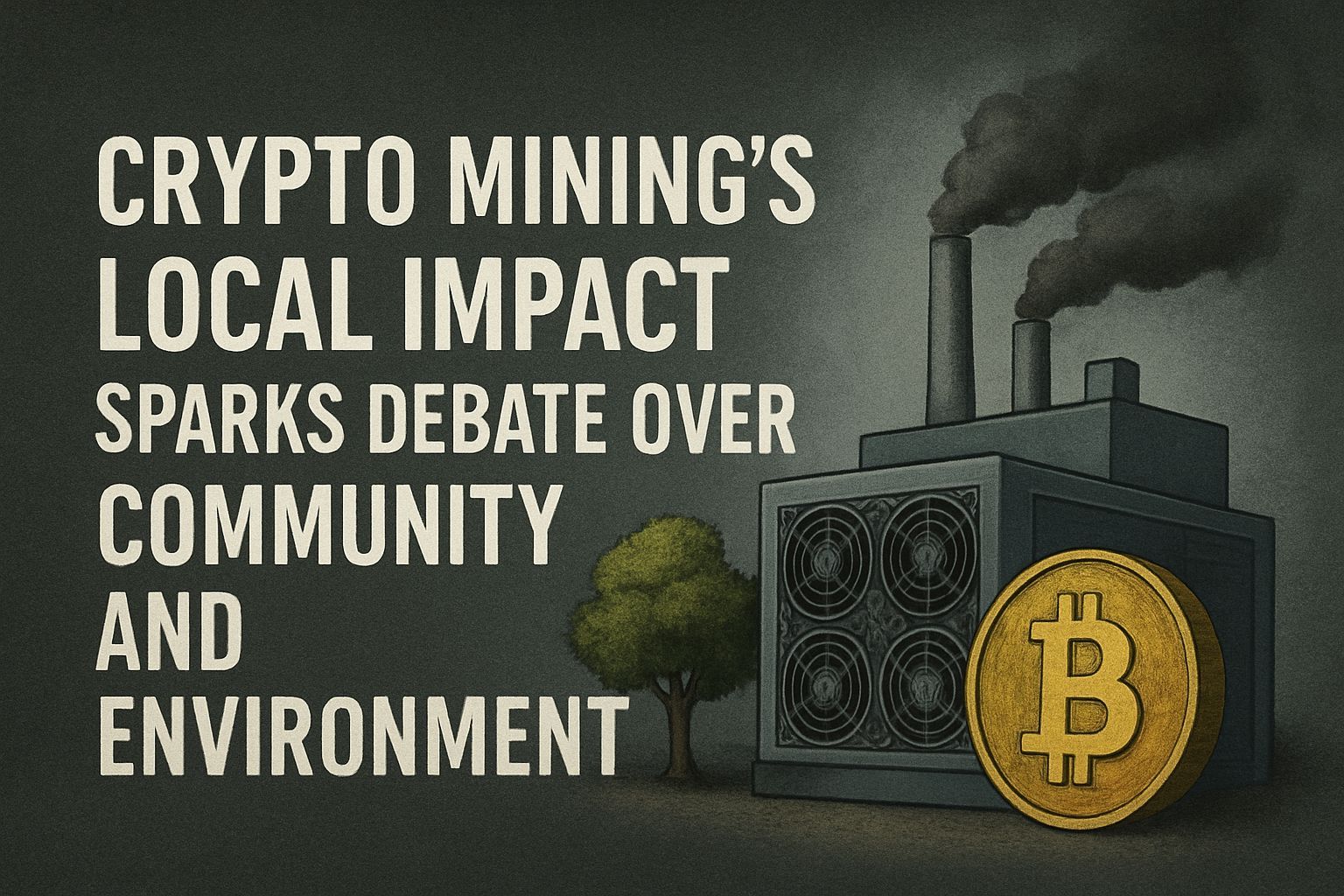
When Crypto Mining Moves In: Friend or Foe to Your Backyard?
Crypto mining’s local impact sparks debate over community and environment like few issues have before. You might think Bitcoin miners are just digital cowboys clicking away in Silicon Valley, but no - the truth is far stickier. These mining operations aren’t just about crunching numbers; they’re guzzling up electricity like there’s no tomorrow and, quite frankly, leaving neighbors up at night with constant noise and air pollution. The result? A tangled mess where community concerns, environmental costs, and the pursuit of crypto riches collide head-on.
Whether you’re holding BTC, ETH, or even dipping toes in altcoins, understanding crypto mining’s real local footprint matters. It’s not just some abstract CO₂ number debated in a boardroom; it’s the hum behind the walls, the spike in your electricity bill, the smog creeping into the air. And oh, it’s stirring an ongoing heated debate in towns from Granbury, Texas, to Kuwait’s entire power grid.
Key Takeaways ?
Subscribe to our Social Media for Exclusive Crypto News and Insights 24/7!
- Bitcoin mining in 2025 consumes massive energy, akin to a small nation, mostly fueled by fossil fuels, though renewables are rising[1][3].
- Communities near mining farms report noise pollution, health issues, and lawsuits, spotlighting social costs beyond environmental ones[1][5].
- Despite green initiatives, mining’s carbon footprint remains colossal-Bitcoin alone emits roughly 98 million metric tons of CO₂ annually, comparable to a mid-sized country[4][7].
- Market mechanics like hash rate jumps and energy demand cycles tie directly into environmental pressures and regulatory backlash.
- Experts stress urgent shifts to sustainable mining to keep crypto viable, with advanced analytics linking mining volume to emissions spikes[6].
? Mining Madness: Energy Use You’ll Want to See
Let’s get this straight: Bitcoin mining isn’t a subtle energy leecher. According to the Cambridge Centre for Alternative Finance, by 2025, Bitcoin mining sucks up approximately 150 terawatt-hours (TWh) of electricity annually - about as much as a middle-sized country like Poland or Mexico uses[1][6]. Imagine your fridge running nonstop, but 100,000 times over.
Here’s a quick snapshot:
| Energy Source | % of Bitcoin Mining Power (2025) |
|---|---|
| Hydropower | 23% |
| Wind | 15% |
| Solar | 3% |
| Nuclear | 10% |
| Fossil fuels | ~49% |
Renewable juice is powering more than half of the network now, but nearly half still depends on carbon-heavy sources - especially coal and natural gas plants, which pump out fine particulate matter (PM2.5), a nasty pollutant linked to heart attacks and respiratory illnesses[2][3].
Speaking of health: A 2025 Harvard study showed that 34 big Bitcoin mines in the U.S. increased PM2.5 pollution levels enough to endanger nearly 2 million people downwind[2]. Imagine that invisible menace lurking in the air - all from your neighbor’s crypto farm.
Oh, and noise? Mining rigs hum like a swarm of angry bees 24/7. In Granbury, Texas-home to Marathon Digital’s mammoth mining facility-residents complain about migraines, panic attacks, and sleep loss caused by this relentless racket[5]. A lawsuit is on, and local governments are dialing up regulations and noise ordinances. Funny how money can stir that quiet little town up.
Market Mechanics: What Mining Means for Crypto’s Pulse

Mining affects the market far beyond noisy rigs and sky-high electric bills. It’s closely intertwined with crypto market dynamics - from dominance cycles and ADX (Average Directional Index) readings to liquidation cascades.
Take BTC’s hash rate - a measure of computing power securing the network. When hash rates spike, miners crank up energy use, often triggering heightened electricity demands and making environmental impacts worse. These surges also coincide with bullish market cycles, as miners hunt for sweet profits[6].
If you watch BTC dominance charts, you’ll notice mining booms seem aligned with certain price cycles. For instance, back in late 2021, hash rates surged despite the market rolling over, signaling that miners were chasing those last, high-margin coins. One trader I chatted with said, “It looked eerily like the 2021 blow-off top - everyone trying to cash in before the music stopped.”
And then there’s the ADX, which shows trend strength. During mining booms, ADX in BTC often pushes above 40, indicating powerful market trends that can fuel both parabolic upswings and painful liquidations.
Remember May 2022? ETH didn’t just drop - it swan-dived into support around $1,800, triggering liquidation cascades across DeFi platforms. Many blamed network congestion and rising gas fees, but miners pulling out due to rising operational costs also played a part. These real-world mining shifts resonate through market actions more than you might realize.
? The Environmental Equation Isn’t Black-and-White

Let’s be real: Mining’s carbon footprint is monstrous. Bitcoin’s global emissions in 2025 hover around 98 million metric tons of CO₂ - similar to Qatar, a country infamous for its fossil-fuel addiction[4][7]. Each BTC transaction emits roughly 700 kilograms of CO₂, equivalent to driving a gas car 1,600 km.
Yet some miners are hustling to green their game. Clean energy projects abound, from Texas wind farms dedicated to mining rigs to flare gas capture in oil fields, a nifty way to recycle waste methane into hashing power[3].
However, critics argue that even renewable-powered mining diverts clean energy from ordinary people and businesses, who then may rely on dirtier fossil fuels to fill the gap. Earthjustice’s Mandy DeRoche puts it plainly: “If you use all that cheap, clean hydro for crypto mining, then humans and small businesses can’t use it - and then they have to go somewhere else for that energy, often fossil fuel-based”[1].
It’s a tricky conundrum: Mining can go green, but only if the transition is smart and doesn’t just shuffle pollution from one place to another.
? What’s Next? Community, Tech, and Crypto’s Social License

Regulators and communities are not staying quiet. Kuwait banned crypto mining outright in 2025 due to power grid strain, and Russia’s introduced seasonal bans[1][5]. In the U.S., Texas’ public hearings and lawsuits in places like Granbury reflect growing impatience.
What do miners do? Invest in quieter tech (think immersion cooling), move to less populated places, or double down on renewable investments. But it’s also about crypto’s social license - mining can’t just maximize profits; it’s gotta win over communities to survive.
In the wild west of crypto, the environmental and social reckoning isn’t a sidebar. It’s the battle for legitimacy. The crypto world needs to wrestle not just with price charts and on-chain metrics, but with air quality monitors and decibel meters. Otherwise, this industry risks alienating the very communities and investors that could fuel its next big wave.
Frequently Asked Questions About Crypto Mining’s Local Impact
Crypto Mining’s Local Impact: Answers to Your Burning Questions
Q1: What exactly causes the environmental problems linked to crypto mining?
A1: Crypto mining demands tons of electricity to verify transactions, often sourced from fossil fuels. This high energy use produces carbon emissions and increases air pollution, especially fine particulate matter harmful to human health.
Q2: How does noise pollution from mining affect local communities?
A2: Mining rigs run cooling fans 24/7, creating loud background noise. Nearby residents have reported sleep disturbances, headaches, and stress, fueling lawsuits and tougher local ordinances.
Q3: Are there any efforts to make crypto mining environmentally friendly?
A3: Yes. Many miners are switching to renewables like hydropower and wind, using flare gas from oil fields, and exploring new cooling tech. However, the transition’s complex because clean power diverted to mining can push others towards fossil fuels.
Q4: How do mining operations influence crypto market behavior?
A4: Mining hash rate cycles often align with market dominance and volatility. Spikes in mining activity may precede price surges or liquidations, reflecting miners’ energy input chasing profits and impacting network security.
Q5: What should communities know before crypto mining moves in?
A5: They should expect increased electricity demand, potential noise disturbance, and possible air pollution if mining relies on fossil fuels. Engaging local governments on regulations and pushing for clean energy use is key.
Explore more about crypto community impact, sustainable mining, and market dynamics:
crypto mining environmental impact
bitcoin energy consumption
crypto mining regulation
- https://coingeek.com/bitcoin-mining-2025-environmental-and-regulatory-concerns/
- https://hsph.harvard.edu/news/bitcoin-mining-increases-levels-of-air-pollution-harmful-to-human-health/
- https://carboncredits.com/bitcoin-hits-all-time-high-but-will-its-carbon-footprint-cloud-the-rally/
- https://news.mongabay.com/2025/06/bitcoin-boom-comes-with-huge-intensifying-environmental-footprint/
- https://markets.financialcontent.com/stocks/article/breakingcrypto-2025-11-5-the-green-divide-crypto-minings-environmental-reckoning-and-the-battle-for-community-trust
- https://www.nature.com/articles/s41598-025-92314-z
- https://www.cigionline.org/documents/3563/Emerging_Digital_Assets_Forrest.pdf






