
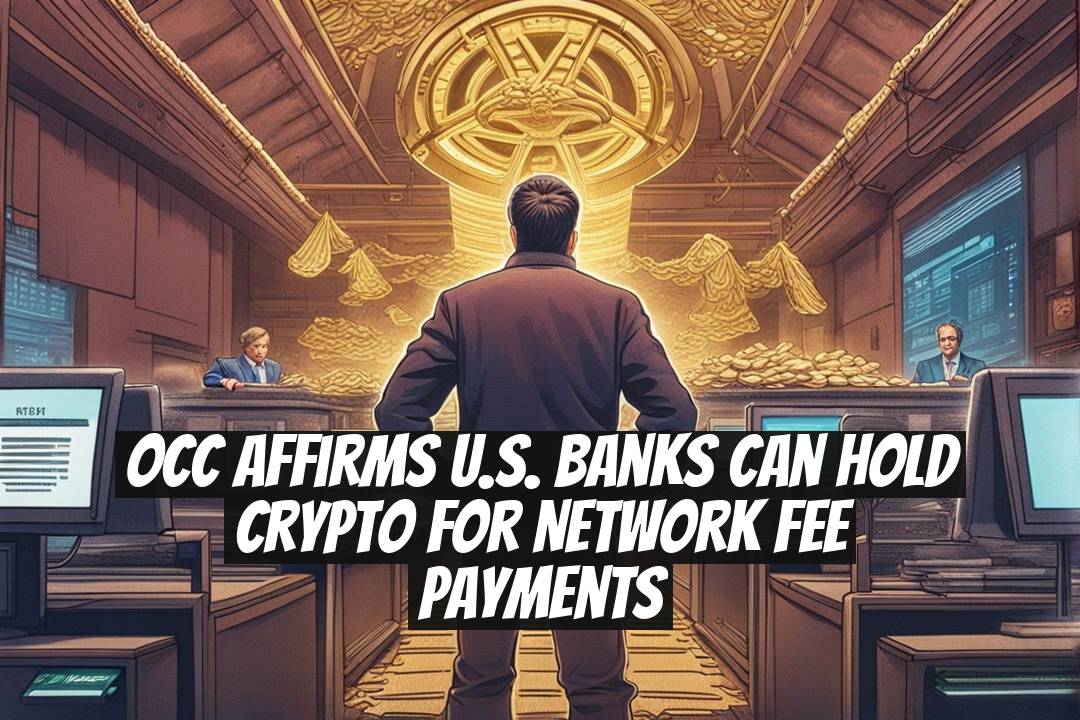
The OCC Just Changed Everything for Banks Holding Crypto-Here’s What It Means for Your Portfolio
When Traditional Finance Finally Embraces the Blockchain: A Watershed Moment Nobody Saw Coming
The U.S. Office of the Comptroller of the Currency dropped a bombshell on Tuesday, November 18th, 2025, and honestly? Most people missed it. While everyone’s been obsessing over Bitcoin’s price action and Ethereum’s latest pump-and-dump cycle, the OCC quietly issued interpretive letter No. 1186, essentially giving national banks the green light to hold cryptocurrency on their balance sheets for paying blockchain network gas fees.[1] This isn’t just regulatory theater. This is the moment traditional banking infrastructure finally admits that crypto isn’t going anywhere-and they need to operate within the ecosystem, not against it.
Think about that for a second. U.S. national banks. The institutions that’ve been skeptical of crypto since day one. Now they can legitimately hold digital assets to facilitate blockchain transactions. That’s a seismic shift in how Wall Street views the space we’ve been building for over a decade.
Subscribe to our Social Media for Exclusive Crypto News and Insights 24/7!
Key Takeaways
- The OCC confirmed that national banks can maintain crypto assets on their balance sheets specifically for paying blockchain network transaction fees (gas fees)[1]
- This regulatory clarity reduces friction and eliminates dependence on third-party intermediaries for crypto custody and transaction facilitation[2]
- The permission aligns with the GENIUS Act requirements, signaling broader institutional adoption of digital assets in traditional banking[1]
- Banks can now hold "reasonably foreseeable" amounts of network-specific tokens needed for their operations-a practical framework that wasn’t there before[1]
- This move opens the door for mainstream financial institutions to participate more directly in blockchain ecosystems, potentially accelerating institutional crypto adoption[3]
? The Architecture Behind the Permission: How This Actually Works
Here’s the thing that separates this announcement from the usual regulatory theater-it’s practical. The OCC didn’t just say "okay, you can hold crypto now." They specifically laid out the framework: banks can maintain digital assets on their balance sheets if they reasonably expect to need them for network fees related to activities that’re already explicitly allowed under the GENIUS Act.[1]
Let me break down what that means in real terms. When you send a transaction on Ethereum, you pay gas in ETH. When you’re moving assets on Solana, you’re paying SOL. If a bank wants to custody digital assets for clients or facilitate stablecoin transactions (which the GENIUS Act specifically covers), they need native tokens sitting in their reserves to actually execute those transactions. Before Tuesday? That was legally murky. After Tuesday? It’s permissible.
The logic is almost boringly sensible, honestly. If you’re going to facilitate an activity-moving money on a blockchain, executing smart contracts, whatever-you need the fuel to make it happen. Forcing banks to go through third-party intermediaries just to access gas tokens created unnecessary friction and middleman costs. The OCC basically said: "Yeah, we get it. You need to hold these assets as operational necessities, not speculative bets."
What’s clever about this framework is the "reasonably foreseeable need" language.[1] It’s not saying banks can warehouse unlimited amounts of every token. It’s practical. If you anticipate needing 50 ETH per week for transaction fees, you can hold something approximating that amount. But you’re not suddenly opening a Coinbase Pro account to accumulate gigabucks of altcoins. The regulators know the difference between operational holdings and speculation. They’re only permitting the former.
? What Does This Mean for the Broader Crypto Market?

This isn’t just banking policy. This is infrastructure maturation.
Think back to 2023-2024. You watched institutional adoption happen, but it always felt staged. BlackRock gets Bitcoin ETF approval. Fidelity starts custody services. Grayscale moves their trust to ETF format. All of it felt like traditional finance testing the waters from the shallow end while wearing a life jacket. Real integration? That required banks to actually operate within crypto ecosystems, not just around them.
The OCC letter changes that calculus. When your local regional bank-or JPMorgan, or Bank of America, or any national bank supervised by the OCC-can legitimately hold crypto on their balance sheets for operational purposes, custody infrastructure becomes… normal. You’re not waiting for some third-party custodian to intermediate your transactions anymore. The banks themselves become native participants.
Here’s where it gets interesting from a market perspective. Institutional adoption typically follows this arc:
- Speculation phase (2017, early 2021)
- Risk management phase (holdings via trusts or ETFs)
- Integration phase (what we’re entering now)
- Native operation phase (where crypto becomes infrastructure, not an asset class)
We’re sliding from phase two into phase three. That’s the moment when volatility often decreases because you’re no longer dealing with speculative positioning. You’re dealing with operational holdings. Boring. Necessary. Profitable long-term.
? The GENIUS Act Connection: Why This Timing Matters
The OCC’s decision didn’t happen in a vacuum. It’s directly tied to the Guiding and Establishing National Innovation for U.S. Stablecoins (GENIUS) Act, which passed earlier in 2025.[1] That legislation explicitly allows banks and certain financial institutions to issue and manage stablecoins. But here’s the catch-to actually operate a stablecoin network, you need access to the blockchain.
The GENIUS Act gave banks permission to play in this sandbox. The OCC letter just handed them the shovel.
What we’re seeing is regulatory infrastructure catching up to operational reality. The Treasury Department, Federal Reserve, and FDIC are all working on writing the actual ruleset for stablecoin issuers and activity.[1] That’s not done yet. But the OCC just said, "Look, while we’re figuring out the full rulebook, here’s what we know is permissible." It’s pragmatic. It’s forward-thinking. And it signals that the entire regulatory apparatus is moving toward enablement rather than containment.
A crypto analyst I spoke with recently put it this way: "The OCC letter is the regulatory equivalent of mainstream adoption. When JPMorgan’s chief risk officer approves holding ETH because it’s operationally necessary for stablecoin infrastructure, that’s not crypto evangelism. That’s just banking."
? Why This Reduces Intermediary Risk (And What That Means for Your Holdings)
Here’s something that doesn’t get enough attention: crypto custody has historically been fragile. You want your bank to stake ETH for you, custody your Bitcoin, manage network transactions? You’re trusting some specialized custodian-Coinbase Custody, Fidelity Digital Assets, Kraken Institutional, whoever. Each one is a potential single point of failure.
Now? Banks can hold those assets directly on their own balance sheets for operational purposes.[2] That’s not just regulatory permission. That’s risk distribution. If your regional bank can manage its own Ethereum holdings for transaction facilitation, they’re no longer dependent on Coinbase’s infrastructure being up when they need to execute. They’re no longer exposed to custody service outages or insolvencies.
You’ve seen this dynamic before, right? Remember when everyone was freaking about FTX? The crypto industry collectively realized that third-party intermediaries-even the supposedly well-run ones-can absolutely crater overnight. What the OCC just did was give institutional actors a way to reduce that dependency. That’s not sexy. It’s not going to pump token prices. But it’s the kind of infrastructure maturation that actually matters long-term.
Think about it analogously to the internet in the late 1990s. You used to access everything through AOL or CompuServe-centralized intermediaries. Then ISP infrastructure became competitive and distributed. That’s what we’re watching happen in crypto custody, and it’s bullish in ways that go beyond quarterly price movements.
? The Real Impact: When Does This Actually Change Market Dynamics?
Okay, so here’s the honest take: this isn’t going to cause some immediate moonshot in Bitcoin or Ethereum prices. The announcement went live on the 18th, and we didn’t see a 15% spike that day. That’s actually healthy. It means the market didn’t get whipsawed by regulatory theater. It means sophisticated actors recognized this for what it is-foundational infrastructure improvement, not a catalyst.
But here’s where it matters operationally. Over the next 12-18 months, watch for:
Stablecoin launch announcements from tier-one banks. JPMorgan already has JPM Coin, but it’s been experimental. Now you might see Bank of America, Citibank, or others seriously enter stablecoin issuance because the infrastructure permissions are there.
Reduced custody costs for institutional investors. When your prime broker can hold your BTC directly instead of routing it through a third-party custodian, fees compress. That’s operational efficiency flowing through to client returns.
Increased on-chain activity from institutional reserves. Banks that were hesitant about holding any crypto because of regulatory ambiguity? They can now justify operational holdings. You’ll see more network activity, more transactions, potentially better network health metrics across Ethereum, Solana, and other chains.
Competitive pressure on independent custodians. Companies like Coinbase and Kraken provide custody services because banks couldn’t do it themselves. Now they can. Some of those specialized custodians might pivot toward serving retail or smaller institutions, or they might face serious revenue pressure. This is creative destruction at work.
I’m not saying the price goes straight up from here. Market cycles don’t work that way. But six months from now, when bank treasuries start reporting crypto holdings in regulatory filings, and when stablecoin transaction volumes spike because institutional actors have clearer operational permission to move-that’s when you’ll see secondary effects.
? What About Dominance Cycles and Network Effects?
Here’s something worth considering from a market structure perspective. Bitcoin dominance (BTC’s percentage of total crypto market cap) has historically oscillated between ~35-65% depending on whether we’re in a "risk-on" or "risk-off" phase in the broader market.
If institutional banking infrastructure starts becoming the primary on-chain activity vector-stablecoin transfers, custody operations, settlement infrastructure-that changes the type of network demand. You’re no longer primarily looking at speculative trading demand. You’re looking at throughput demand. Transactions per second. Settlement finality. Censorship resistance.
That typically favors networks with strong fundamentals and institutional tooling. Ethereum’s already positioned there. Solana’s aggressively building institutional infrastructure. Bitcoin’s remaining the settlement layer. Altcoins that were purely speculative vehicles? They might face compression.
A trader I know who’s been in this space since 2017 put it bluntly: "When the banks come, the shitcoins go. Network effects concentrate around utility, not hype." He’s not wrong. The OCC letter doesn’t kill speculation, but it does shift the long-term allocation incentive away from narrative-driven altcoins toward genuine infrastructure networks.
? The Custody Angle: Why This Matters for Your Self-Custody Thesis
Here’s a hot take that might surprise you: this OCC letter is actually bullish for self-custody advocates.
Wait, hear me out. When banks hold crypto on their balance sheets for operational purposes, they’re using custody infrastructure. That custody infrastructure needs to be robust, auditable, and compliant. Banks will demand security standards from their service providers and their own operations. That raises the quality bar for custodial services industry-wide.
When custody infrastructure improves and becomes more transparent, it makes the case for self-custody stronger, not weaker. Users can compare: "Okay, my bank is holding 100 BTC in institutional custody with quarterly audits and insurance. Or I can hold my own with proper hardware security, redundancy, and backup protocols." The comparison becomes informed rather than ideological.
Plus-and this is the overlooked part-when banks can hold crypto directly, that reduces the need for individuals to use risky third-party custody solutions. You’re no longer trapped choosing between self-custody and trusting a startup. You can use institutional-grade custody from your actual bank. That’s a huge shift in the risk matrix for retail investors.
? The Macro Picture: Regulatory Clarity as Infrastructure
Step back for a moment. The OCC didn’t invent a new banking capability. They clarified a permission that should’ve been obvious: if you’re running a permissible business activity on a blockchain, you need the tools to execute that activity.
What they actually did-beyond the specific crypto permission-is signal that the entire regulatory apparatus is capable of nuanced decision-making. They’re not banning crypto. They’re not treating it as this monolithic risk category. They’re saying, "Okay, here’s what’s permissible under current law. Here’s the framework. Here’s what we need clarified further as the rest of the rulemaking process happens."
That’s mature regulation. And that’s what crypto desperately needed. Not cheerleading. Not hostility. Just clarity.
The Federal Reserve, FDIC, and Treasury are still writing the full ruleset on stablecoins and crypto activities.[1] But the OCC just gave the market a roadmap: institutional participation in crypto infrastructure is not just tolerated-it’s legally permissible and operationally necessary.
That changes the entire risk calculation for institutional investors who were sitting on the sidelines. JPMorgan’s risk committee can now point to an OCC interpretive letter and say, "Yeah, this is compliant. We can operate here."
? FAQ: Everything You Need to Know About OCC Crypto Clarity and Bank Asset Holdings
Q1: What exactly is a blockchain "gas fee" and why do banks need to hold crypto for it?
Gas fees are transaction costs required by blockchain networks-you pay in the network’s native token (ETH for Ethereum, SOL for Solana) to have your transaction processed. Banks need to hold these tokens operationally if they’re facilitating customer transactions or managing custody services on these networks, so they can execute transfers without relying on third-party intermediaries.
Q2: Can banks now just accumulate unlimited amounts of crypto as speculative investments?
No. The OCC specifically limited holdings to amounts that "reasonably foreseeable" for operational needs.[1] This isn’t permission for banks to run trading desks or accumulate Bitcoin as a treasury reserve. It’s purely for transaction facilitation tied to permissible banking activities like stablecoin operations or custody services.
Q3: How does this OCC letter relate to the GENIUS Act?
The GENIUS Act (passed in 2025) explicitly allows banks to issue and manage stablecoins. The OCC letter essentially says, "To actually execute stablecoin operations on blockchains, you need to hold the network-specific tokens for gas fees." It’s the operational clarification that makes the legislative permission practically executable.[1]
Q4: Could this lead to major banks issuing their own stablecoins?
Potentially, yes. JPMorgan already has JPM Coin, but other banks were hesitant due to regulatory ambiguity. This clarity removes a major barrier. Expect announcements from tier-one institutions over the next 12-18 months as they formalize stablecoin programs previously in the experimental phase.
Q5: Does this mean I should move my crypto holdings to my bank instead of keeping them in self-custody?
That’s a personal risk decision, but this letter improves the custodial infrastructure landscape overall. You now have a legitimate choice between institutional bank custody (regulated, insured, auditable) versus self-custody or other custodians. Compare the options based on your risk tolerance rather than regulatory ambiguity forcing your hand.
Q6: What’s the long-term impact on Ethereum and other layer-1 networks?
Institutional operational holdings on networks increase transaction volume, improve network health through consistent on-chain activity, and shift incentives toward genuine utility rather than speculation. This typically strengthens networks with robust infrastructure and reduces volatility driven by speculative altcoin trading cycles.
Learn More About Crypto Institutional Infrastructure
Explore deeper insights into how traditional finance is integrating with crypto networks through institutional crypto adoption, understand the mechanics of blockchain gas fees, and discover how stablecoin regulation is evolving.






