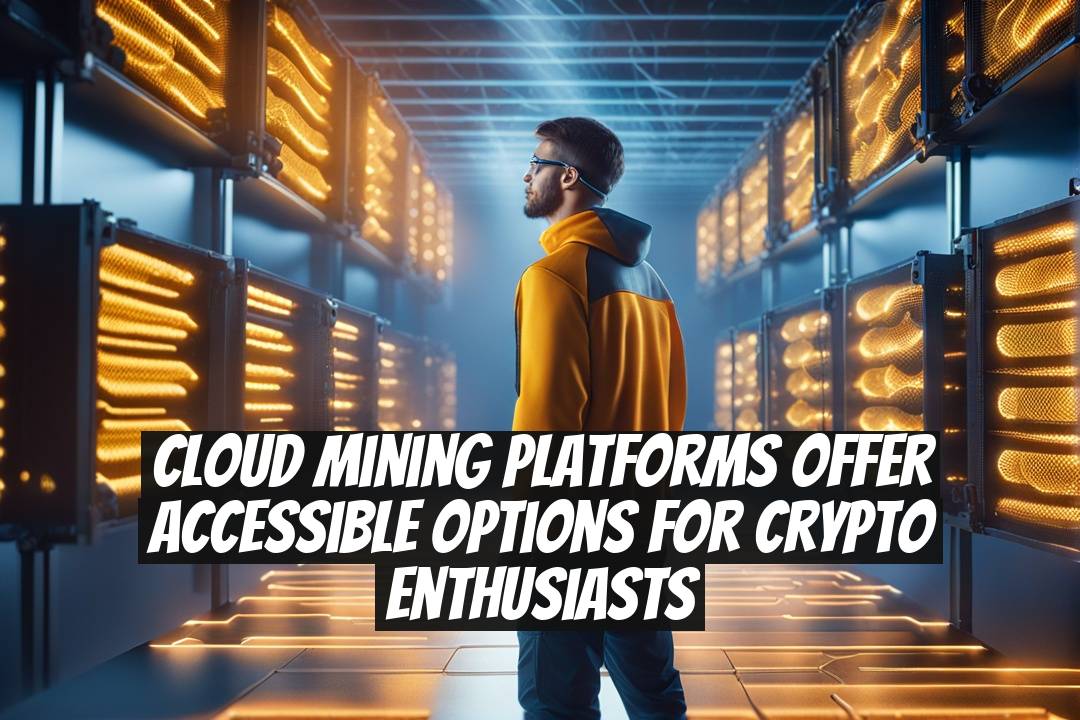
What If You Could Mine Crypto Without The Expensive Hardware? ?
The cryptocurrency mining landscape has undergone a dramatic transformation over the past few years, and if you’ve been on the sidelines wondering how to participate in this digital revolution without breaking the bank, cloud mining platforms offer an intriguing solution that deserves your attention. Cloud mining has emerged as a game-changing approach to cryptocurrency earning, democratizing access to mining rewards and making it possible for everyday investors to generate passive income from digital assets without the technical expertise or substantial capital investment traditionally required. Whether you’re a seasoned crypto enthusiast or someone just beginning to explore the possibilities of blockchain technology, understanding how cloud mining platforms work and what they offer could fundamentally change your approach to building wealth in the digital economy.
Key Takeaways: Essential Insights Into Cloud Mining ?
- Cloud mining eliminates the need for expensive hardware purchases and technical setup complexity
- Users can earn cryptocurrency rewards by renting computing power from remote data centers
- Multiple contract types provide flexibility for different investment goals and risk tolerances
- Recent market developments in 2025 have brought renewed attention to cloud mining services
- On-site mining remains a viable alternative for those willing to invest more upfront capital
Subscribe to our Social Media for Exclusive Crypto News and Insights 24/7!
Understanding Cloud Mining: Breaking Down The Basics ?
Let me paint a picture for you. Imagine you’ve always wanted to mine Bitcoin, but every time you looked into it, you encountered the same roadblocks: expensive ASIC miners costing thousands of dollars, astronomical electricity bills, complex technical setups, and the constant worry about hardware maintenance and cooling systems. For most people, these barriers felt insurmountable. Cloud mining essentially eliminates these obstacles by allowing you to participate in the mining process from virtually anywhere in the world[1][2].
At its core, cloud mining is a method where individuals rent computing power from remote data centers rather than purchasing and maintaining their own mining hardware[1][6]. Think of it as outsourcing your mining operation to professionals who specialize in running large-scale facilities. When you join a cloud mining service, you’re essentially purchasing a share of their computational resources, and in return, you receive a proportional share of the mining rewards generated by those resources.
The beauty of this approach lies in its simplicity. Instead of dealing with the headaches of setting up a mining rig, ensuring reliable internet connectivity, managing electricity costs, and performing regular maintenance, you can simply sign up for a cloud mining platform, choose your contract, and let the professionals handle everything else[2]. The provider manages all the operational aspects-hardware maintenance, cooling systems, electricity supply-while you sit back and watch your earnings accumulate.
How Cloud Mining Actually Works: The Mechanics Behind The Magic ️

To truly appreciate cloud mining, you need to understand the mechanics of how it functions. Cloud mining operates on the principle of pooled mining, where multiple users combine their rented hash power to compete for cryptocurrency rewards[1]. Let me break this down into digestible pieces.
When you sign up for a cloud mining service, you’re purchasing a specific amount of "hash power," measured in hashes per second (TH/s for terahashes per second). This computational power is allocated to your account from the provider’s mining farm-essentially a massive facility filled with specialized mining equipment[1][3]. The provider then assigns a portion of their overall mining operations to your account.
Once your mining contract becomes active, the provider’s hardware automatically begins performing the complex mathematical calculations required to validate blockchain transactions and create new blocks. Your share of the mining rewards is calculated based on the amount of hash power you’ve rented relative to the total hash power operating in the pool[1]. If you’ve rented 100 TH/s out of a pool’s 10,000 TH/s, for example, you’d receive approximately one percent of the pool’s rewards.
The entire process operates "in the cloud," meaning the mining doesn’t happen on your personal computer or equipment[1]. The provider handles all the heavy lifting-literally and figuratively. This setup particularly benefits individuals in remote regions with limited infrastructure or those without significant technical expertise[1].
Types of Cloud Mining Contracts: Choose What Fits Your Strategy ?
Not all cloud mining contracts are created equal, and understanding the different options available is crucial for making informed investment decisions. The market offers several contract types, each with distinct advantages and considerations.
Fixed-Term Contracts represent the most straightforward option[2]. With these agreements, you pay an upfront fee in exchange for mining access over a specific duration-typically ranging from 12 months to multiple years[2]. This predictability can be appealing if you want to lock in a known cost structure. However, if the cryptocurrency price crashes, you’re still obligated to pay for the contract.
Pay-As-You-Go contracts offer greater flexibility[2]. Instead of paying one large upfront fee, you pay daily or monthly charges based on the active hash rate you’re currently utilizing[2]. This approach allows you to scale your mining operation up or down depending on market conditions and your changing financial situation. If profitability declines, you can simply reduce your active hash power without being locked into a long-term commitment.
Lifetime Contracts represent the most ambitious option for committed miners[2]. These agreements allow you to continue mining indefinitely, either until they’re no longer profitable or until you and the provider mutually agree to terminate the arrangement[2]. While this sounds attractive on paper, lifetime contracts typically command higher initial fees, and profitability over such extended periods remains uncertain.
The Accessibility Revolution: Making Mining Democratic ?

One of the most significant advantages of cloud mining is how it has democratized cryptocurrency mining. Historically, mining was exclusively the domain of wealthy individuals and corporations who could afford the infrastructure investment. Cloud mining fundamentally changed this dynamic[1].
By eliminating the need for expensive equipment purchases and technical expertise, cloud mining platforms have opened the door to a much broader audience[1]. You don’t need to be an electrical engineer or possess advanced technical knowledge to participate. You simply need to understand the basic concept of renting computing power and be willing to commit capital to a mining contract.
This accessibility has profound implications for wealth distribution in the cryptocurrency ecosystem. Previously, mining rewards were concentrated among those with sufficient capital to build mining operations. Now, someone with just a few hundred dollars can rent mining power and begin earning cryptocurrency rewards. This democratization aligns with many of the original philosophical principles underlying cryptocurrency-making financial participation more accessible to ordinary people.
The reduction in capital requirements represents another crucial accessibility factor. Traditional mining requires substantial upfront investment in specialized ASIC miners (which can cost $1,000-$10,000) or high-end GPU configurations[5]. Cloud mining typically requires a much lower initial investment, often starting at just a few hundred dollars or even less depending on the provider[2].
Recent Developments: Cloud Mining in 2025 ?
The cryptocurrency market’s trajectory in 2025 has brought renewed energy to the cloud mining sector. The bullish crypto market combined with increasingly pro-crypto policies has created a favorable environment for mining expansion[5]. Several notable developments have emerged on the platform landscape.
Platforms like Zaminer have positioned themselves at the forefront of sustainable mining, emphasizing high-efficiency NVIDIA and AMD GPUs while requiring no user hardware management[5]. Similarly, HashFly launched cutting-edge mining solutions designed to provide high hash rates with optimized energy consumption specifically for Bitcoin and Ethereum mining[5]. DNminer entered the market by offering Bitcoin and XRP cloud mining services with flexible plans accommodating various budget levels[5].
These developments reflect a broader trend: the cloud mining industry is becoming increasingly sophisticated, competitive, and user-friendly. Providers are investing in better technology, more attractive contract terms, and improved user interfaces to attract miners of all experience levels. The market saturation is actually beneficial for consumers, as increased competition drives innovation and better pricing[5].
Advantages That Actually Matter: Why Cloud Mining Appeals To So Many ?
Let’s talk about what makes cloud mining genuinely appealing beyond the theoretical benefits. For most people, the practical advantages are what matter most.
Eliminated Capital Investment for Equipment: This might seem obvious, but it’s genuinely transformative. You’re not dropping $5,000-$15,000 on ASIC miners that might become obsolete within a year or two as difficulty increases[5]. Instead, you’re paying a service fee to access computing power without owning the underlying hardware. The provider absorbs the depreciation risk, not you[1].
No Electricity Cost Burden: One of mining’s most underappreciated challenges is the electricity cost. Large-scale mining operations consume enormous quantities of power, and in many developed nations, these costs can make mining operations unprofitable. Cloud mining providers operate facilities in locations with cheap electricity-often near hydroelectric dams or in countries with abundant renewable energy resources. They benefit from economies of scale and strategic location selection, passing some of these advantages to customers through lower mining fees[1].
Zero Technical Complexity: You don’t need to understand hash algorithms, difficulty adjustments, or pool configurations. The provider handles all technical aspects. You simply choose a contract, make a payment, and begin earning. This simplicity appeals particularly to busy professionals or casual investors who lack the time or inclination to manage complex technical setups[2].
Flexibility and Scalability: Most cloud mining platforms allow you to easily increase or decrease your mining power depending on your goals and market conditions[3]. If Bitcoin’s price surges and you want to capitalize, you can increase your hash power. If profitability declines, you can scale back. This flexibility provides a level of control that appeals to strategic investors[3].
Diversification Options: Many platforms support multiple cryptocurrencies beyond Bitcoin, including Litecoin and Dogecoin[2]. This diversification capability allows you to spread risk across different assets rather than betting everything on a single cryptocurrency[3].
Comparing Cloud Mining To Traditional Mining: Which Path Is Right For You? ?️
The comparison between cloud mining and traditional on-site mining isn’t straightforward because they serve different investor profiles. Let me help you think through which approach makes sense for your situation.
Capital Requirements: Traditional on-site mining demands significant upfront investment in hardware, potentially $5,000-$10,000 or more[5]. Cloud mining typically requires far less initial capital, making it more accessible to beginners and those with limited investment budgets[2].
Control and Optimization: On-site miners maintain complete control over hardware selection, pool choice, and operational parameters[5]. They can optimize their setup for maximum profitability. Cloud mining customers lack this control; the provider makes all operational decisions[4].
Technical Knowledge: On-site mining requires substantial technical expertise-understanding electricity costs, hash rate calculations, equipment specifications, and network protocols. Cloud mining eliminates these technical barriers entirely[2][7].
Profitability Timeline: Research suggests on-site miners might achieve break-even within 18-24 months when mining Bitcoin-adjacent cryptocurrencies like BSV[5]. Cloud mining profitability is less certain because you’re paying ongoing fees to the provider rather than owning assets that appreciate. Your returns depend entirely on the fees charged relative to generated rewards[5].
Long-Term Sustainability: On-site miners build equity in hardware and infrastructure. Cloud miners never own anything-they’re essentially renting. This distinction has significant implications for long-term wealth building versus short-term income generation[5].
The Risk Factor: Understanding Cloud Mining’s Persistent Challenges ️
I’d be remiss not to address the elephant in the room: cloud mining carries legitimate risks that deserve serious consideration. The industry has unfortunately attracted its share of scams and unscrupulous operators, and this reality must inform your decision-making[5].
Scam Operations: Not all cloud mining providers operate with integrity. Some companies have engaged in outright fraud, collecting upfront fees and then disappearing or providing artificially inflated earnings statements. This reality requires thorough due diligence before committing capital[5].
High Fees and Profitability Concerns: Even legitimate providers charge substantial fees that can significantly erode your earnings. After accounting for the provider’s operational costs and profit margin, your actual returns might be substantially lower than you initially calculated[5]. Profitability isn’t guaranteed.
Centralization Issues: Cloud mining arguably contradicts cryptocurrency’s fundamental decentralization ethos. By concentrating mining power in the hands of large providers, cloud mining creates centralization risks similar to those that traditional finance presents-the very problem Bitcoin was designed to solve[5].
Provider Risk: You’re entirely dependent on the provider’s continued operation and integrity. If they shut down, declare bankruptcy, or get hacked, you could lose your investment or earnings. You have no recourse or insurance protecting your interests[4].
Practical Tips For Selecting A Cloud Mining Platform ?
If you’re genuinely interested in exploring cloud mining, here’s my practical framework for evaluating platforms and protecting yourself.
Conduct Thorough Research: Before committing any capital, research the provider extensively. Read reviews from multiple independent sources, join cryptocurrency communities to solicit firsthand experiences, and verify the company’s registration and regulatory status where applicable[5]. Legitimate providers welcome scrutiny.
Calculate Actual Profitability: Don’t simply accept the provider’s earnings estimates. Research current mining difficulty, block rewards, your contract’s hash power, the provider’s fees, and electricity costs. Calculate realistic returns based on conservative assumptions about cryptocurrency price movements[2].
Start Small: Don’t invest your life savings in cloud mining contracts. Begin with a small amount to test the platform, verify that earnings are actually paid as promised, and evaluate the user experience before scaling up[2].
Monitor Your Dashboard Regularly: Most providers offer dashboards showing real-time mining status, earnings, and performance metrics[2]. Review these regularly to ensure everything operates as expected and catch any anomalies early.
Understand Contract Terms Completely: Before purchasing any contract, thoroughly understand the terms, conditions, fees, and conditions under which the provider might terminate your contract. Don’t skip the fine print-it often contains crucial details about profitability thresholds or automatic termination clauses[2].
Diversify Across Multiple Platforms: Rather than placing all capital with a single provider, consider spreading investment across multiple platforms. This approach reduces the impact if one provider shuts down or disappoints[3].
The Broader Market Implications: What Cloud Mining Means For Cryptocurrency ?
From a macro perspective, the rise of cloud mining has several significant implications for the broader cryptocurrency market and mining industry.
Democratization of Mining Rewards: Historically, mining rewards were concentrated among wealthy miners and large operations. Cloud mining enables wealth distribution to a broader population, which could have stabilizing effects on cryptocurrency valuations over time[1].
Infrastructure Investment: The expansion of cloud mining platforms requires massive investments in data centers, cooling infrastructure, and electrical capacity. This capital deployment stimulates technology development and grid infrastructure improvements[3].
Market Accessibility: Lower barriers to entry mean more participants in the mining ecosystem. More miners typically means greater network security and faster block validation, benefiting the entire cryptocurrency network[2].
Energy Efficiency Progress: Competition among providers incentivizes efficiency improvements and renewable energy adoption. Providers operating in locations with cheap renewable electricity gain competitive advantages, accelerating the transition toward greener mining practices[5].
Centralization Concerns: As cloud mining grows, mining becomes increasingly concentrated among a handful of large providers. While this creates efficiency, it potentially undermines the decentralization principles underlying cryptocurrency[5].
Looking Ahead: The Future of Cloud Mining ?
As we move deeper into 2025, several trends suggest where cloud mining might be headed. The market continues attracting new platforms with increasingly sophisticated technology, better user experiences, and more flexible contract options[5]. Regulatory clarity is gradually emerging, which could increase consumer protection and reduce fraud.
However, the comparison with traditional on-site mining remains significant. As cryptocurrency technology matures and becomes increasingly accessible, some observers believe on-site mining might ultimately prove more reliable and profitable than perpetually paying fees to cloud providers[5].
The cryptocurrency market’s maturation will likely determine cloud mining’s ultimate trajectory. If crypto becomes increasingly mainstream and valuations stabilize at higher levels, cloud mining profitability could improve. Conversely, if the market experiences sustained downturns, cloud mining could become significantly less profitable as mining costs might exceed generated rewards[5].
Personal Insights: What This Means For You ?
Here’s my honest take after reviewing the landscape: cloud mining serves a genuine purpose for specific investor profiles. If you want to earn cryptocurrency rewards without technical complexity or significant capital investment, and you’re willing to accept modest returns in exchange for convenience and peace of mind, cloud mining is worth serious consideration.
However, if you’re seeking maximum long-term wealth building or have the technical skills and capital to operate your own mining equipment, traditional mining might ultimately serve your interests better. The decision ultimately depends on your specific financial situation, technical capabilities, risk tolerance, and investment timeline.
The Final Question ?
As you contemplate whether cloud mining aligns with your financial goals, here’s something to genuinely consider: In a world where passive income streams and accessibility are increasingly valuable, how much are you willing to pay for convenience and simplicity in exchange for potentially lower returns? Your answer to that question might ultimately determine whether cloud mining is right for your cryptocurrency journey.
- https://www.coinbase.com/learn/crypto-basics/what-is-cloud-mining-in-crypto
- https://crypto.com/us/crypto/learn/cloud-mining-for-beginners-how-to-mine-bitcoin
- https://www.tokenmetrics.com/blog/cloud-mining
- https://river.com/learn/can-cloud-mining-be-trusted/
- https://coingeek.com/cloud-mining-in-2025-recent-developments-promises-pitfalls/
- https://www.kucoin.com/es/learn/crypto/cloud-mining-everything-you-should-know
- https://freemanlaw.com/mining-explained-a-detailed-guide-on-how-cryptocurrency-mining-works/