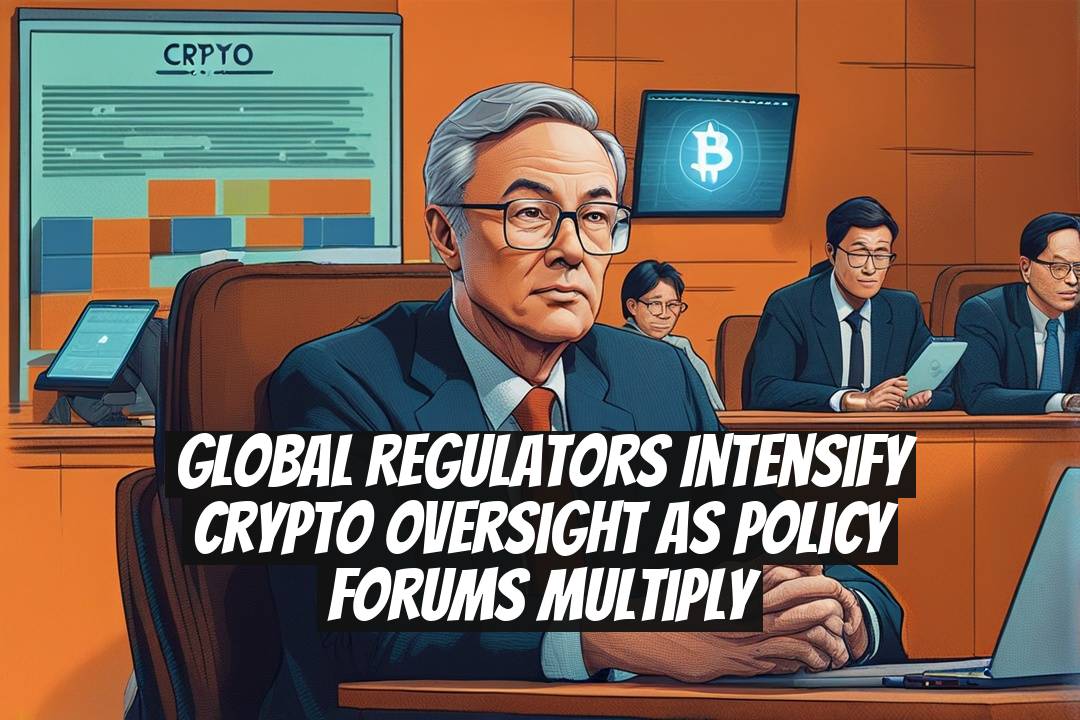
Global Regulators Intensify Crypto Oversight as Policy Forums Multiply: What This Means for Your Investments
? Are We Witnessing the End of the Wild West in Crypto?
The cryptocurrency landscape has undergone a seismic shift. What was once a space defined by innovation and minimal oversight is rapidly transforming into a heavily regulated ecosystem where compliance isn’t optional-it’s mandatory. As we move deeper into 2025, global regulators are intensifying their crypto oversight while policy forums multiply across jurisdictions, creating a complex web of rules that investors, institutions, and everyday crypto enthusiasts must navigate. The convergence of international regulatory frameworks, national initiatives, and emerging standards represents a pivotal moment for the digital asset industry. This comprehensive analysis explores how global regulators intensify crypto oversight, examines the proliferation of policy forums, and unpacks what these developments mean for the future of cryptocurrency markets, investment strategies, and the broader financial system.
? Key Takeaways: What You Need to Know Right Now
Subscribe to our Social Media for Exclusive Crypto News and Insights 24/7!
- Regulatory harmonization is accelerating: The International Monetary Fund (IMF) and Financial Stability Board (FSB) are leading global standard-setting efforts that will influence how countries regulate cryptocurrencies by 2026
- Multiple policy forums are creating a complex landscape: The EU’s MiCA, U.S. executive orders, and emerging international frameworks are simultaneously reshaping the regulatory environment
- Non-custodial wallets remain relatively protected: While centralized exchanges face stricter requirements, self-custody solutions continue to operate with less direct regulatory pressure
- Stablecoins are under the microscope: Global regulators are implementing specific requirements for stablecoin reserves and transparency standards
- The "same risk, same rule" principle is becoming the new standard: Decentralized finance platforms, crypto lending, and decentralized exchanges will increasingly face securities and anti-money laundering laws
- 2026 marks a critical implementation deadline: Multiple regulatory frameworks are converging around January 2026, signaling a major shift in the regulatory landscape
?️ The Global Regulatory Awakening: Understanding the Current Landscape
The transformation happening in cryptocurrency regulation isn’t happening in a vacuum. It’s the result of coordinated efforts among international organizations, national governments, and supranational bodies that have collectively recognized the need for comprehensive oversight. The FSB has created a Global Regulatory Framework for Crypto-Asset Activities, while the IMF actively assists countries in developing their own crypto regulations.
Here’s what’s remarkable: just a few years ago, crypto operated in a regulatory gray zone where innovation moved faster than government response. Today, that dynamic has completely reversed. Regulators are now proactively developing frameworks before problems escalate, rather than reactively responding to crises. This shift reflects a maturity in how governments approach digital assets-they’re no longer dismissing cryptocurrency as a fad but acknowledging it as a legitimate financial asset class requiring oversight.
The principle of "same activity, same risk, same regulation" has emerged as the foundational philosophy guiding this regulatory wave. What does this mean practically? If a traditional bank offers a loan product, a crypto lending platform offering comparable services should face equivalent regulatory requirements. If a brokerage firm trades securities, a decentralized exchange facilitating similar transactions should operate under similar rules. This principle sounds straightforward in theory, but its implementation across different jurisdictions and technological paradigms creates genuine complexity.
? Multiple Policy Forums Creating a Byzantine Regulatory Structure

One of the most striking developments is the multiplication of policy forums and regulatory bodies asserting authority over crypto assets. We’re not dealing with a single regulatory framework anymore-we’re navigating an increasingly Byzantine structure where different organizations operate at different levels of the regulatory hierarchy.
International Standard-Setters Taking Center Stage
At the highest level, international organizations like the International Organization of Securities Commissions (IOSCO) and the Basel Committee on Banking Supervision are establishing minimum standards that influence how individual countries regulate crypto. The FSB expects national authorities to regulate, supervise, and oversee cryptocurrency arrangements following international standards. By 2026, we expect to see significant regulatory harmonization efforts as these international standard-setting bodies develop global frameworks for digital assets.
The banking sector is particularly affected by these initiatives. The Basel Committee on Banking Supervision has set implementation standards for January 2026, extended from the original 2025 deadline. These minimum requirements may result in stricter standards, including potential prohibitions on bank dealings in certain crypto assets. Most jurisdictions have already indicated they’re taking steps to incorporate these rules into their national regulatory frameworks.
Regional Frameworks Diverging
While international standards provide baseline guidance, regional frameworks are diverging in meaningful ways. The European Union has taken perhaps the most comprehensive coordinated approach through the Markets in Crypto-Assets Regulation (MiCA). This isn’t a theoretical framework-MiCA established concrete rules for crypto-asset service providers across EU member states that came into force in June 2023, with full implementation expected by 2025. The regulation creates harmonized rules for crypto-asset issuance, trading platforms, and custody services.
Key requirements of MiCA include authorization and supervision for crypto-asset service providers (CASPs), who must obtain authorization from national competent authorities. The regulation extends the Single Market framework to include crypto-assets, creating a uniform framework that provides legal certainty for crypto-asset issuers and service providers.
The United Kingdom, meanwhile, published its "Future financial services regulatory regime for cryptoassets" in October 2023, extending current traditional asset regulations to crypto. This approach emphasizes applying existing frameworks rather than creating entirely new regulatory structures.
Across the Atlantic, the situation remains more fragmented. In January 2025, President Donald Trump issued an executive order requiring the creation of a working group to develop federal regulations imposing clarity and consistency within the U.S. This represents a significant moment-explicit acknowledgment from the executive branch that federal crypto regulation needs to be clarified and standardized.
? Decentralized Finance Under Intensifying Scrutiny

Perhaps the most notable shift involves how regulators are targeting decentralized finance (DeFi) platforms and other crypto innovations that previously operated in gray areas. Regulators including the U.S. and EU are actively exploring how to apply securities, fraud, and anti-money laundering laws to DeFi protocols. This represents a fundamental challenge to the DeFi narrative that "code is law" and that decentralized systems operate beyond regulatory reach.
The reason for this intensified focus is clear: as DeFi platforms have grown, they’ve accumulated significant value and user deposits, creating systemic risks that regulators cannot ignore. Crypto lending platforms, decentralized exchanges, and other decentralized services are increasingly subject to the same regulations as their centralized counterparts. Global standard-setters like IOSCO and FATF have issued specific policy recommendations for DeFi, signaling that regulatory pressure on this sector will only increase.
?️ The SEC and CFTC’s "Crypto Sprint": Reshaping American Regulation

In August 2025, the cryptocurrency regulatory environment in the United States shifted dramatically with coordinated initiatives from both the Securities and Exchange Commission (SEC) and the Commodity Futures Trading Commission (CFTC). These weren’t incremental policy adjustments-they represented a fundamental reimagining of how American regulators approach digital assets.
SEC Chair Atkins tasked the SEC staff with creating a licensing framework permitting the trading of non-security crypto assets alongside crypto-asset securities on SEC-regulated platforms. This represents a break from the SEC’s previous approach and signals a willingness to accommodate crypto trading within traditional regulatory frameworks. Additionally, the SEC staff was asked to evaluate whether non-security crypto assets subject to investment contract designations could trade on non-Commission-registered trading venues.
Acting CFTC Chair Caroline D. Pham announced the CFTC’s "crypto sprint" initiative on August 1, 2025, directing the agency to use its existing authorities to immediately enable trading of digital assets at the federal level. The first initiative involved soliciting feedback on a plan to allow trading of spot crypto asset contracts listed on CFTC-registered futures exchanges (designated contract markets). What’s particularly significant is that the CFTC doesn’t currently exercise supervisory authority over non-security spot crypto assets outside of specific categories-this crypto sprint represents a major expansion of the CFTC’s intended regulatory reach.
The coordination between the SEC and CFTC matters enormously. Acting Chair Pham explicitly affirmed that the CFTC would work closely with SEC Chairman Paul Atkins and Commissioner Hester Peirce to achieve what’s become known as "Project Crypto." This collaboration suggests that American regulation might finally move toward coherence after years of jurisdictional uncertainty.
? What This Means for the Crypto Market: A Multi-Dimensional Analysis
The intensification of global regulatory oversight creates a complex set of implications for cryptocurrency markets, and honest analysis requires acknowledging both positive and negative dimensions.
Short-Term Market Volatility
In the immediate term, regulatory clarity often produces market volatility. Prices fluctuate as investors reassess valuations based on regulatory expectations. Some crypto projects and tokens will face significant headwinds if they don’t comply with emerging regulations. Platforms that have built business models around regulatory arbitrage-exploiting gaps between jurisdictions-will face substantial challenges as these gaps narrow.
However, this volatility should be understood as a feature rather than a bug. Healthy markets require transparent, understood risk factors. When regulatory requirements are clear, investors can accurately price assets accordingly. The uncertainty of the previous era, while creating opportunity for some, generated genuine risk that made institutional adoption more difficult.
Institutional Adoption Accelerating
The flip side of regulatory clarity is that it dramatically reduces barriers to institutional investment. Traditional financial institutions-pension funds, insurance companies, hedge funds-have struggled to justify crypto allocations given regulatory uncertainty. As frameworks clarify and compliance becomes standardized, these institutions can more easily enter the market with institutional-grade risk management.
We’re already seeing this dynamic play out. As MiCA implementation progresses in Europe and American regulatory frameworks consolidate, institutional capital flows into crypto are accelerating. The global cryptocurrency market projected to exceed $5 trillion by 2025 reflects this reality-much of this growth involves institutional money that requires regulatory clarity before committing capital.
Geographic Shifts and Regulatory Arbitrage
The multiplication of policy forums and regulatory frameworks creates incentives for platforms to relocate or restructure to operate in jurisdictions with more favorable regulatory environments. However, as regulations harmonize around international standards, pure regulatory arbitrage becomes less viable. Platforms can’t simply move from the EU to Asia and avoid MiCA compliance if their users are EU residents.
This geographic rationalization will likely concentrate crypto infrastructure in jurisdictions perceived as having more favorable regulatory approaches. Switzerland, Singapore, and certain Middle Eastern jurisdictions are positioning themselves as crypto-friendly regulatory hubs. Meanwhile, jurisdictions perceived as hostile to crypto innovation may see their crypto infrastructure migrate elsewhere.
? Self-Custody and Non-Custodial Wallets: The Relatively Protected Space
One nuance that often gets overlooked in regulatory discussions involves the distinction between custodial and non-custodial solutions. Most new regulations primarily target centralized exchanges and custodial services rather than non-custodial wallet providers. This creates a meaningful regulatory distinction with real implications for users.
Non-custodial wallets-applications where users retain complete control over their private keys-remain largely outside the regulatory perimeter. MiCA, for instance, focuses on regulation of crypto-asset service providers (CASPs) and stablecoin issuers. Non-custodial wallet providers that don’t take custody of user assets fall outside MiCA’s direct scope.
This distinction matters for privacy advocates and those prioritizing financial sovereignty. While exchanges face increasingly stringent capital requirements, security audits, and disclosure obligations, individual wallet holders using non-custodial solutions maintain autonomy. That said, interaction points with the regulated financial system-on-ramps where fiat currencies convert to crypto, off-ramps where crypto converts back to fiat-will involve CASPs subject to regulatory requirements. The interface between custodial and non-custodial ecosystems remains an evolving regulatory frontier.
? Stablecoins: From Wild West to Regulatory Centerpiece
Stablecoins deserve special attention in this regulatory evolution because they’ve moved from regulatory afterthought to central focus. Global regulators have implemented specific requirements for stablecoin issuers ensuring these digital assets maintain proper reserves and meet transparency standards. The FSB has set out expectations for national authorities to require that global stablecoin arrangements have adequate governance, risk management, and transparency mechanisms.
What does this mean practically? Stablecoin issuers must demonstrate that the assets backing their tokens are held in reserve with appropriate disclosure. They can’t issue $100 million in USDC tokens without $100 million in equivalent assets backing the liability. This sounds obvious, but it represents a fundamental shift from earlier stablecoin projects that made vague reserve claims without transparent verification.
The regulatory focus on stablecoins reflects a legitimate systemic concern. If a major stablecoin experienced a run or reserve failure, it could cascade through DeFi platforms, crypto lending services, and institutional crypto holdings. By imposing reserve requirements and transparency standards, regulators are building firewalls that protect financial stability.
? Looking Forward: What 2026 and Beyond Hold
The regulatory trajectory is remarkably clear for those paying attention to policy documents and regulatory speeches. By 2026, expect significant regulatory harmonization as international standard-setting bodies’ recommendations are implemented across jurisdictions. The January 2026 implementation deadline for Basel Committee standards and the expected completion of MiCA implementation represents a watershed moment-this is when multiple regulatory frameworks converge simultaneously.
By 2030, mature regulatory frameworks for cryptocurrency derivatives, staking services, and other sophisticated digital asset products will likely be established. These frameworks will probably incorporate elements from traditional financial regulation while addressing unique characteristics of blockchain-based assets. Cross-border regulatory cooperation will become increasingly important as digital assets operate across jurisdictional boundaries. International regulatory sandboxes, mutual recognition agreements, and coordinated enforcement actions will address global regulatory challenges.
? Practical Tips for Navigating the Regulatory Landscape
For Individual Investors
- Understand which assets and platforms operate under which regulatory frameworks-EU residents should familiarize themselves with MiCA requirements, U.S. residents with SEC/CFTC jurisdictions
- Prioritize exchanges and custodial services regulated in your jurisdiction-this reduces counterparty risk
- Consider allocating a portion of holdings to non-custodial wallets to reduce regulatory exposure at the exchange level
- Monitor stablecoin reserve reporting-choose stablecoins from issuers with transparent, audited reserves
For Platforms and Service Providers
- Begin compliance processes now rather than waiting until deadlines-January 2026 will create bottlenecks for late adopters
- Assess jurisdiction strategically-some jurisdictions offer more favorable regulatory treatment while maintaining access to global user bases
- Invest in robust AML/KYC systems-these will become regulatory baseline requirements everywhere
- Consider application for regulatory sandbox programs where available-these provide clarity while frameworks mature
For Institutions
- Engage with regulatory consultants who understand your jurisdiction’s specific framework
- Participate in industry associations involved in regulatory discussions-early input shapes final rules
- Build compliance infrastructure that exceeds minimum requirements-this reduces future regulatory surprises
- Establish relationships with regulators through formal channels before regulatory actions are necessary
? Personal Insights: What This Regulatory Wave Really Means
Having analyzed this regulatory evolution extensively, a few observations strike me as particularly significant. First, the speed at which regulatory consensus has emerged is remarkable. Three years ago, crypto regulation seemed irredeemably fragmented with countries taking completely contradictory approaches. Today, there’s genuine consensus on foundational principles-this represents a maturation moment for the entire industry.
Second, the regulatory focus on DeFi and non-custodial protocols suggests that regulators have recognized they cannot prevent crypto innovation through prohibition. Instead, they’re bringing innovation within the regulatory perimeter through surveillance and compliance requirements. This pragmatic approach should concern privacy advocates but reassure those worried about systemic financial risk.
Third, the distinction between tokens as securities versus commodities versus utility tokens remains genuinely unresolved. Until this fundamental question is answered consistently across jurisdictions, regulatory uncertainty will persist in certain market segments. Projects that haven’t pre-emptively positioned themselves for whichever classification emerges face significant risk.
Finally, the regulatory intensity is creating a genuine moat for well-capitalized platforms. Compliance costs are substantial-establishing robust AML/KYC systems, securing regulatory licenses, conducting security audits, and maintaining ongoing compliance requires millions in investment. Smaller competitors without these resources face barriers to entry, potentially consolidating the market around larger platforms. This may ultimately produce a more stable ecosystem, but it comes at the cost of some innovation that might have flourished in a less regulated environment.
? The Question Worth Considering
As global regulators intensify crypto oversight and policy forums multiply, creating an increasingly complex but arguably more stable regulatory environment, the fundamental question becomes: Will regulatory clarity ultimately accelerate or inhibit cryptocurrency’s revolutionary potential to transform global finance?
Related Articles and Resources:
global regulators intensify crypto oversight
policy forums multiply cryptocurrency
crypto regulatory landscape 2025