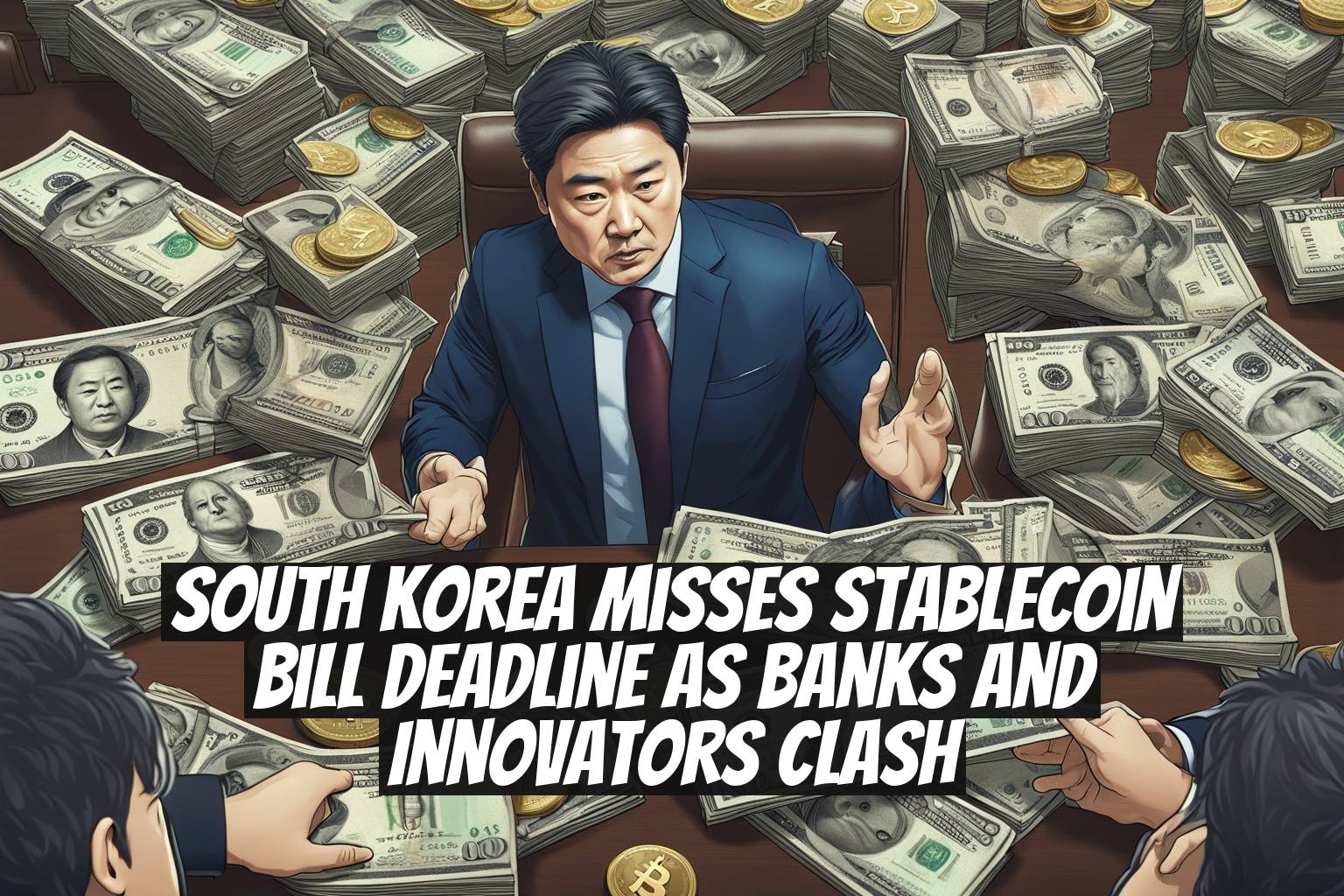
When policy drama meets crypto ambition - Seoul’s deadline slipped, and the market noticed
South Korea misses stablecoin bill deadline as banks and innovators clash - and now everyone from exchanges to payment startups is staring down regulatory limbo as the Financial Services Commission (FSC) and the Bank of Korea (BOK) bicker over who gets to run won‑pegged tokens[1][2]. This delay - the FSC failed to deliver the December 10, 2025 draft to the National Assembly - leaves KRW stablecoin issuance effectively stalled and pushes lawmakers, banks, and builders into a bruising second act[1][3].
Key Takeaways
- The FSC missed the government-imposed December 10 deadline for its won‑stablecoin bill after failing to reach consensus with the Bank of Korea on issuance control and governance[1][2].
- The BOK favors a bank‑led model requiring majority bank ownership and stronger veto powers, citing monetary stability and anti‑money‑laundering risks; the FSC prefers a regulatory regime more aligned with international examples and broader issuer eligibility[1][2][6].
- The miss amplifies uncertainty: private issuers can’t lawfully launch KRW‑pegged stablecoins yet, and lawmakers may push their own bills if the executive branch stays gridlocked[1][6].
- Market mechanics to watch if and when a bill appears: on‑chain flows into Korean crypto services, liquidity fragmentation, dominance shifts (KRW stablecoins vs. USDC/USDT), and increased liquidation risk during headline volatility.
Subscribe to our Social Media for Exclusive Crypto News and Insights 24/7!
Why this matters: stablecoins are plumbing - if Seoul lets banks own the taps, it changes who profits, who scales, and how resilient the market becomes. If lawmakers step in, the policy may swing either way. The next 6-12 months will tell whether South Korea builds an open, competitive stablecoin market or a bank‑centric system that’s slower, but (arguably) safer.
What actually happened - the timeline and the spat
The FSC was expected to submit a consolidated stablecoin bill to the National Assembly by December 10, 2025, per the ruling Democratic Party’s timetable; it didn’t[1][3]. FSC officials said they needed more time to coordinate positions with related agencies, notably the Bank of Korea, which has been pushing back hard[1][6]. The BOK’s concern: a free‑for‑all stablecoin market risks undermining monetary policy, consumer protections, and anti‑money‑laundering controls; they’ve proposed strong bank involvement and even veto rights over issuers[1][2]. The FSC counters that models in the EU and Japan show regulatory frameworks can protect consumers without forcing a bank monopoly on issuance[4][6].
That impasse explains the missed deadline - and why industry sources now expect either a delayed government bill in early 2026 or legislators to table their own proposals, which could take the policy in a different direction[1][6].
What banks want vs. what innovators want - the real clash
- Bank position: majority ownership for banks (≥51%), approval veto power, stricter controls to safeguard monetary sovereignty and reduce systemic risks[1][2].
- Innovator/startup position: broader issuer eligibility (including fintech and big tech), faster market access, more permissive frameworks modeled on global stablecoin rules[4][6].
Why this matters to you as an investor: the structure determines competition and trust. A bank‑led system could lead to fewer issuers, higher deposit‑like safety (arguably), and higher barriers to entry - which may benefit incumbents but stifle innovation. An open model encourages product diversity and faster innovation, but could increase short‑term risks if reserve frameworks aren’t ironclad.
Market mechanics - where price, liquidity, and risk collide

If South Korea authorizes won‑stablecoins, expect immediate on‑chain and CEX impacts:
- Liquidity fragmentation: KRW‑pegged stablecoins will compete with global USD pegged stablecoins (USDT, USDC). Watch dominance cycles - a locally issued KRW stablecoin could rapidly capture KRW trading pairs on domestic exchanges, reducing reliance on USD‑pegged liquidity[2][4].
- ADX & trend strength: headlines drive volatility; an initial approval draft followed by BOK pushback will likely spike ADX and force trend re‑evaluations. Strong ADX readings during policy breakthroughs could indicate sustained flows into KRW stablecoins; weak ADX would suggest whipsaw and uncertainty.
- Liquidation cascades: if local exchanges list KRW pairs with leverage but thin depth, rapid flows into/out of newly‑minted KRW stablecoins can trigger liquidation cascades during headline swings - think forced sells feeding margin calls. You’ve seen this: a small on‑chain imbalance becomes a cascade in thin order books.
- On‑chain signals to monitor: reserve attestations, large wallet outflows to exchanges, and stablecoin mint/burn activity. When legal clarity hits, mint volumes for KRW stablecoins will be the fastest early indicator of adoption.
Real historical analogies: remember Terra‑UST’s collapse? Different mechanism (algorithmic) and scale, but the lesson is the same - peg stability depends on credible reserves and market confidence. In the U.S. and EU, regulatory attention around reserve audits and redemption rights followed initial growth phases - Korea’s debate is functionally an attempt to set those guardrails in advance[1][2].
Live data and charts you should be watching now

- CoinMarketCap/TradingView: track market share shifts among stablecoins and volatility in KRW pairs once domestic exchanges start prepping listings.
- On‑chain analytics: watch mint/burn rates, reserve adjudications, and exchange inflows (whale clustering). High mint volume without transparent reserve attestations = red flag.
- ADX (Average Directional Index): use ADX on KRW pairs to judge whether price moves are trending (ADX > 25) or choppy (ADX < 20). Trending moves around regulatory news often mean directional capital flow; choppiness means headlines are being parsed and reversed quickly. (Embedded charts and live tickers from CoinMarketCap or TradingView should be used to follow KRW‑stablecoin dominance, local exchange KRW volumes, and ADX readings on KRW/BTC and KRW/ETH pairs - these will be the early market‑structure gauges once issuance is even on the table.)
Policy scenarios and market outcomes - three paths forward
1. Bank‑led model wins (BOK prevails): slower issuance, fewer issuers, conservative reserve requirements, likely gradual adoption. Expect premium on “bank‑backed” KRW tokens and muted innovation. Domestic exchanges may list fewer KRW stablecoins initially, keeping liquidity concentrated[1][2].
2. Open issuer model (FSC lean): faster entry for fintech and big tech, more competition, higher innovation but potentially increased regulatory patches after the fact if reserve rules are lax[4][6].
3. Lawmaker intervention (National Assembly drafts/forces bill): could swing either way depending on political deals - this is the wildcard. Legislators could craft compromises, or push through partisan provisions that change economic incentives for banks and fintechs[1][6].
Analyst take: realistically, Seoul will aim for a hybrid model - visible bank involvement on paper (to appease BOK) but operational roles for licensed fintech issuers. That compromises speed for political viability. Honestly, that move caught everyone off guard - we’d’ve expected a clearer push for open issuance given President Lee’s earlier pledges[2][6].
What market participants are saying - voices from the trading floor and the boardroom
A trader I spoke to (anonymous for obvious reasons) said this looked eerily like 2021’s blow‑off top in terms of narrative mania: “Everyone’s pricing how big these KRW stablecoins could be, but there’s zero clarity on the reserve and redemption mechanics. Feels like hype + policy risk - recipe for whipsaw.” Back in 2022, a retail holder held ADA through a 60% dump; it was brutal. But that taught him one thing: rules matter more than pump stories - credibility wins in the long run.
Insiders at local fintechs tell a different micro‑story: they’ve been building rails quietly for months, preparing for either a bank‑partnered issuance or standalone licensure. One product lead conceded, “the project they launched is solid, but banks control clearing and that changes settlement models.” The whales ain’t sleeping, fam. They’re rotating into narrative plays - paying attention to who’s making reserve attestations and which banks signal support.
Technical deep‑dive - dominance cycles, ADX, and liquidation mechanics explained
- Dominance cycles: dominance measures supply/liquidity share of one asset class over another (e.g., KRW stablecoins vs. USDT). A newly authorized KRW stablecoin could quickly gain dominance in local KRW pairs via exchange listings and fiat onramps. When dominance shifts, market makers reprioritize inventory and spreads widen or tighten accordingly.
- ADX movements: ADX quantifies trend strength (not direction). During regulatory clarifications, ADX will spike as capital commits to perceived winners. Use ADX with DI+ and DI− to see whether buyers or sellers drive the trend.
- Liquidation cascades: margin positions are collateralized with stablecoins or futures. If a thin KRW‑stablecoin market faces a sudden sell (e.g., reserve audit shows a hole), price slippage can blow through liquidations, creating a cascade - leveraged sellers get margin called, exchanges execute, price drops further, more margin calls. Thin order books amplify this. Example: the May 2021 liquidations across BTC/ETH were driven by concentrated leverage and liquidity gaps; substitute in a fledgling KRW stablecoin market and the same mechanics apply.
Audit transparency and trust - the non‑sexy but crucial bit
Reserve audits and transparent redemption mechanics are the sodium chloride of stablecoins: not glamorous, but the thing that prevents spoilage. International precedents show regulators demand periodic attestations, reserve segregation, and clear redemption rights - whether the issuer is a bank or a fintech[4][6]. If South Korea wants both safety and innovation, audit cadence and enforceable redemption guarantees will be the bargaining chips in the FSC‑BOK negotiations.
What investors should do right now
- Watch on‑chain activity and exchange listings for early signs of shift.
- Monitor ADX on KRW pairs; spikes with high volume suggest directional commitment.
- Prefer assets with transparent reserve attestations and redemption processes.
- Avoid leverage in nascent KRW‑stablecoin pairs until markets show depth.
- Consider scenario hedges: if bank‑led model looks likely, favor incumbents with bank ties; if open model wins, short‑term volatility spikes may present buying opportunities in quality projects.
Quick checklist for traders and allocators
- Check recent FSC/BOK statements for word changes - political language matters.
- Track mint/burn and reserve attestations on-chain and in issuer audits.
- Use ADX + volume as a confirmation filter for trend moves around policy headlines.
- Size positions for possible liquidation cascades; set margin limits accordingly.
Before I sign off: imagine holding SOL through that crash while sipping coffee and watching KOSPI react to political headlines. You remember the feeling - stomach in your throat, phone buzzing. That’s what delayed policy and ambiguous reserve rules will feel like to anyone with exposure to KRW stablecoin play.
Three clickable keyphrases you might want to explore next:
KRW stablecoin
stablecoin regulation
bank led stablecoin
1. https://financefeeds.com/south-korean-stablecoin-legislation-hits-roadblock-as-fsc-misses-deadline/
2. https://coinedition.com/south-korea-stablecoin-bill-stalls-central-bank-blocks-presidents-plan/
3. https://www.bitrue.com/blog/south-korea-delays-won-stablecoin-bill
4. https://www.kucoin.com/news/flash/south-korea-s-fsc-misses-deadline-for-won-backed-stablecoin-regulatory-bill
5. https://www.ainvest.com/news/south-korea-stablecoin-regulatory-stalemate-double-edged-sword-fintech-banking-2512/
6. https://www.dlnews.com/articles/regulation/south-korean-regulator-misses-government-stablecoin-deadline/
7. https://chavanette.com/news/tickertape-159