We’re not in Kansas anymore - US banks are going on-chain.
The US Treasury and federal regulators have effectively greenlit a new chapter for national banks by approving crypto-friendly national trust bank charters and clarifying banks’ authority to hold and use crypto-assets - a move that reshapes custody, stablecoin plumbing, and institutional on‑chain activity for years to come[7][1].
Key Takeaways
- Regulators (OCC) granted preliminary conditional approvals for multiple national trust bank charters to crypto firms, signaling broader federal acceptance of bank-held crypto services[7][6].
- The OCC’s interpretive guidance allows national banks to hold certain crypto-assets as principal (e.g., to pay network fees) and to provide custody, node operation, and certain stablecoin activities when done safely and consistent with law[1][2].
- This is a structural shift toward banks participating directly in on‑chain markets - custody, settlement, and tokenized payment rails - and it will change liquidity, counterparty risk, and market structure dynamics for crypto markets[5][4].
- Markets should expect faster institutional flow, shrinking custody spreads, and greater regulatory scrutiny - but also complex new risks: concentration, contagion paths (liquidation cascades), and operational node risk[6][3].
Subscribe to our Social Media for Exclusive Crypto News and Insights 24/7!
Why this matters: crypto markets have long awaited clear rules for banks. Now that national trust charters are being conditionally approved, the institutional plumbing can scale - and with scale comes both liquidity upside and systemic complexity. Read on for the why, the mechanics, the market maps, and an analyst take (with a few war stories and blunt opinions).
What the approvals actually are - and what they’re not
- The Office of the Comptroller of the Currency (OCC) announced conditional approvals for multiple national trust bank charter applications for digital‑asset firms, including entities tied to Ripple, Circle, Fidelity, BitGo and others, enabling them to operate as federally chartered trust banks pending preopening requirements[7][6].
- The OCC’s interpretive letter and related documents explicitly state banks can perform crypto‑asset custody, act as nodes, buy/sell assets held in custody at customer direction, and hold limited crypto-assets as principal to facilitate payment activities like paying gas or testing platforms - subject to sound risk management and OCC supervision[1][2].
- These approvals are preliminary and conditional - not carte blanche. Final authorization requires meeting preopening conditions, Federal Reserve requirements, and continuing supervisory review[2][7].
Think of this as the difference between “you passed the interview” and “you can start building customers once you finish the compliance checklist.”
Why banks + crypto changes market structure
- Custody & settlement: Federally chartered banks reduce counterparty and custody fragmentation. Institutional custody spreads should compress, and settlement times and finality for tokenized assets may tighten as these banks integrate with on‑chain rails[5].
- Stablecoin plumbing: With banks permitted to engage in certain stablecoin activities under guidance, the path to bank-linked settlement stablecoins and on‑balance-sheet payment rails becomes viable - accelerating on‑chain payments adoption by traditional corporates[5][1].
- Liquidity & flows: Expect quicker, larger institutional inflows and reduced friction for OTC desks; market depth for high‑cap assets will likely improve, yet liquidity may concentrate across bank custodians and prime desks - a new centralization risk[6][3].
A bank with a national charter brings trust - and a single failure there would be a different beast from a failed exchange. The market’s plumbing will get stronger in places, but more interconnected elsewhere.
Data & charts to watch (and where to get them)
- Spot liquidity and bid-ask compression: pull real‑time spreads for BTC/USDT and ETH/USDC on CoinMarketCap and TradingView to track whether custody-led demand tightens spreads (look at 1h and 24h spread curves).
- On-chain stablecoin flows: use on‑chain analytics dashboards (Glassnode/Chainalysis) to watch stablecoin issuance and reserve movements tied to bank entities.
- Exchange balance sheet shifts: monitor BTC/ETH exchange reserves on-chain charts; falling exchange reserves while bank custody inflows rise is a big signal of institutional migration.
- Volatility & ADX: overlay ADX (Average Directional Index) on BTC, ETH daily charts (TradingView) - Institutional entry phases may lower short-term ADX as liquidity improves, but breakouts could show sharp ADX spikes as leverage re-enters.
Pro tip from an analyst: watch dominance cycles - if BTC dominance creeps up as banks onboard custody for large BTC allocations, alts may lag until tokenized-product rails and bank custodial alts mature.
How market mechanics change - liquidation cascades, ADX, dominance cycles

- Liquidation cascades: When institutional custody routes use on‑chain settlement, large unwinds might shift from centralized exchange margin engines to OTC/prime balance sheets, altering cascade dynamics. Previously, a leveraged long on a retail-heavy exchange could trigger fire‑sales on order books; now, large bank-driven positions could be managed in bilateral channels - lowering public cascade probability but increasing hidden systemic exposure.
- ADX & trend strength: If banks bring steadier flows, we’d’ve expected lower short-term ADX during accumulation phases; conversely, bank-backed ETF-like products could amplify trend strength during breakouts, spiking ADX sharply. Historical analog: 2021’s ETF‑rumor runs showed ADX spikes as passive/inflow products compressed liquidity, then reversed violently when flows drew down - same pattern could repeat with bank products[?].
- Dominance cycles: Institutional preference for BTC or high‑liquidity tokens can push BTC dominance higher; when banks expand token custody to high‑cap alts and stablecoin rails, capital rotation may broaden dominance cycles to include tokenized bonds, tokenized equities, and DeFi blue chips.
A trader I spoke to said this looked eerily like 2021’s blow-off top - large flows compressing liquidity, then a sudden de-risking event echoing across concentrated custody lines. That’s a red-flag worth logging.
Real examples and micro-stories
- Back in 2022, a holder who bought ADA at peak and held through a 60% dump learned brutal discipline: “Hodling works only if your thesis didn’t melt,” he told a friend. That lesson is relevant now - bank custody may improve safety, but it doesn’t immunize tokens from market structure shocks.
- When Paxos and other institutions moved to expand custody services earlier, order books tightened and OTC desks saw volume spikes - it’s the same playbook on larger scale now[6].
- A former prime broker quipped: “The whales ain’t sleeping, fam. They’re rotating.” Expect rotation between custody pools, tokenized instruments, and stablecoin pools - and watch volume center-of-gravity shift.
Regulatory nuance - what to watch in the fine print
- Permissible activities are framed as “consistent with sound risk management” - that’s the OCC’s lever to enforce limits on banks’ crypto exposure and activities[1].
- Banks must follow sections 23A/23B, Regulation W, and other affiliate transaction rules - so intra-group token transfers, staking affiliate deals, and lending to affiliates will draw scrutiny[2].
- Conditional approvals require preopening actions - including Fed membership steps - so operational readiness and compliance infrastructure are non-trivial blockers before full activity commences[2][7].
Don’t mistake conditional approval for free rein. These charters bring structure - and a long list of supervisory checkpoints.
Trading implications - short & long
Short-term:
- Expect knee-jerk rallies on approval news and announcements tied to product launches; short squeezes might be sharper because liquidity is concentrated in fewer institutional pools.
- Watch leverage pockets and funding rates on perpetuals - if funding goes hyper-positive performers can flip quickly.
Medium/long-term:
- Narrower custody spreads, deeper liquidity for spot markets, and more stable institutional flows - but watch concentration risk in bank custodial stacks.
- Tokenized on‑chain yield products and bank stablecoin rails could create new yield curves and cross‑asset arbitrage opportunities.
Honestly, that move caught everyone off guard - but once you think of banks as utility-layer nodes and custody engines, the market design implications start to add up quick.
Analyst take - risks, opportunities, and the one line I’m watching
Opportunity: This is foundational infrastructure. If banks successfully integrate custody, settlement, and stablecoin rails, the on‑chain economy goes from niche to institutional-grade plumbing - lowering capital costs for tokenized instruments and attracting corporate treasuries[5].
Risk: Centralization. One failed bank or a supervision lapse could transmit shocks differently than an exchange collapse; think counterparty webs and hidden leverage between bank custody books and prime brokers[3].
Line I’m watching: net transfers of BTC/ETH from exchanges to bank custody addresses - if sustained, that’s the raw signal of institutional migration and liquidity re-allocation.
Where to track live data and the must-watch charts
- CoinMarketCap - spot volumes, spread comparisons across venues.
- TradingView - BTC/ETH ADX, RSI, OBV overlays; use 1D and 4H to detect trend shifts.
- Glassnode / Chainalysis - exchange reserves, stablecoin flows, whale movement dashboards.
- OCC and Fed filings - monitor charter conditions, supervisory letters, and any enforcement actions[2][1].
If you trade this, put alerts on: exchange reserve declines, bank-address inflows, and sudden ADX spikes on BTC/ETH; those three combined equals a thesis signal.
Clickable resources for deeper reading
US Treasury Crypto Bank Charters
National Trust Bank Charter
Bank Onchain Future
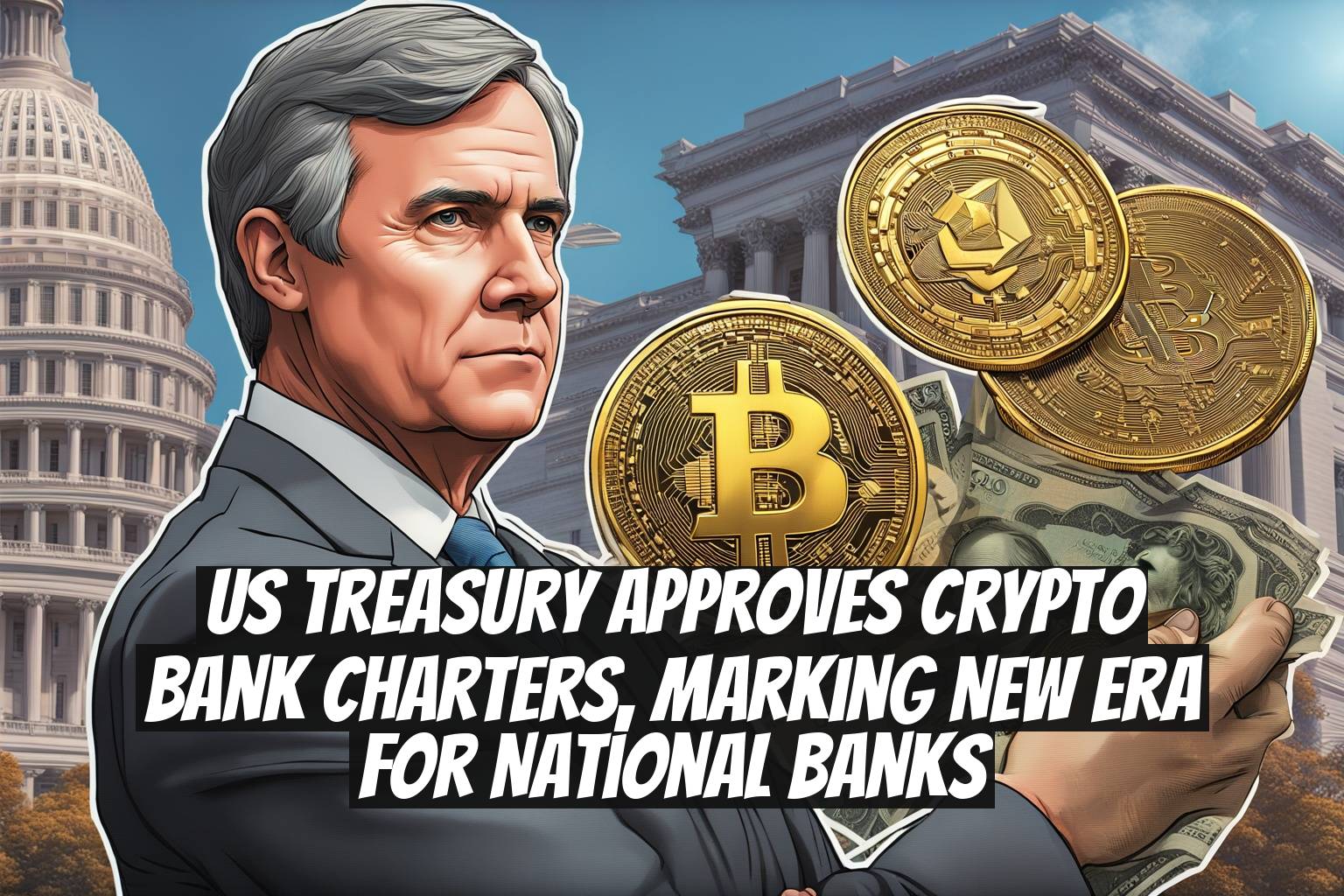
- Image for the piece: (embedded visual) “US Treasury Approves Crypto Bank Charters - Marking New Era for National Banks.” The visual frames the story: bridge between legacy finance and on‑chain rails.
External sources referenced:
1. https://www.goodwinlaw.com/en/insights/newsletters/2025/12/newsletter-finance-fs-roundup-120425
2. https://www.occ.gov/news-issuances/news-releases/2025/nr-occ-2025-125a.pdf
3. https://bpi.com/bpinsights-december-13-2025/
4. https://bravenewcoin.com/insights/sec-releases-crypto-custody-guidance-as-regulators-greenlight-tokenization-and-bank-charters
5. https://www.coindesk.com/policy/2025/12/15/bank-of-america-says-u-s-banks-are-heading-for-an-onchain-future
6. https://www.coindesk.com/policy/2025/12/12/five-crypto-firms-step-closer-to-become-a-bank-including-ripple-circle-fidelity
7. https://www.occ.gov/news-issuances/news-releases/2025/nr-occ-2025-125.html