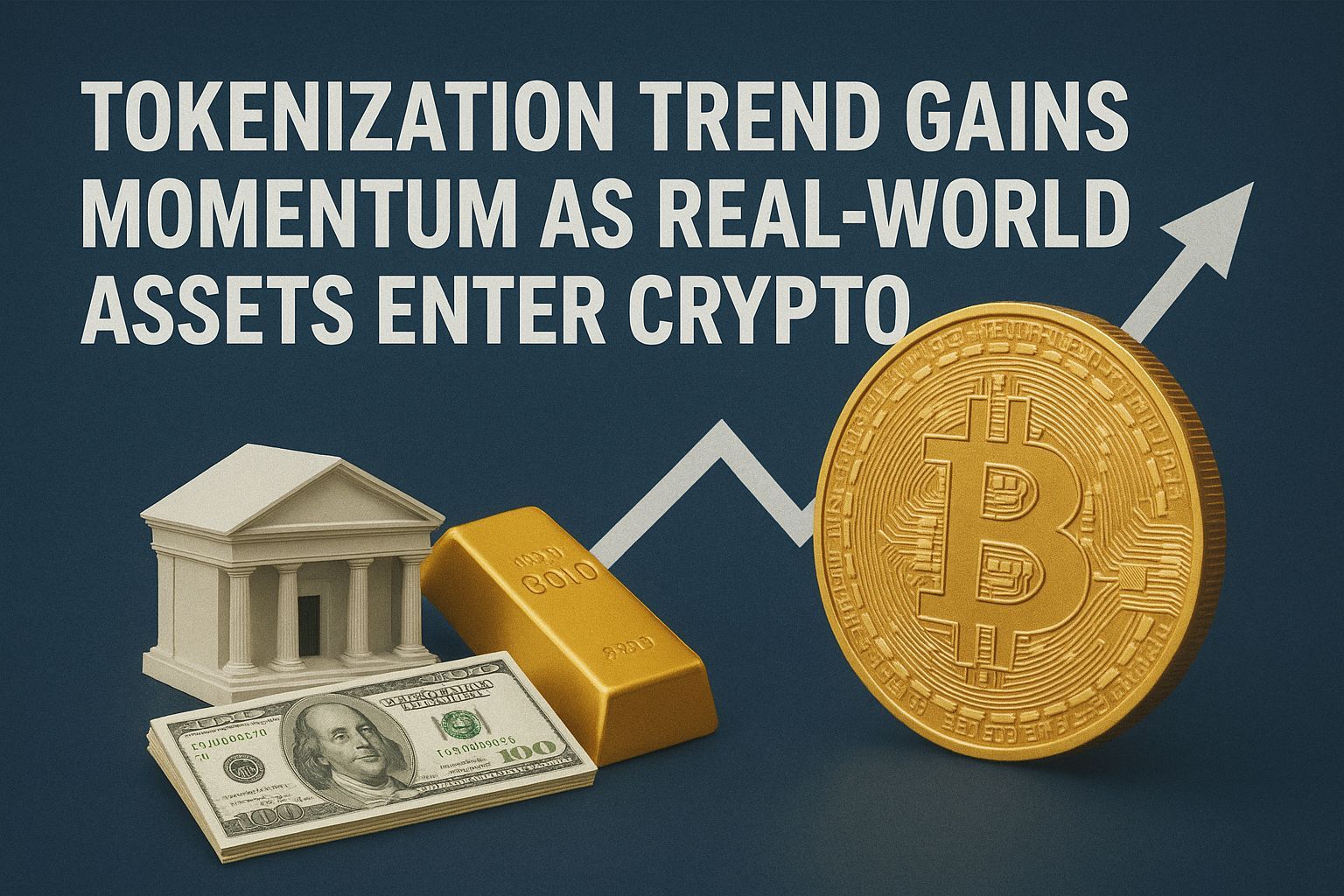
Tokenization Supercycle: How Real-World Assets Are Finally Crashing the Crypto Party
The $36 Billion Shift That Changes Everything
You’ve probably heard the term "tokenization" thrown around enough times to roll your eyes. But here’s the thing-it’s not hype anymore. It’s happening. Right now. Real-world assets are moving from pilot projects and PowerPoint decks into actual, production-scale financial infrastructure on blockchain networks, and the numbers don’t lie[2].
We’re talking about on-chain representations of cash, treasuries, and money market instruments that crossed $36 billion in 2025 across public and permissioned blockchains[2]. That’s not some niche experiment. That’s mainstream adoption knocking on the door. The momentum carrying real-world assets (RWAs) into the financial mainstream isn’t slowing down-it’s accelerating into 2026, and frankly, it’s reshaping how we think about finance entirely.
Subscribe to our Social Media for Exclusive Crypto News and Insights 24/7!
Key Takeaways: What You Need to Know Right Now
- The RWA market hit $36 billion in on-chain representations of cash, treasuries, and money market instruments in 2025, signaling a seismic shift from experimental pilots to genuine financial infrastructure[2]
- Tokenization’s expanding far beyond T-bills: ETFs, private markets, equity markets, and consumer-grade applications are all getting the on-chain treatment in 2026[2]
- Institutional adoption is the real story here: Money market funds are settling redemptions and collateral flows directly on-chain, while major players like Robinhood, Figure, and Securitize are testing tokenized securities[2]
- Crypto-native features matter more than you think: The real innovation isn’t just moving traditional assets on-chain-it’s about leveraging what blockchain actually does better[3]
- Compliance and standardization are the gatekeepers, but builders are already solving these problems[3]
Why Traditional Finance Suddenly Cares About Blockchain

Look, when Silicon Valley Bank starts publishing crypto predictions and they’re talking about RWA tokenization as a mainstream trend, you know something’s shifted[2]. This isn’t fringe stuff anymore. Banks, fintechs, and asset managers are genuinely interested in bringing U.S. equities, commodities, indices, and other traditional assets on-chain[3].
But here’s where it gets interesting. And honestly, this is where most people miss the actual play.
The move toward tokenization isn’t just about copying traditional finance onto a blockchain. That’s the skeuomorphic approach-basically mimicking what already exists. What’s actually happening in forward-thinking circles is crypto-native tokenization. Think about it: if you’re going to move something on-chain, why not actually use the features that make blockchain useful? Why settle for just digitizing the old playbook?
According to a16z crypto’s analysis, we’re seeing "strong interest from banks, fintechs, and asset managers in bringing U.S. equities, commodities, indices, and other traditional assets onchain"[3]. But the real differentiation comes from what they call "perpification vs. tokenization"-essentially, the question of whether you’re creating perpetual derivatives or actual tokenized ownership[3]. Either way, expect more crypto-native RWA tokenization this year.
The Treasury Play: Where It All Started
Let’s rewind briefly. Tokenized T-bills showed institutions what this could look like. Money market funds are increasingly settling redemptions, subscriptions, and collateral flows directly on-chain[2]. That’s the institutional playbook working in real-time. It’s not flashy. It’s not meme-worthy. But it’s working.
This foundation matters because it proved the concept. You can tokenize something boring-literally government bonds-and it actually works better. Lower friction. Faster settlement. Less overhead. Once institutions saw that, the floodgates started opening.
The Expansion: Where Real Money Sees Opportunity

Here’s what’s wild about 2026: tokenization’s spreading like it’s got a mandate.
ETFs and Funds Getting the On-Chain Treatment
WisdomTree, 21Shares, and Hashnote aren’t just testing this stuff-they’re running actual pilots on tokenized fund wrappers[2]. The angle? Reduce transfer costs and enable intraday settlements. That’s not trivial. That’s institutional-grade efficiency.
Equity Markets Say "Why Not Us?"
Robinhood launched tokenized security trading for European users, allowing traders to buy and sell tokenized contracts that track stocks and ETFs over Arbitrum[2]. They’re planning to expand to U.S. markets, including tokenized secondary trading for still-private companies. Figure and Securitize are exploring the same territory[2]. Yeah, these efforts will face regulatory scrutiny-lots of it-but they signal something huge: private and public markets converging on the same settlement networks[2].
Private Markets Opening Up
Retail investors now have easier access to illiquid private market assets like private credit, pre-IPO companies, and private equity, thanks to tokenization[3]. That’s democratization in action. Imagine being a retail investor who could actually participate in pre-IPO rounds without needing connections or $25 million under management.
The Real Game-Changer: Personalized Wealth Management for Everyone

Here’s what’s been exclusive forever: personalized wealth management. It’s been locked behind high net-worth requirements at banks because it’s expensive and operationally complex to deliver tailored advice across asset classes. Enter tokenization and AI.
As more asset classes tokenize, crypto rails enable strategies with personalized AI recommendations and co-pilots to execute and rebalance instantly with minimal cost[3]. DeFi tools like Morpho Vaults automatically allocate assets into lending markets with the best risk-adjusted yield[3]. Hold stablecoins instead of fiat, and tokenized money market funds instead of traditional ones, and you’ve suddenly got possibilities that didn’t exist before.
The endgame? As various components of a balanced portfolio become tokenized-bonds, stocks, privates, alts-they can be automatically rebalanced without wire transfers and all that friction[3]. That’s not a small thing.
The Infrastructure Play: Tokeny, Centrifuge, and the New Plumbing
The tokenization landscape has matured. Real platforms are emerging. Tokeny provides enterprise-grade tokenization services for equity, debt, and real estate, following compliant token standards like ERC-3643[4]. They’re particularly strong in European and cross-border markets. Centrifuge specializes in tokenizing non-traditional assets-invoices, receivables, SME loans-bridging real-world cash flows with DeFi liquidity[4].
These platforms aren’t afterthoughts. They’re the infrastructure that makes this whole thing scale. A16z’s perspective is sharp here: origination on-chain reduces loan servicing costs, back office structuring costs, and increases accessibility[3]. The challenging part? Compliance and standardization. But builders are already working on solving those problems.
What’s Really Happening Under the Hood
Let’s talk market mechanics because this is where sophisticated investors are positioning. On-chain RWA value sits around $299.15 billion as of early January 2026, with Ethereum commanding 65% market share at $12.6B in tokenized assets[5]. BNB Chain’s growing faster-up 15.63% over 30 days-while Ethereum’s up 3.36%[5]. That’s interesting. That’s where capital’s rotating.
The asset flexibility question matters more than most realize. A strong tokenization platform should support real estate, debt, art, and commodities while allowing future expansion without requiring platform changes[4]. Technical infrastructure is essential too-blockchain support, smart contracts that are customizable and audited, enabling token issuance, transfers, dividends, and compliance enforcement efficiently[4].
The Regulatory Question Everyone’s Avoiding
Here’s the reality: these plans will face additional regulatory scrutiny[2]. Lots of it. But that scrutiny signals something. It means regulators are paying attention. It means this is real enough to regulate, which means it’s big enough to matter.
The compliance angle isn’t just a checkbox. It’s the difference between tokenization that scales and tokenization that stalls. Standards like ERC-3643 exist for a reason. They’re the bridge between traditional compliance frameworks and blockchain infrastructure. Think of them as the translator between two worlds that historically didn’t speak the same language.
The 2026 Outlook: Expect Distribution, Not Just Issuance
Here’s the analyst take: in 2026, expect tokenization to expand beyond T-bills into tokenized funds, private markets, and consumer-grade applications[2]. The keyword here? Distribution and compliance moving on-chain, not just issuance.
That shift matters because it means we’re past the "prove this works" phase. We’re entering the "how do we operationalize this at scale?" phase. That’s when real adoption accelerates.
Think about carbon credit tokenization-it’s already happening. Enhanced transparency, liquidity, and efficiency in carbon markets through tokenization are real trends[6]. Or look at how transfer agents and registrars for tokens are becoming actual roles[6]. These aren’t hypothetical. These are jobs, roles, and infrastructure being built right now.
So What’s the Play?
For a savvy crypto audience, the play isn’t buying some random RWA token and hoping. The play is understanding that infrastructure builders, compliance platforms, and cross-chain bridges are where institutional money’s flowing. The tokenization supercycle isn’t hype-it’s momentum. It’s $36 billion crossing into production-scale infrastructure. It’s Robinhood launching tokenized securities for Europeans. It’s money market funds settling on-chain.
The institutions aren’t coming. They’re already here. They’re just using different language, different platforms, and moving at institutional speed.
The question isn’t whether tokenization happens. It’s whether you understand it before the capital flow makes it obvious.
- https://cryptorank.io/news/feed/38674-tokenization-supercycle-2026-crypto-bull-run
- https://www.svb.com/industry-insights/fintech/2026-crypto-outlook/
- https://a16zcrypto.com/posts/article/trends-stablecoins-rwa-tokenization-payments-finance/
- https://www.securitytokenizer.io/best-real-world-asset-tokenization-platforms-of-2026
- https://app.rwa.xyz
- https://www.rwa.io/post/tokenized-assets-trends-for-2026