
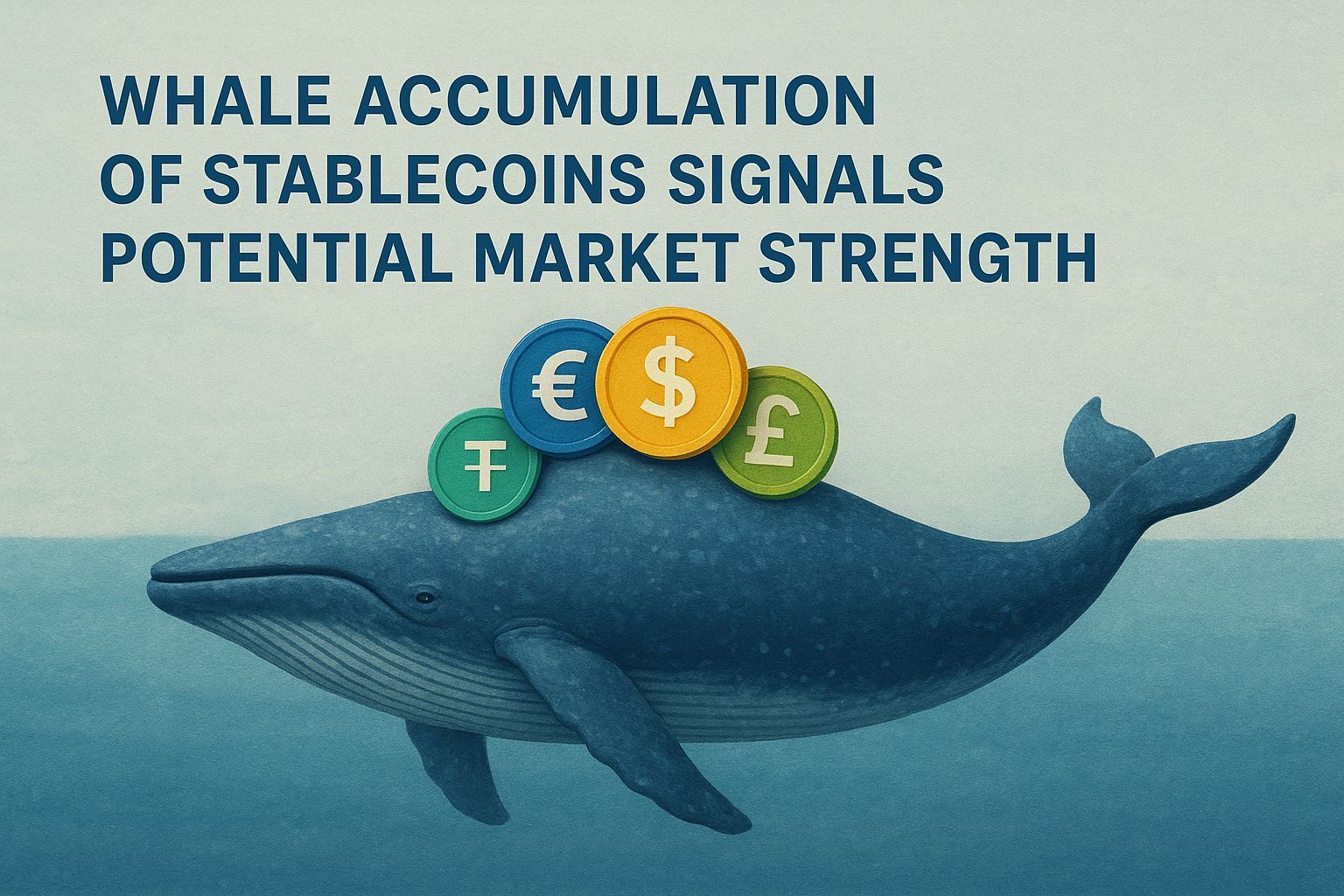
When Stablecoin Whales Start Moving, You Pay Attention
Whale accumulation of stablecoins as a signal of potential market strength has become one of the more reliable “tells” in crypto macro - but only when you read it in context: dominance cycles, on‑chain behavior, ETF flows, and where that liquidity actually rotates next.[4]
Right now, the data around whales, stablecoin flows, and accumulation behavior on majors like Ethereum, Bitcoin, and Solana is pointing to a market that’s quietly re‑arming for the next big move, not one that’s fully exhausted.[2][3][4][5]
Key Takeaways - Whales Are Reloading, Not Retiring
Subscribe to our Social Media for Exclusive Crypto News and Insights 24/7!
- Whale accumulation = dry powder, not instant moonshot. Large holders stacking stablecoins and core assets usually front‑run big market legs, but the price impact often comes later.[3][4]
- Ethereum is the stablecoin backbone. Around 57% of all stablecoin issuance and massive transfer volume (~$8T in 2025) are riding on Ethereum, making ETH the main liquidity rail institutions use to deploy capital.[4]
- Solana whales are buying into fear. Despite a ~46% drawdown in late 2025, SOL whales kept accumulating and on‑chain usage stayed high, suggesting conviction, not capitulation.[1][2][5]
- Whale behavior is increasingly institutional. ETF inflows, self‑custody moves, and reduced leveraged open interest are all signs of a more “TradFi‑style” accumulation phase rather than casino‑style speculation.[2][4][5]
- Not all ‘whale data’ is clean. On‑chain watchers warn that exchange wallet consolidation can fake apparent whale accumulation - you’ve got to separate “real whales” from bookkeeping noise.[3]
Why Stablecoin Whales Matter More Than Ever
Traditional bull markets were all about “who’s buying BTC.” Today, it’s increasingly about who’s holding USDT, USDC, and other stables - and where they can deploy it fastest.
On Ethereum, 2025 on‑chain metrics show:
- Roughly $8 trillion in stablecoin transfer volume flowing through the network in a year.[4]
- 43% annual growth in stablecoin issuance, reflecting growing institutional and DeFi use.[4]
- Ethereum securing about 57% of global stablecoin issuance and 65% of RWA (real‑world asset) value (~$19B).[4]
That’s not meme‑coin behavior. That’s infrastructure.
One report framed Ethereum as the “financial backbone” of tokenized assets and stablecoins, where whales and institutions use ETH rails to move size quietly before it shows up on price charts.[4]
So when you see:
- Increased stablecoin balances on whale‑controlled wallets, and
- Rising stablecoin transfer activity into major chains (ETH, SOL, sometimes BTC side rails),
you’re basically watching whales load the clip. They’re not firing yet - but they’re preparing to.
Ethereum: Where Stablecoin Liquidity Turns Into Market Structure

ETH Isn’t Just a Coin. It’s the Highway.
Ethereum’s late‑2025 data paints a picture of a network that’s become the default settlement layer for big money, especially via stablecoins.[4]
Key structural metrics:
- Stablecoin transfers: ~$8T over 2025.[4]
- Stablecoin issuance: 43% YoY growth, with ETH hosting 57% of all stablecoin supply.[4]
- RWA & tokenization: About 65% of all RWA value (~$19B) sits on Ethereum.[4]
That means:
- When whales accumulate stables on Ethereum, they’re not just parking cash. They’re sitting right on the rails that can instantly push capital into DeFi, L2s, NFTs, or direct ETH spot.
- When they start moving ETH off exchanges into self‑custody, it’s typically not the behavior of short‑term traders - it’s long‑term positioning.[4]
Whale Accumulation Below $2,800: Quiet Confidence
On‑chain data across late 2025 showed that ETH whales (10K-100K ETH) kept accumulating on dips, especially around the $2,800 zone, while avoiding buys at local peaks.[4]
Analysts highlighted several patterns:[4]
- Accumulation during fear: Whales stepped in during retail‑driven panic, not euphoria.
- Self‑custody move: ETH was leaving exchanges and heading into self‑custodial wallets - a classic sign of long‑term conviction and reduced near‑term sell pressure.[4]
- Contrast with XRP: While ETH whales accumulated and held, XRP whales were seen rotating out and reactivating dormant supply - structurally weaker behavior for price.[4]
Academic work referenced in the same analysis found that:
- Large transfers and whale activity are strongly predictive of future volatility, often signaling where the next big move is brewing.[4]
So if you combine:
- Stablecoin dominance on Ethereum,
- Whales hoarding ETH on dips and taking it off exchanges, and
- Institutional ETF flows (more on that below),
you get a picture where whale accumulation of stablecoins and ETH is a structural bullish signal, even if price chops sideways in the short term.
Bitcoin & Whale Accumulation: The Caution Flag
Let’s pivot to Bitcoin for a second - because it shows the flip side: how whale signals can get noisy.
In early 2026, Arkham Intelligence flagged that three wallets accumulated about 3,000 BTC (~$280M) in just 10 hours.[3] That’s the kind of number that lights Crypto Twitter on fire.
On top of that:
- On‑chain data from Santiment showed that large BTC holders added 56,227 BTC (~$5.3B) since mid‑December, increasing their share of the supply.[3]
- Historically, as Santiment pointed out, markets tend to follow whale direction more than retail activity.[3]
Sounds super bullish, right?
Here’s the nuance. CryptoQuant’s Head of Research, Julio Moreno, stepped in with a reality check:
- He argued that whales “aren’t buying an enormous amount” of BTC on a net basis.[3]
- A lot of the so‑called “whale addresses” are actually exchange consolidation wallets - operational moves where exchanges group many small addresses into a few huge ones for efficiency.[3]
- That consolidation can fake a narrative of whale accumulation on simple on‑chain dashboards.[3]
So with BTC:
- Whales are accumulating to some extent.
- But a meaningful chunk of “big wallet growth” is structural noise from exchange bookkeeping.
This is why you can’t just see “whale holdings up” and scream “bull market confirmed.” You’ve got to look at:
- Exchange balances vs self‑custody
- Derivatives positioning (open interest, funding)
- Stablecoin inflows into BTC pairs
Without that, whale stats are just vibes.
Solana: Whales Accumulating Into a 46% Drawdown
This is where things get spicy.
Solana Got Smacked… and Whales Bought the Fear
From late 2025 into early 2026, Solana saw roughly a 46% price drop over three months, with SOL stuck under $130.[1][2]
Most people looked at the chart and saw pain. Whales saw opportunity.
Data from Santiment and other on‑chain tools showed:[1][2]
- Large wallets were repeatedly buying 10+ SOL chunks, even as price bled out.[2]
- Whale accumulation in SOL became one of the top crypto trends at the start of 2026.[2]
- Behavioral confidence scores for SOL‑linked assets clocked around 70%, signaling moderate but steady conviction rather than panic.[1][2]
An analyst cited in one report put it bluntly:
“Continued whale accumulation at these levels looks like positioning for a recovery, not exit liquidity.”[2]
On top of that, Solana wasn’t exactly dead on‑chain:
- DEX volume in 2025: About $1.6 trillion, putting Solana just behind Binance’s $7.2T in DEX volume.[2]
- Solana processed ~8x more daily transactions than its closest competitors, underscoring genuine network usage, not just speculative ghost volume.[5]
So while price action was ugly, whale behavior + network data screamed: “This chain is still very much alive.”
ETF Flows & Dormant Whales: Structural Capital, Not Just DeFi Degens
In early 2026, Solana also got a boost from institutions:
- US Solana spot ETF flows remained net positive, with persistent inflows since December 2025.[5]
- A dormant whale reactivated, scooping 80,000 SOL (~$10.87M) from Binance in a single move - a classic “I’m back, and I’m serious” signal.[5]
One market recap described 2026 for SOL as:
“A year shaped by a convergence of ETF capital and whale accumulation - with price trying to catch up to on‑chain reality.”[5]
At the same time, there were warning signs:
- Open interest on SOL futures dropped from about $17B in September to $7.5B by January 2026, suggesting leveraged players were stepping aside.[2]
- Technicals flagged downside risk: a failure to hold the $122-$145 range could open a path down toward $102, near the 61% Fib retracement zone.[5]
Translation:
- Whales and ETFs were building positions.
- Leverage was being flushed out.
- Spot and on‑chain metrics were strong, but the chart still had room to hurt anyone overexposed on margin.
You’ve seen this movie: strong fundamental flows + shaky technicals = painful shakeout, then trend continuation - if the macro doesn’t completely rug.
How Stablecoin & Whale Cycles Usually Play Out
When you look historically at crypto dominance and liquidity cycles, there’s a rough pattern that keeps replaying (with variations, of course):
Stablecoin Hoarding Phase
- Whales and funds start accumulating stablecoins (mostly on ETH, sometimes on SOL and other ecosystems) rather than exit to fiat.
- On‑chain stablecoin transfer activity rises, but spot prices can still drift down or chop sideways.
- Think of this as the “ammo stack” period.
Stealth Accumulation in Majors (BTC, ETH, SOL)
- You see whale accumulation into weakness, not strength - exactly what showed up with ETH around $2,800 and SOL after its 46% decline.[2][4][5]
- Exchange balances for majors trend down as coins move to self‑custody.[4]
- Leveraged open interest starts to decline (as seen with SOL futures dropping from $17B to $7.5B), reducing fragility.[2]
Dominance Shift & ETF/Institution Flows
- Institutional channels (like spot ETFs on BTC, ETH, SOL) steadily pull in capital.[4][5]
- These flows are slow, sticky, and often counter‑cyclical to retail sentiment - buying weakness, not strength.
- Stablecoin inflows increasingly convert into spot holdings rather than just sitting idle.
Trend Confirmation & Liquidation Cascades
- Once price starts to break key levels (e.g., that $3,128 triangle on ETH mentioned in analysis, or SOL reclaiming the $130-$145 area), trend traders and late bulls pile in.[4][5]
- Leverage comes back. Funding flips.
- Then you get the classic liquidation cascades - both up and down - as derivatives amplify what started as a whale‑led, spot‑driven move.
Distribution & Rotation
- Whales start rotating: from majors into high beta (alts), or from on‑chain yield into more conservative structures (like ETFs or RWAs), depending on where we are in the macro cycle.[4][5]
- Stablecoin balances rise again on‑chain as profits are taken and redeployed.
Are we at step 2-3 right now for many assets? Based on the data above - that’s a reasonable, defensible view, especially for ETH and SOL.[2][4][5]
So… Does Stablecoin Whale Accumulation Signal Market Strength?
Based on the sources, a more accurate, data‑supported title than the original would be:
“Whale Stablecoin Stacks and On‑Chain Flows Hint at a Re‑Loading Phase for Ethereum and Solana”
Here’s what the data actually supports:
- Yes, whale accumulation of stablecoins and core assets like ETH and SOL has historically lined up with forward market strength, especially when combined with:
- Rising stablecoin transfer volume on key networks.[4]
- Coins moving from exchanges to self‑custody.[4]
- ETF and institutional inflows staying positive even in drawdowns.[4][5]
- No, it’s not a short‑term trading signal by itself.
- BTC data shows how raw “whale holdings up” can mislead when exchange consolidation is involved.[3]
- SOL’s case shows you can have whales buying and still see another leg down if key levels fail and leveraged traders get liquidated.[2][5]
One analyst summed up the ethos around these whale + stablecoin signals:
“Whale accumulation is less about calling the next daily candle and more about identifying where the next major leg of capital wants to live.”[4][5]
So if you’re looking at the current environment as an investor, not a scalper, here’s the pragmatic read:
- Ethereum sits at the center of stablecoin and RWA infrastructure, with whales and institutions quietly loading during dips and moving to self‑custody.[4]
- Solana combines brutal volatility with real usage and ongoing whale + ETF demand - a high‑beta, high‑conviction bet where the big players are stepping in, not out, even after a 46% drop.[1][2][5]
- Bitcoin remains the macro benchmark, but its whale data needs to be filtered carefully due to exchange consolidation noise.[3]
The whales aren’t sleeping. They’re rotating, stacking stables, and choosing their battlegrounds.
Whether you ride with them or fade them - that’s on you. But ignoring what they’re doing with stablecoins and on‑chain liquidity? That’s one mistake this market rarely forgives.
- https://intellectia.ai/news/crypto/solana-whales-massively-accumulate-despite-46-price-drop-at-start-of-2026
- https://www.mexc.co/en-PH/news/389580
- https://www.mexc.com/news/425542
- https://www.ainvest.com/news/whale-activity-market-sentiment-ethereum-implications-2026-2601/
- https://ambcrypto.com/inside-solanas-whale-buying-etf-demand-and-rising-downside-risks/






