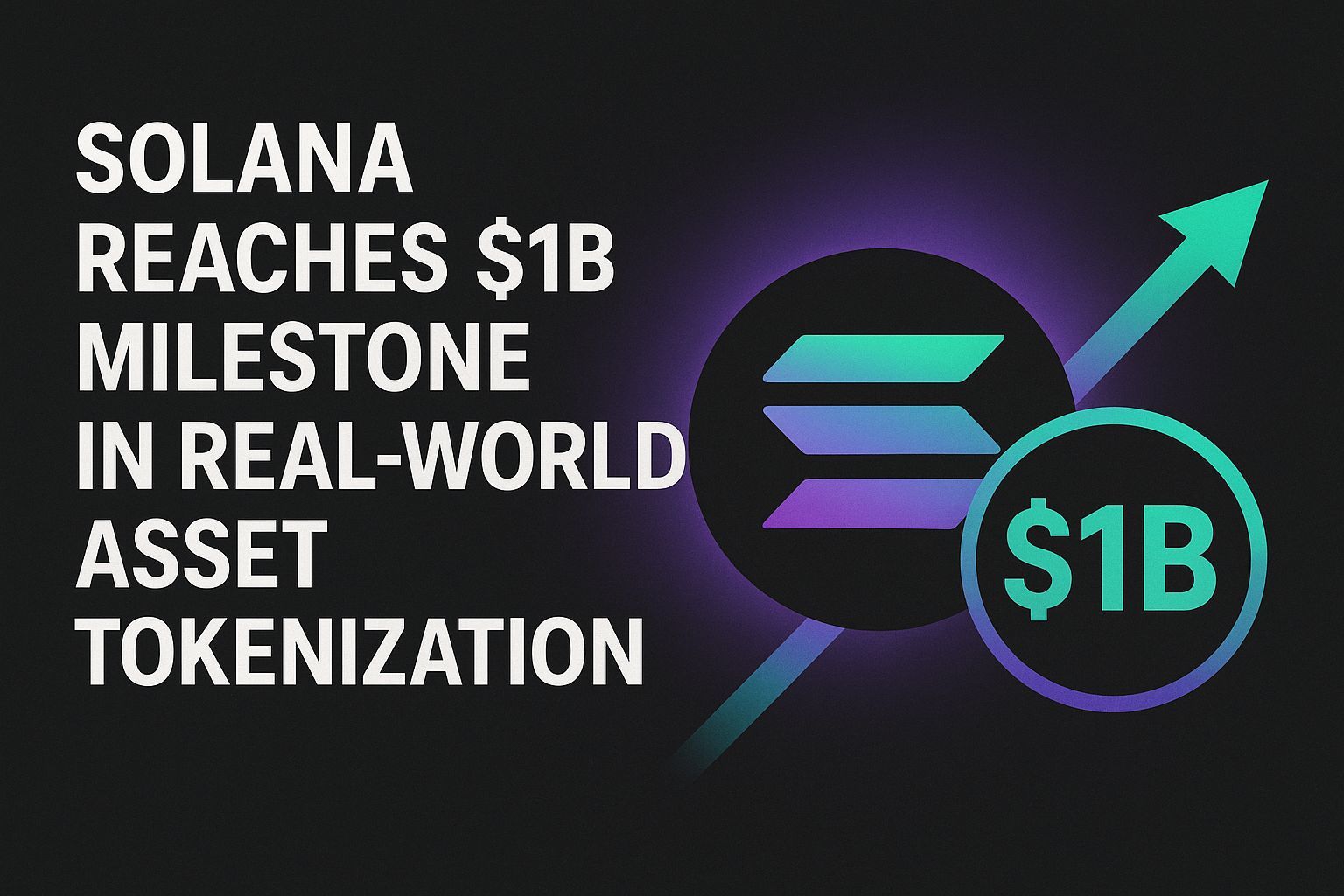
Solana’s Institutional Pivot: The $873M RWA Milestone That’s Reshaping Blockchain Finance
Not Quite $1B-But the Momentum Is Real
Here’s the thing: Solana hasn’t actually hit that $1 billion milestone in tokenized real-world assets yet. But before you click away, understand what has happened-because it’s arguably more interesting. The network hit $873.3 million in tokenized RWAs in December 2025, marking a near-10% monthly surge and capturing genuine institutional attention in a way that feels fundamentally different from the retail-driven chaos of past cycles[1][3][4].
The story isn’t about a headline number. It’s about what that number represents-a quiet but seismic shift in how serious money thinks about blockchain infrastructure.
Subscribe to our Social Media for Exclusive Crypto News and Insights 24/7!
Key Takeaways: What Actually Matters Here
- The RWA Boom Is Real, Not Hype: Solana’s $873.3M in tokenized assets signals authentic institutional adoption moving beyond speculation into actual financial infrastructure[1][3][4]
- Ethereum Still Dominates (For Now): The leader holds over $2 billion in RWAs, but Solana’s growth trajectory is undeniably steep-and that matters more than today’s snapshot[1]
- Technical Advantages Are Finally Paying Off: Penny-fraction transaction costs and 99.9% uptime aren’t marketing fluff anymore-they’re the reason institutions are building here[2]
- Western Union’s Adoption Changes the Game: A 150-million-user payment behemoth launching Solana-based stablecoin settlements in early 2026 isn’t background noise. It’s infrastructure maturation[3][4]
- ETF Inflows Are Institutional Positioning, Not Retail FOMO: Unlike short-term trading moves, ETF accumulation signals long-term conviction[4]
The Real Picture: Why $873M Matters More Than You Think

Let’s zoom out. Solana spent 2022-2023 as the punchline-network outages, FTX contagion, and a reputation for instability. Honestly, that’s ancient history now, but it’s why this moment stings different.
The $873.3 million in tokenized RWAs encompasses three major categories[1]:
Tokenized U.S. Treasury Securities dominate the mix. BlackRock’s USD Institutional Digital Liquidity Fund clocks in at $255.4 million, while Ondo’s US Dollar Yield sits at $175.8 million[3][4]. These aren’t Uniswap liquidity pools-they’re actual fixed-income instruments providing yield to institutional investors and stablecoin holders. You’re watching real money park itself here.
Private Credit Tokenization has emerged as the second pillar. Lending platforms are now tokenizing loan portfolios to create liquid secondary markets. Why? Because Solana’s settlement finality (seconds, not minutes) and transaction costs (fractions of a cent) make it economically sensible for portfolio managers[1][2].
Tokenized Equities like Tesla xStock ($48.3M) and NVIDIA xStock ($17.6M) are the wildcard-smaller in absolute terms, but they signal that asset tokenization isn’t limited to fixed income anymore[3].
The Competitive Landscape: Ethereum’s Lead, Solana’s Sprint
Here’s where it gets spicy. Ethereum still dominates RWA tokenization with over $2 billion in assets[1]. BNB Chain recently surpassed $2 billion itself[3]. But-and this is crucial-Solana is on track to become the third-largest blockchain by tokenized RWA value[3].
The gap between $873M and $2B+ looks wide until you consider velocity. Solana’s RWA holdings grew nearly 10% in December alone[3][4]. At that growth rate, we’re not talking years before Solana challenges current leaders. We’re talking quarters.
Why the momentum? Two words: technical advantages[2].
Solana’s architecture delivers:
- Settlement finality within seconds (critical for trading active portfolios)
- Transaction costs of 0.01 cents (100x cheaper than alternatives when processing large asset portfolios)[2]
- 99.9% uptime throughout 2025, demolishing previous concerns about network stability[2]
For institutional finance, this isn’t flashy. It’s efficient. And efficiency moves capital.
Western Union’s Play: The Infrastructure Inflection Point
Here’s the micro-story that’s flying under the radar: Western Union is building on Solana[3][4].
The company operates across 200 countries and serves 150 million users. Its stablecoin remittance platform, launching in early 2026, will run on Solana[3][4]. Think about that for a second. A legacy payments giant-the kind of institution that makes crypto purists roll their eyes-is choosing Solana as infrastructure for a global settlement system.
This isn’t venture capital validation. This isn’t a crypto exchange listing. This is a Fortune 500 company integrating blockchain into actual payment flows serving 150 million people. When that goes live, network activity doesn’t just tick up-it potentially accelerates RWA adoption because you’ve suddenly got institutional-grade transaction volume from a non-crypto entity[3].
The Tokenization Market’s Explosive Potential
Here’s the macro picture that gives this all context: the broader tokenization and stablecoin markets are projected to reach $4 trillion[6].
Right now, we’re looking at single-digit billions across all blockchains. Solana’s $873M sits in a market still in its infancy. When you’re this early in an infrastructure shift-when the killer app is still being built-positioning in the platform with technical superiority starts looking less like speculation and more like forward positioning.
Analysts tracking this momentum highlight Solana’s cost efficiency and mature developer ecosystem as competitive edges[2]. The developer ecosystem matters because, historically, where talent clusters, capital follows.
The ETF Story: Long-Term Conviction, Not Retail Fomo
Solana ETF inflows have been meaningful. Here’s why that’s different from typical price rallies: ETF inflows represent institutional allocations and long-term positioning, not short-term speculation[4].
The timing matters too. These inflows occurred when SOL was trading at the lower end of its recent range, pointing to institutional accumulation during weakness-the exact behavior you’d expect from investors with multi-year conviction, not traders chasing momentum[4].
Looking Ahead: What 2026 Holds
Galaxy Research is projecting Solana’s Internet Capital Markets to reach $2 billion in value this year, up from $750 million[4]. That’s 167% growth in a single year. For context, Solana processed over 121 billion transactions in 2025-more than any other blockchain[4].
The infrastructure is humming. The use cases are diversifying. And the institutions? They’re not making moves based on Twitter conversations. They’re integrating Solana into actual financial systems.
The $1 billion milestone in RWAs might come in Q2 or Q3 2026. When it does, it won’t feel like a breakout moment-it’ll feel inevitable, like something that was always going to happen once the pieces aligned.
That’s how you know institutional adoption has truly arrived.
- https://www.mexc.com/news/396924
- https://www.ainvest.com/news/solana-rallies-873m-rwa-tokenization-institutional-momentum-2601/
- https://www.mexc.com/news/391159
- https://www.mexc.co/en-PH/news/397377
- https://www.nasdaq.com/articles/cryptocurrency-could-be-one-best-own-2026
- https://blog.amplifyetfs.com/digital-assets/digital-assets-large-scale-products-and-investment-setting-up-for-2026