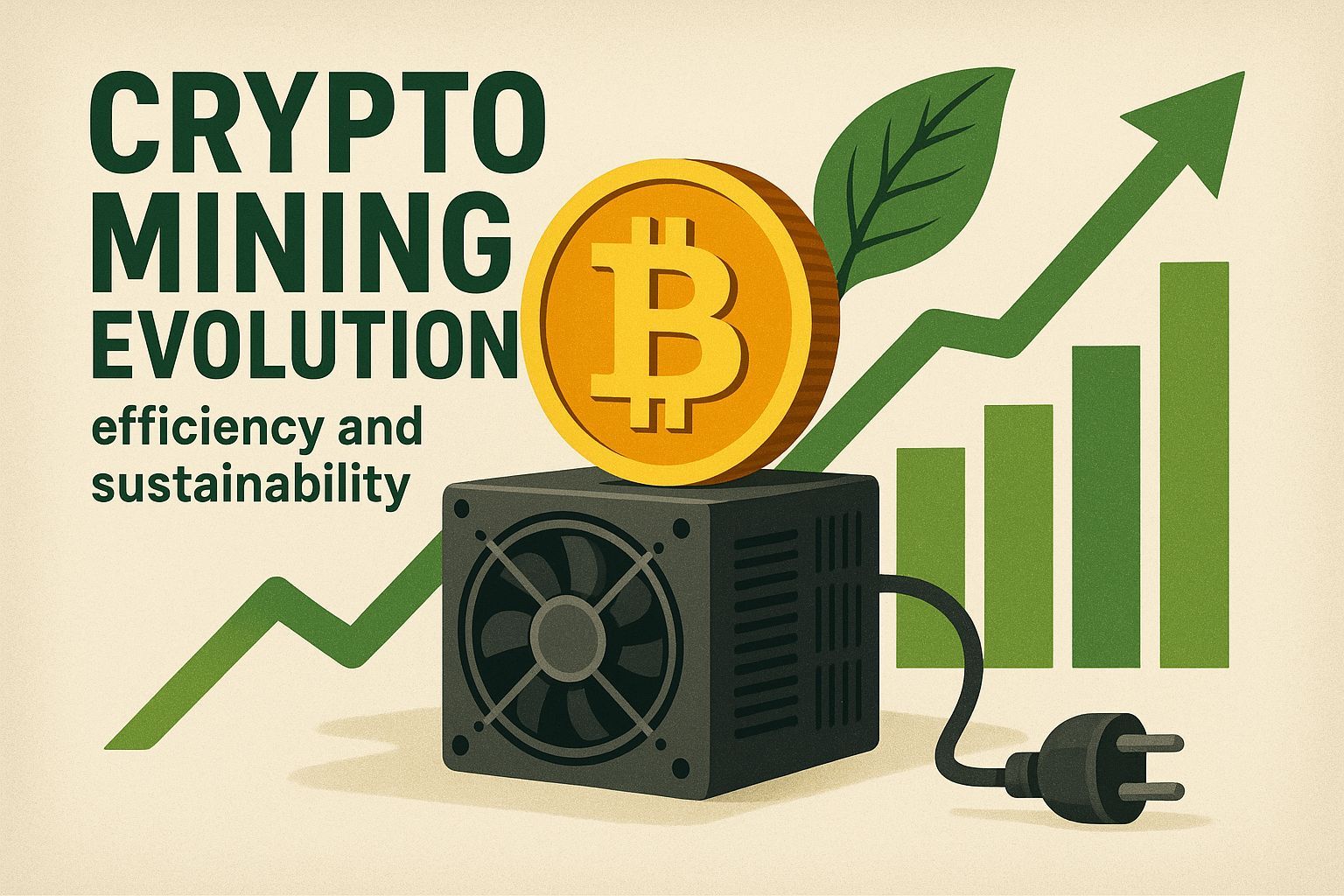
From Hobby Rigs to Industrial Powerhouses: Why 2026 is Make-or-Break for Crypto Miners
The Era of Efficiency or Obsolescence
Here’s what’s actually happening in crypto mining right now: it’s stopped being a game for people running equipment in their garage, and it’s become a ruthless efficiency war where electricity costs and hardware generations determine who survives and who gets liquidated.[1] The industry’s evolved so fast that miners from just a couple years ago are watching their rigs hemorrhage money, while a new breed of operations-armed with next-generation ASICs and strategic power deals-are printing steady returns.
The shift isn’t subtle. Energy efficiency and electricity costs now define profitability more than raw hash power ever did.[1] That’s a fundamental change in how the game works, and it’s reshaping who can actually compete in 2026.
Subscribe to our Social Media for Exclusive Crypto News and Insights 24/7!
Key Takeaways
- Next-gen ASICs delivering 16-19 J/TH efficiency are raising the bar; older rigs are becoming economically unviable in most regions[1]
- Electricity costs between $0.05-$0.07/kWh are the sweet spot for healthy margins; anything above $0.10/kWh makes even efficient operations struggle[1]
- Sustainable energy and heat recovery aren’t just PR anymore-they’re becoming central to ROI models and competitive advantage[2]
- Major mining firms are pivoting hard toward AI data centers, securing multi-billion-dollar contracts that dwarf mining revenue[3]
- Cloud mining is going mainstream, driven by rising energy costs and the ripple effects from 2024’s Bitcoin halving[6]
The Hardware Arms Race Got Real
When miners talk about "the efficiency race" these days, they’re not bragging about terahash numbers anymore.[1] They’re obsessing over Joules per Terahash-literally the energy it takes to compute one unit of work. It sounds nerdy, but here’s why it matters: a machine that produces 300+ TH/s while drawing only 5,400 watts is the difference between profit and loss.[1]
Bitmain, MicroBT, and other major ASIC manufacturers have leapfrogged from older 7-nanometer architectures straight into 5-nm and 3-nm territory.[1] That jump compressed massive computing power into smaller silicon-meaning more hash rate per watt. But here’s the catch: if you’re still running older generation ASICs or legacy GPUs, you’re probably watching returns evaporate in real time, especially if your electricity isn’t dirt-cheap.[1]
Think of it like this: older rigs are the equivalent of showing up to a Formula 1 race in a 2008 Honda. You’re burning fuel at the same rate, but you’re not covering the distance. In regions where power costs more than $0.10/kWh, even the "efficient" older machines can’t cut it-cooling, maintenance, and auxiliary costs eat into margins until you’re basically operating at a loss.[1]
The Energy Cost Threshold: Where Miners Win or Lose
Here’s the real talk about electricity: between $0.05 and $0.07 per kilowatt-hour, modern rigs can maintain healthy margins even as network difficulty climbs.[1] Cross that $0.10/kWh threshold? Even today’s best hardware struggles.
That’s why miners aren’t just randomly spreading operations across the planet anymore. They’re strategically deploying capital to jurisdictions with-or building infrastructure around-renewable energy sources, off-peak pricing windows, and hosting arrangements that lock in favorable rates.[1] This isn’t sentimentality about the environment; it’s pure economics. A miner running on Norwegian hydropower or paired with a renewable wind farm has a built-in cost advantage that a competitor in a grid-dependent region simply can’t match.
Some operators are even getting creative. Sazmining, a carbon-neutral mining outfit, launched a hydro-powered site in a Norwegian village where excess heat from the rigs replaced an oil-fired boiler and helped dry locally caught codfish.[2] That’s not just clever optics-it’s a revenue play. When you can monetize waste heat, your effective operating costs drop. Canaan, another hardware manufacturer, is piloting agricultural heat recovery in colder climates, aiming to build a replicable model for "households, businesses, and industrial partners."[2]
The takeaway? Miners who aren’t obsessing over power procurement deals or renewable energy partnerships in 2026 are essentially hoping to compete with one arm tied behind their back.
The Sustainability Reframe: From PR to Profit Center
Remember when mining sustainability was primarily a PR problem? That era’s officially over.[2] In 2022, Bitcoin mining drew only 37.4% of its power from sustainable sources. By now, that figure’s hit 52.4%-a 15-point jump in less than four years.[2]
But here’s what’s interesting: the industry didn’t shift because of environmental activism (though there’s plenty of that). It shifted because renewable energy and heat recovery started making financial sense at scale. When your electricity becomes cheaper and cleaner, it’s a win-win that investors actually want to fund.
TeraWulf, a zero-carbon Bitcoin mining operator, exemplifies this pivot. The company’s leveraging hydroelectric and similar sustainable power sources, not out of virtue signaling, but because it locks in durable cost advantages.[3] And like many major mining firms, TeraWulf’s also pivoting aggressively toward AI and data center hosting-they recently signed a 10-year hosting agreement with FluidStack worth an expected $670 million in average annual revenue.[3]
Cipher Mining, another heavyweight, is playing the same game: Bitcoin mining operations nationwide, but the real action is in the data center business. They snagged a 15-year, 300-MW direct lease with Amazon Web Services generating roughly $5.5 billion in contract revenue over the initial term.[3] In their last quarter, they still pulled $72 million in mining revenue, but you can see where the industry’s attention is pivoting.[3]
The Elephant in the Room: Everyone’s Chasing Data Centers Now

Here’s something that caught a lot of people off guard: major mining operators have already deprioritized mining operations entirely-or phased them out-to pivot into AI and high-performance computing data centers.[2]
Why? Because AI’s energy demands are astronomical. BlackRock predicts AI could consume one-quarter of U.S. electricity by 2030.[2] That’s not a threat; that’s opportunity if you’ve already got industrial-scale infrastructure, grid relationships, and cooling expertise built out.
But there’s turbulence ahead. These massive data center pivots face headwinds because the electrical grid itself is straining under AI demand, prompting some political pushback even from nationalistic AI champions.[2] That means miners-turned-data-center-operators need to stay nimble. The operators with the strongest balance sheets, like Cipher, are generating enough Bitcoin mining cash flow ($72 million in a single quarter) to self-fund these transitions without getting strangled by financing concerns.[3]
For smaller operations? This is a bloodbath. If you don’t have the capital to transition, you’re stuck competing in pure mining-where margins are tightening by the month.
Cloud Mining Goes Mainstream (For Real This Time)
Cloud crypto mining isn’t new, but in 2026, it’s genuinely moved into mainstream territory.[6] Why? Rising energy costs plus the lingering effects of 2024’s Bitcoin halving pushed regular users-people who’d never run hardware themselves-toward cloud mining services.[6]
It makes sense: you get mining exposure without the capital equipment burden, the cooling headaches, or the electricity risk. You pay a service fee, they handle the infrastructure, and you collect rewards. For retail investors who got priced out of industrial-scale mining, it’s the path of least resistance.
What This Means for You
If you’re thinking about mining in 2026, here’s the unvarnished reality: you need efficient hardware (sub-20 J/TH), rock-bottom electricity costs, and ideally, a path to monetize waste heat or transition into adjacent services like AI hosting.[1] The days of casual profitability are dead.
Miners still generating solid returns aren’t doing it on faith or luck. They’re ruthlessly optimizing power procurement, deploying latest-generation hardware, and building optionality into their operations-whether that’s heat recovery, data center contracts, or geographic diversification.
The industry’s matured. It’s moved from speculative side-hustle to industrial infrastructure. And if you’re not aligned with that reality, you’re going to get ground down.
- https://ezblockchain.net/article/will-crypto-mining-stay-profitable-in-2026/
- https://coingeek.com/miners-enjoy-btc-gains-but-are-higher-energy-costs-coming/
- https://www.investing.com/analysis/is-2026-the-year-to-load-up-on-crypto-miners-200672929
- https://coincub.com/mining/cloud-crypto-mining/
- https://blockchain-life.com/news/2026-crypto-mining-trends/