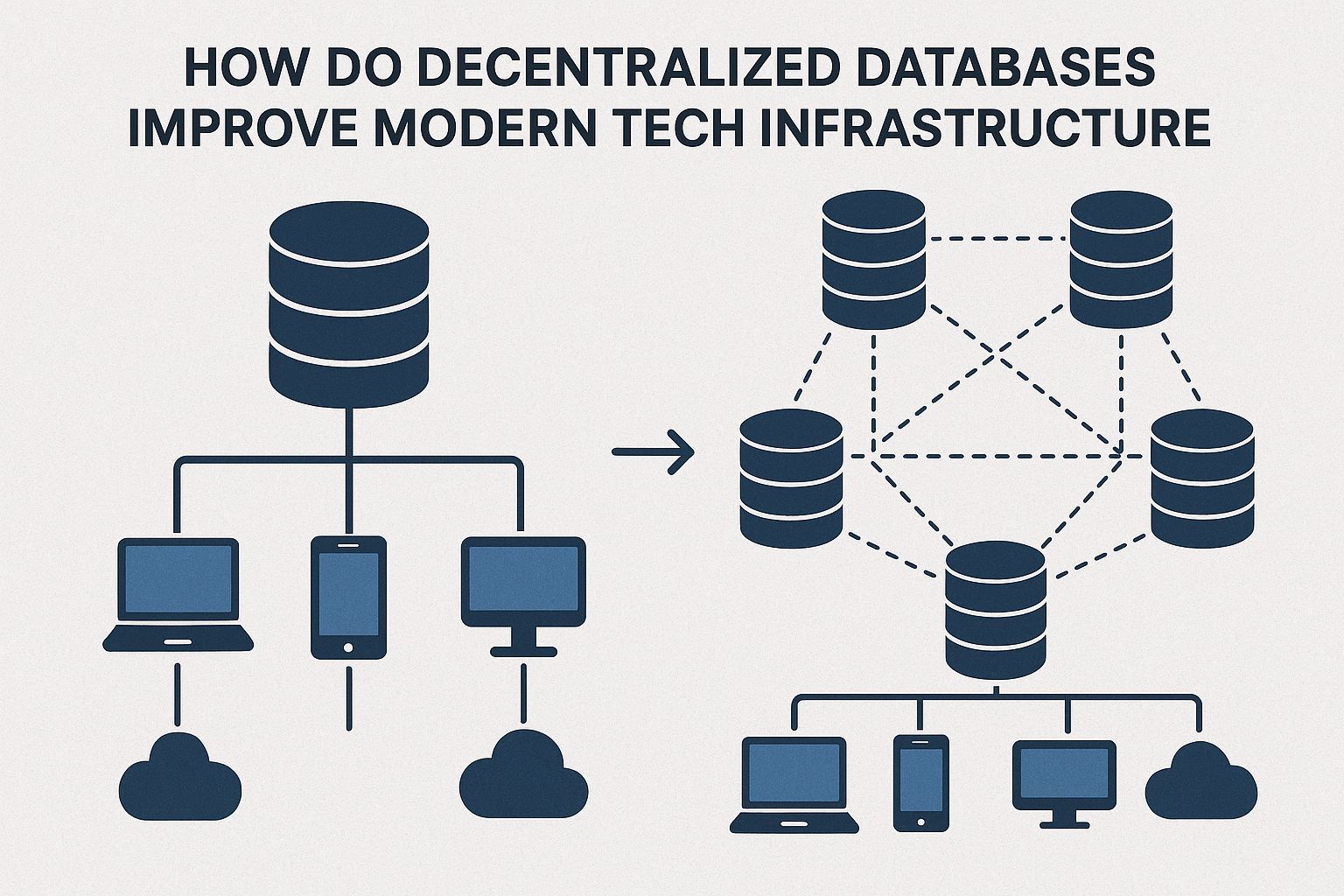
Why Ditch the Middleman? Decentralized Databases Are the Backbone of Tomorrow’s Tech
Hey, imagine you’re building the next big app, and some hacker wipes out your entire database in one swoop. Nightmare, right? Decentralized databases-powered by blockchain-flip that script by spreading data across nodes, killing single points of failure and supercharging modern tech infrastructure with resilience and trust.[1][2] It’s not hype; it’s how we’re fixing the messes of centralized systems like data silos and breaches.
Key Takeaways from the Blockchain Database Shift
- No more single-server doom: Data lives everywhere, so one crash? No biggie-others pick up the slack.[1][3]
- Hackers hate this: Immutability and crypto locks make tampering a fool’s errand.[2][3]
- Always on, always true: Perfect for finance, supply chains, even AI-think uptime that centralized setups dream of.[4][7]
- Trade-off alert: Slower speeds for that ironclad security. Worth it? You bet for high-stakes stuff.[6]
Subscribe to our Social Media for Exclusive Crypto News and Insights 24/7!
The Single Point of Failure Killer
You’ve seen it-big corps go dark because one server coughs. Centralized databases? Convenient till they’re not. Decentralized ones distribute data across nodes, so if a few drop offline, the network shrugs and keeps humming.[1][2][5] Fault tolerance on steroids. In business terms, that’s e-commerce staying live during a DDoS or finance apps chugging through outages. One source nails it: “Even if one node is compromised, the rest of the network remains secure.”[3] Brutal truth: traditional setups can’t touch that reliability.[3][5]
Immutability: Your Unhackable Audit Trail
Data can’t just vanish or get tweaked. Blockchain’s hash chains mean altering one bit ripples everywhere-good luck pulling that off without the whole network’s nod.[1][2] It’s an “unequivocal source of truth,” as Inery puts it.[1] For enterprises, this shines in operational reporting: admins log data immutably, clients verify directly. No fraud, full transparency. Picture supply chains where every step’s etched in stone-IBM calls this boosting “traceability across business networks.”[8] Sarcasm aside, who wouldn’t want that over shady logs?
- Security stack: Consensus mechanisms + public-private keys = fortress-level privacy.[2][3]
- Real-world flex: Healthcare owns its data sans Big Tech snoops; finance dodges mass surveillance.[2][4]
Data Ownership: You Control the Keys, Not Some Corp

Centralized? They own your info. Decentralized? Shift to users. Tokenized assets prove ownership on-chain, slashing disputes.[3] Privacy sovereignty? Check-data stays local, GDPR-compliant, no sovereignty headaches.[4] Civo’s breakdown: Enterprises keep control under local laws, mixing open-source AI models for custom power.[4] It’s empowering, fam. No more “trust us” from cloud giants.
| Centralized Databases | Decentralized (Blockchain) |
|---|---|
| One breach = total loss[1][3] | Nodes cover failures[2][5] |
| Mutable, fraud-prone[6] | Immutable truth[1][8] |
| Downtime kills ops[3] | 24/7 resilience[5] |
| Corp controls data[3] | User-owned sovereignty[4] |
The Catch: Speed vs. Security Reality Check

Don’t get starry-eyed-blockchains guzzle compute for consensus, lagging behind SQL’s blistering TPS.[6] Bitcoin or ETH? Orders of magnitude slower. Higher latency, storage costs. But for trustless ops? Priceless. Rapydo sums it: Decentralization’s “cost of security.”[6] Historical nod: Bitcoin’s never “gone down” thanks to global nodes-no gov can fully ban it.[5] Analogy time: Centralized is a sports car-fast till it wrecks. Decentralized? Armored truck. Slow burn, but it delivers.
Enterprise Plays: Where It Wins Big
Supply chains? Consensus without trust-entities collab sans middlemen.[7] AI infra? Ditch breach risks, flex open models.[4] Businesses get transparency, tokenized control, zero-downtime ops.[3] One vivid use: Multi-admin ops data, audited forever.[1] Honestly, that move from silos to shared, unalterable ledgers? Game-changer for devs-no fumbles, just resilient stacks.[1][6]
- https://inery.io/blog/article/the-benefits-of-blockchain-as-a-database-solution/
- https://insights.ncog.earth/decentralized-database-benefits/
- https://www.outeredge.live/post/top-10-benefits-of-decentralized-infrastructure-for-businesses
- https://www.civo.com/blog/the-benefits-of-decentralized-ai-infrastructure
- https://www.verytechnology.com/insights/blockchains-vs-centralized-databases-whats-the-difference
- https://www.rapydo.io/blog/databases-in-the-blockchain-era
- https://pmc.ncbi.nlm.nih.gov/articles/PMC9347267/
- https://www.ibm.com/think/topics/benefits-of-blockchain