Breaking Down the DeFi Revolution: How Blockchain is Actually Making Cross-Border Payments Work
The Speed Game Just Changed-And Traditional Banks Didn’t See It Coming
Here’s the thing about international payments: they’re broken. You send money across borders and watch it vanish into the correspondent banking network for 3-5 business days while fees stack up like pancakes. But decentralized finance is quietly demolishing that entire system, and 2026 is the year it stops being theoretical and starts being real.
The infrastructure shift happening right now isn’t just incremental-it’s fundamental. Permissioned DeFi models can slash cross-border payment costs by up to 80% while boosting speed, security, and compliance in ways traditional finance simply can’t match.[1] We’re talking settlement times dropping from nearly a week to under 10 minutes.[2] That’s not a minor optimization. That’s a structural redesign of how money moves globally.
Subscribe to our Social Media for Exclusive Crypto News and Insights 24/7!
Key Takeaways: What’s Actually Happening Right Now
- Cost compression is real: Blockchain alternatives operate at 0.1-0.5% transaction costs versus the 4-6% traditional correspondent networks charge.[2]
- Speed is no longer theoretical: Settlement times have collapsed from 3-5 business days to seconds or minutes depending on the implementation.[2]
- Major institutions are already live: JP Morgan processes over $1 billion daily through JPM Coin, while Visa’s blockchain network handles cross-border payments at 70% lower costs than traditional wire transfers.[2]
- The killer use case is emerging: Cross-border payments represent the most immediate blockchain opportunity, with transaction volumes reaching $3 trillion in 2026.[2]
How the Plumbing Actually Works (And Why It Matters)

Let me break down what’s happening under the hood, because this is where it gets genuinely interesting.
In the old world, when you send USD to someone who wants EUR, a series of intermediaries handle the conversion. Your bank confirms the transaction through correspondent networks, foreign exchange operations convert the currencies, and somewhere along that chain, fees compound. It’s inefficient by design-each intermediary takes a cut, and delays stack up.
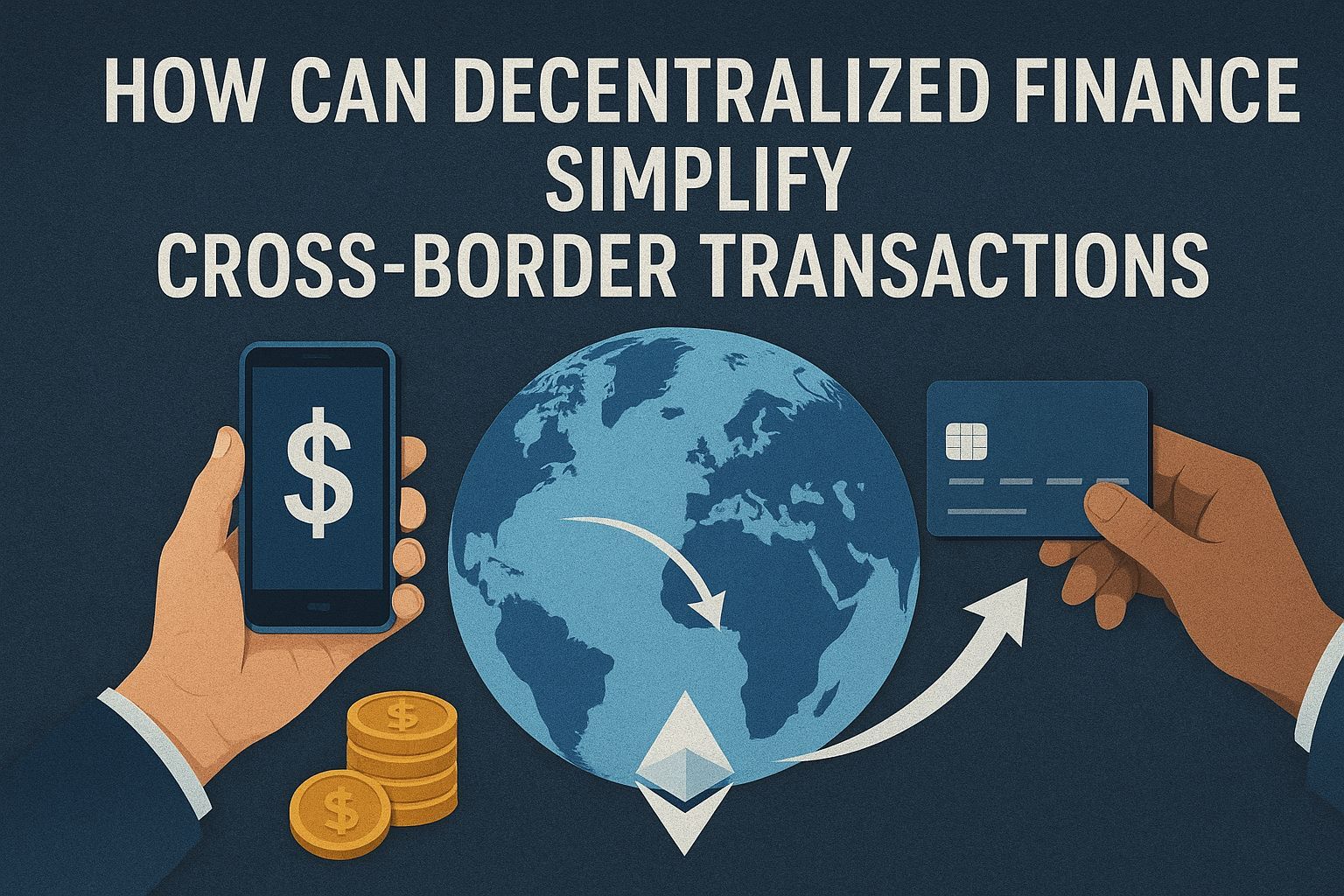
DeFi does it differently. A sender converts their tokenized US dollars and transfers them through a liquidity pool via an automated market maker (AMM) smart contract, which then executes the swap and transfers the tokenized euro to the receiver.[1] The receiver can then either hold the token on another blockchain or off-ramp to fiat currency through an unwrapping platform that credits their bank account.[1]
The beauty? No intermediaries. No correspondent networks. Just protocol-level execution that’s transparent, fast, and auditable.
The Real Numbers: What Companies Are Actually Seeing

You want proof this isn’t vaporware? Look at what’s shipping right now:
Traditional finance: Standard Chartered processes $8 billion annually through blockchain trade finance platforms-that’s 90% faster document verification than paper-based systems.[2] DBS Bank reduced trade finance processing from 10 days to literally 4 hours using distributed ledger technology, handling over $12 billion in transactions since 2022.[2]
Enterprise adoption: Walmart Canada eliminated 70% of freight invoice disputes through smart contract automation.[2] Maersk processes $14 billion in trade finance annually on blockchain platforms.[2] These aren’t pilot projects anymore. These are billion-dollar operations running on distributed ledger infrastructure.
Companies integrating blockchain payment rails with existing corporate infrastructure are reporting 70% cost savings on international transfers while reducing settlement times from 3-5 days to under 10 minutes.[2] ROI hits within 90 days of deployment-sometimes within 6-12 months for larger implementations.[2]
Why Banks Actually Care (And Why They Should Be Nervous)

The institutional adoption isn’t happening because DeFi evangelists convinced them. It’s happening because the economics are undeniable.
Traditional correspondent networks charge 4-6% fees for international transfers. JPM Coin and Visa’s B2B Connect operate at 0.1-0.5% transaction costs.[2] That’s a 50-80x difference in fee structure. When you’re processing billions in cross-border volume, that gap stops being theoretical and becomes existential.
JP Morgan’s decision to launch JPM Coin on a public blockchain and Citi’s integration of Token Services with 24/7 USD Clearing for Real-Time Cross-Border Payments aren’t PR moves-they’re institutional recognition that the old infrastructure is becoming obsolete.[5] These aren’t crypto startups. These are the titans of traditional finance admitting the game has shifted.
The Interoperability Story: Where Things Get Complicated
Here’s where it gets thorny: for DeFi to truly simplify cross-border payments, everything needs to talk to everything else. And that’s messier than it sounds.
Multiple digital wallet networks announced interlinks in 2025, and this is accelerating in 2026. PayPal World (integrating PayPal, Venmo, UPI, and Mercado Pago), TerraPay’s Xend (connecting Airtel, Barq, and M-Pesa), and AliPay+ (already linking AliPay, GrabPay, and Touch ‘n Go) plan to give more than five billion individual digital wallets cross-border payment capabilities by the end of the year.[3]
That’s not just a feature upgrade-that’s fundamental infrastructure for emerging