Zero-Knowledge Proofs: The Blockchain Verification Game-Changer Nobody’s Really Talking About (Yet)
When Privacy Met Proof-And Changed Everything
Here’s the thing about blockchain verification: it’s always been this awkward dance between transparency and security. You want to prove something’s legit without showing your whole hand. That’s exactly where zero-knowledge proofs (ZKPs) come in, and honestly, they’re reshaping how blockchain networks operate at a fundamental level.
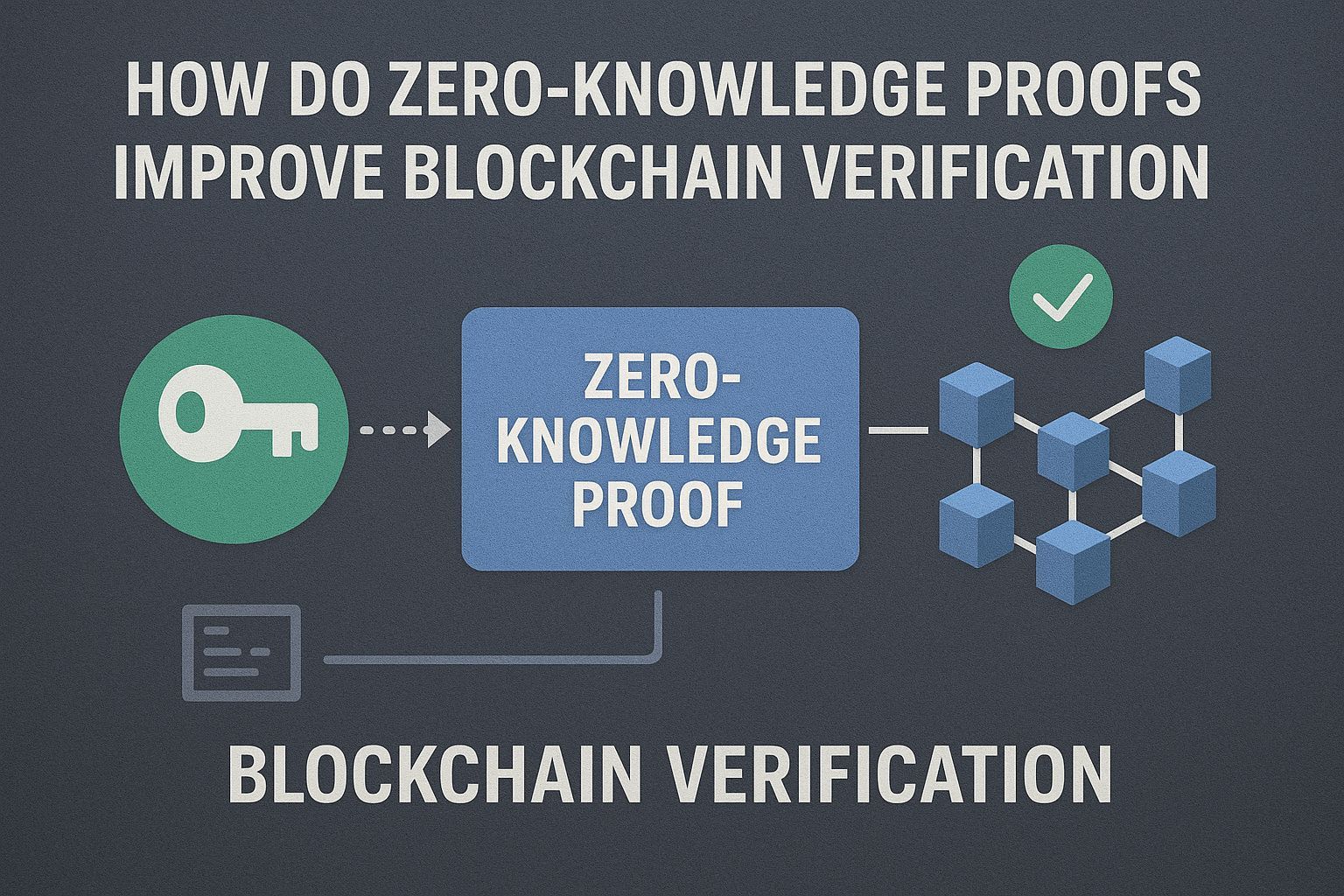
A zero-knowledge proof is a cryptographic method that allows one party (the prover) to convince another party (the verifier) that a statement is true without revealing any information beyond the fact that the statement itself is valid[4]. Think of it like proving you know the combination to a safe without actually opening it in front of someone-you just demonstrate you can open it, and that’s proof enough.
Subscribe to our Social Media for Exclusive Crypto News and Insights 24/7!
Key Takeaways: Why This Matters for Your Portfolio
- Three non-negotiables: Completeness (honest proofs convince honest verifiers), Soundness (false statements can’t fool anyone), and Zero-Knowledge (verifiers learn nothing extra)[1][3][4]
- Blockchain security gets a serious upgrade: Multiple parties can verify transactions without exposing sensitive data, meaning private information stays locked down while trust builds[2]
- Layer 2 solutions scale like never before: zk-Rollups and similar tech let networks process transactions faster and cheaper without sacrificing security[3]
- Authentication without exposure: Employees and users can access systems or conduct transactions by proving they know what they need to know-no passwords or personal details leaking into the wild[3]
The Mechanics: How Zero-Knowledge Actually Secures the Chain

Let’s break this down in real terms. When you’re sending crypto on a blockchain using ZKPs, here’s what’s actually happening[2]:
- You encrypt your transaction and submit it to the network
- You provide a zero-knowledge proof alongside it-mathematical proof that your transaction is legitimate
- Network nodes inspect that proof (not your transaction data)
- If the proof checks out, boom-the transaction goes through
- Everything gets recorded on-chain, but your sensitive details? Still yours.
What makes this genuinely powerful is that verifiers are hitting you with multiple rounds of communication and cryptographic challenges[2][3]. They’re essentially asking you to prove you know something by performing actions only someone with actual knowledge could pull off. It’s like a security test you can’t cheat on-guess wrong a few times, and the verifier knows you’re full of it.
The three properties that make ZKPs bulletproof are straightforward but revolutionary[1][4][5]:
Completeness means if you’re honest and actually know what you’re proving, an honest verifier will believe you. Soundness means if you’re lying, no amount of creative cheating gets past an honest verifier-the math just doesn’t work. Zero-Knowledge is the kicker: the verifier learns nothing except “yep, this statement’s true.” They don’t reverse-engineer your password, your transaction details, or anything else. You’ve literally proved something while keeping everything hidden.
Where This Gets Real: Blockchain Applications

Decentralized oracle networks are already leveraging ZKPs to prove facts about off-chain data without exposing that data on-chain[3]. Imagine a smart contract that needs to verify real-world information-interest rates, stock prices, weather data-without dumping all that raw information onto the blockchain where anyone can see it. ZKPs handle that seamlessly.
Then there’s the Layer 2 scaling story, which is where things get genuinely interesting for users tired of $50 Ethereum transaction fees[3]. Technologies like zk-Rollups use zero-knowledge proofs to bundle transactions, prove they’re all valid with a single mathematical proof, and submit that to Ethereum as a settlement layer. You get security inherited from Layer 1, speeds that compete with centralized exchanges, and settlement finality in minutes instead of hours. It’s the holy grail of scaling that actually works.
Authentication systems are getting a privacy makeover too[3]. Instead of storing passwords (which, let’s be real, databases get hacked constantly), systems can verify you know your password using ZKPs. You prove you know it without ever revealing it. No data breach can leak what was never stored in the first place.
The Trust Problem Gets Solved

Here’s what gets overlooked: blockchain’s whole value prop is “don’t trust, verify.” But traditional verification means exposing everything. ZKPs flip that-you’re still verifying, but participants can interact with confidence knowing sensitive information won’t get compromised or weaponized by malicious actors[2]. That’s not a small thing.
In supply chains, for example, companies can prove the authenticity and origin of products without revealing proprietary manufacturing data, cost structures, or supplier relationships[1]. In finance, institutions can prove compliance and transaction validity without exposing customer information or trading strategies. The circle of trust expands without the circle of exposure.
The Real Takeaway

Zero-knowledge proofs aren’t flashy like a 10x token pump. They’re foundational. They’re the boring infrastructure that makes everything else work better, faster, and more privately. If you’re evaluating blockchain projects-whether Layer 2s, privacy-focused chains, or oracle networks-ZKPs are the technical moat that separates the serious players from the pretenders.
The ecosystem’s still early in weaponizing these tools at scale, but the trajectory’s clear: more privacy, more verification, less exposure. That’s not just an upgrade. That’s the future actually working.
Sources Used
- https://www.circularise.com/blogs/zero-knowledge-proofs-explained-in-3-examples
- https://www.chainalysis.com/blog/introduction-to-zero-knowledge-proofs-zkps/
- https://chain.link/education/zero-knowledge-proof-zkp
- https://en.wikipedia.org/wiki/Zero-knowledge_proof
- https://www.nttdata.com/global/en/insights/focus/2024/what-is-zero-knowledge-proof