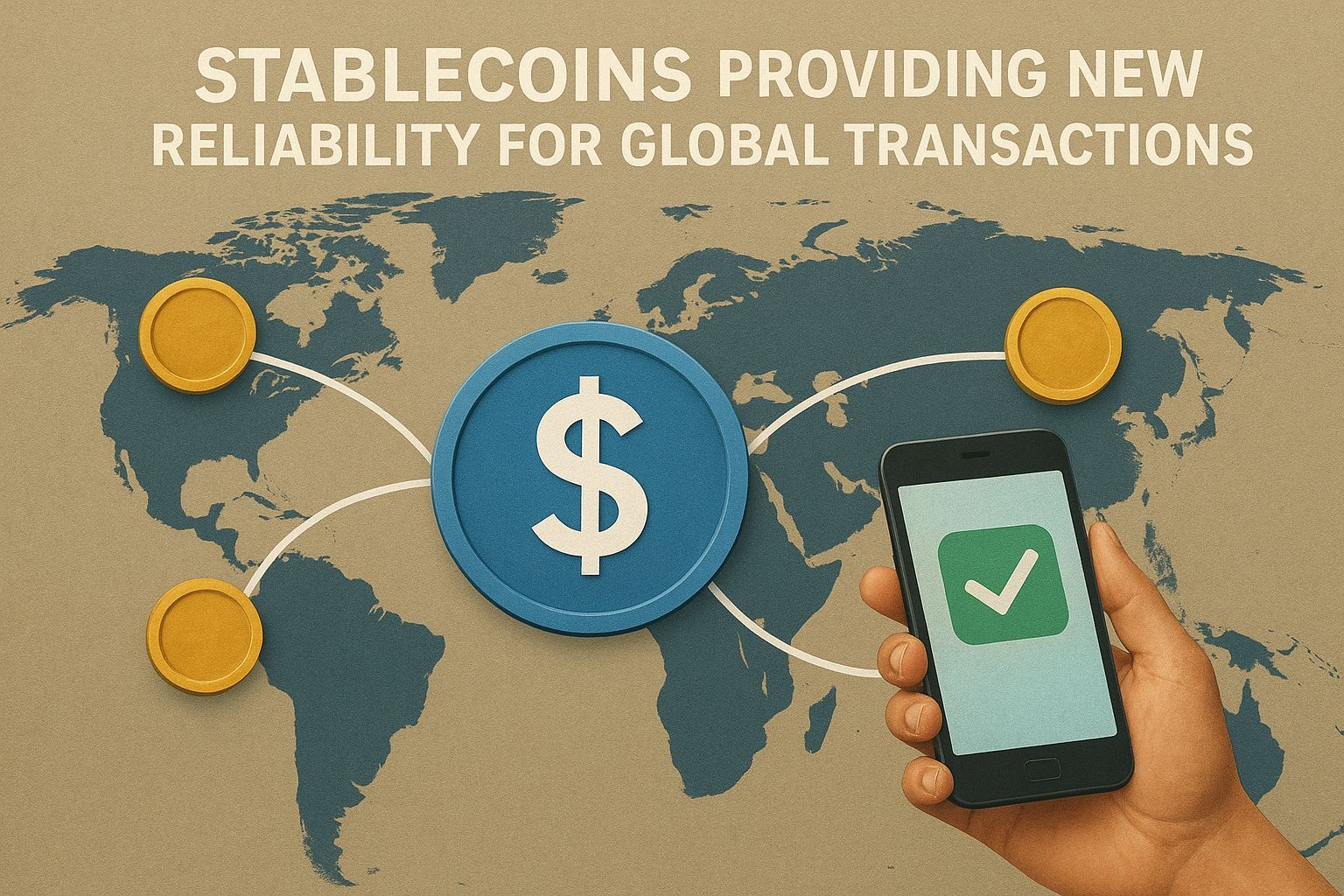
Stablecoins: From Crypto Sidekick to Global Payment Powerhouse
Hey, if you’ve been eyeing how stablecoins are providing new reliability for global transactions, you’re spot on-2026 is their breakout year. These digital dollars aren’t just chilling in DeFi anymore; they’re slashing cross-border friction, settling in seconds, and outpacing old-school rails like correspondent banking.[1][2][3]
Key Takeaways
- Massive volume explosion: Stablecoins hit $33T+ in 2025 transactions, dwarfing Visa’s throughput and signaling real utility over speculation.[2]
- B2B dominance: $226B in business payments (60% of total), up 733% YoY-think supply chains humming without delays.[3][8]
- Speed & savings king: Near-instant, 24/7 settlement at lower fees, especially for Asia-Pacific remittances and emerging markets.[1][3][4]
- Enterprise ready: Regs aligning, banks jumping in, platforms adopting-2026 flips the switch to mainstream workhorse status.[1][9]
Subscribe to our Social Media for Exclusive Crypto News and Insights 24/7!
Why Stablecoins Are Killing Cross-Border Headaches
Picture this: You’re a biz shipping widgets from Singapore to Vietnam. Traditional wires? Days of waiting, fat fees, reconciliation nightmares. Enter tokenised liquidity-USD stablecoins zip value on a unified ledger, 24/7, no middlemen drama.[1] Thunes nails it: “Tokenised USD can reach a local entity instantly,” then local FX kicks in seamlessly. It’s like upgrading from a rusty bike to a hyperloop.
Asia’s leading the charge-$245B in outflows from hubs like Singapore, Hong Kong, Japan. That’s 60% of global stablecoin payments![3] No wonder Indonesia and Philippines are hooked; inflation hedges plus instant access beat depreciating local cash every time.[2]
The Volume Boom: $33T and Counting-Not Just Hype
Don’t sleep on the numbers, fam. 2025 saw stablecoin volumes smash $33T, with monthly peaks over $1T repeatedly.[2][5] Adjusted for bots? Still $9T rock-solid.[4] USDC and USDT own 95% dominance, but niches like gasless transfers via Plasma are nibbling edges.[2]
Regional heat map (straight from the data):
- Asia-Pacific: $2.36T inflows in 2024 alone, exploding into 2025 on payment/remittance demand.[2]
- North America/Europe: Solid but trailing-$95B and $50B outflows.[3]
- LatAm/Africa: Tiny now (<$1B), but watch for volatility plays.[3]
It’s maturing fast. As Plasma puts it, stablecoins are “the primary bridge between fiat and decentralized systems,” disrupting bank fees while hybrids emerge.[2] You’ve seen trading volumes fake out before, right? This ain’t that-consistent surges scream infrastructure.
B2B Payments: The Silent 733% Surge

B2B’s the real story-$226B yearly, 60% of all stablecoin payments, rocketing 733% in 2025.[3][8] McKinsey spots early adopters streamlining supply chains: “Stablecoins address inefficiencies… high fees and settlement delays.”[3] SMEs love the liquidity boost; no more trapped cash in slow pipes.
Analogy time: It’s like Venmo for global trade. Cards linked to stablecoins? $4.5B spend in 2025, up 673%-spend direct at merchants, skip exchanges.[3] Gig platforms, gaming, creators? All piling in where local rails suck.[1]
Regs + Rails = Enterprise Green Light

Stablecoin regulation’s making ’em enterprise-ready-alignment with issuers, networks, banks.[1] Europe’s banks are all-in, issuing their own in 2026.[9] Taylor Wessing echoes: Near-instant finality, lower fees crush multi-day clears.[4]
Use case breakdown (IMF via sources):
| Use Case | Adoption | Why It Wins |
|---|---|---|
| Crypto Trading | Very High | Liquidity king for exchanges [4] |
| Cross-Border Payments | Growing Fast | Speed/cost for remittances, biz [1][3][4] |
| DeFi | High | Collateral on steroids [4] |
Thunes predicts: “2026 is the year stablecoins go to work,” via APIs bridging 130+ countries with compliance baked in.[1] Whales ain’t sleeping-they’re rotating into real yield.
Illicit Shadows? Yeah, But Concentrated
Quick reality check: Volumes enable crime too, like sanctions evasion (e.g., $83B tied to Russian networks via Garantex).[5] But it’s uneven-legit use dwarfs it, and regs are closing nets. TRM Labs warns: Stablecoins stay “central to… consequential crime,” so expect scrutiny.[5] Still, growth’s legit-first.
Honestly, that $33T surge caught tradfi off guard. Imagine holding through 2022’s chaos, then watching stablecoins flip to payment rails… vindication, right?
- https://www.thunes.com/insights/trends/stablecoin-trends-shaping-global-payments/
- https://www.plasma.to/learn/stablecoin-transaction-volume
- https://www.mckinsey.com/industries/financial-services/our-insights/stablecoins-in-payments-what-the-raw-transaction-numbers-miss
- https://www.taylorwessing.com/en/insights-and-events/insights/2026/02/stablecoins-no-longer-the-new-kid-on-the-block
- https://www.trmlabs.com/resources/blog/stablecoins-at-scale-broad-adoption-and-highly-concentrated-illicit-networks
- https://www.fintechfutures.com/blockchain-crypto-digital-assets/is-2026-a-make-or-break-year-for-stablecoins
- https://www.spglobal.com/ratings/en/regulatory/article/european-banks-are-embracing-stablecoins-with-an-eye-on-the-future-s101654757