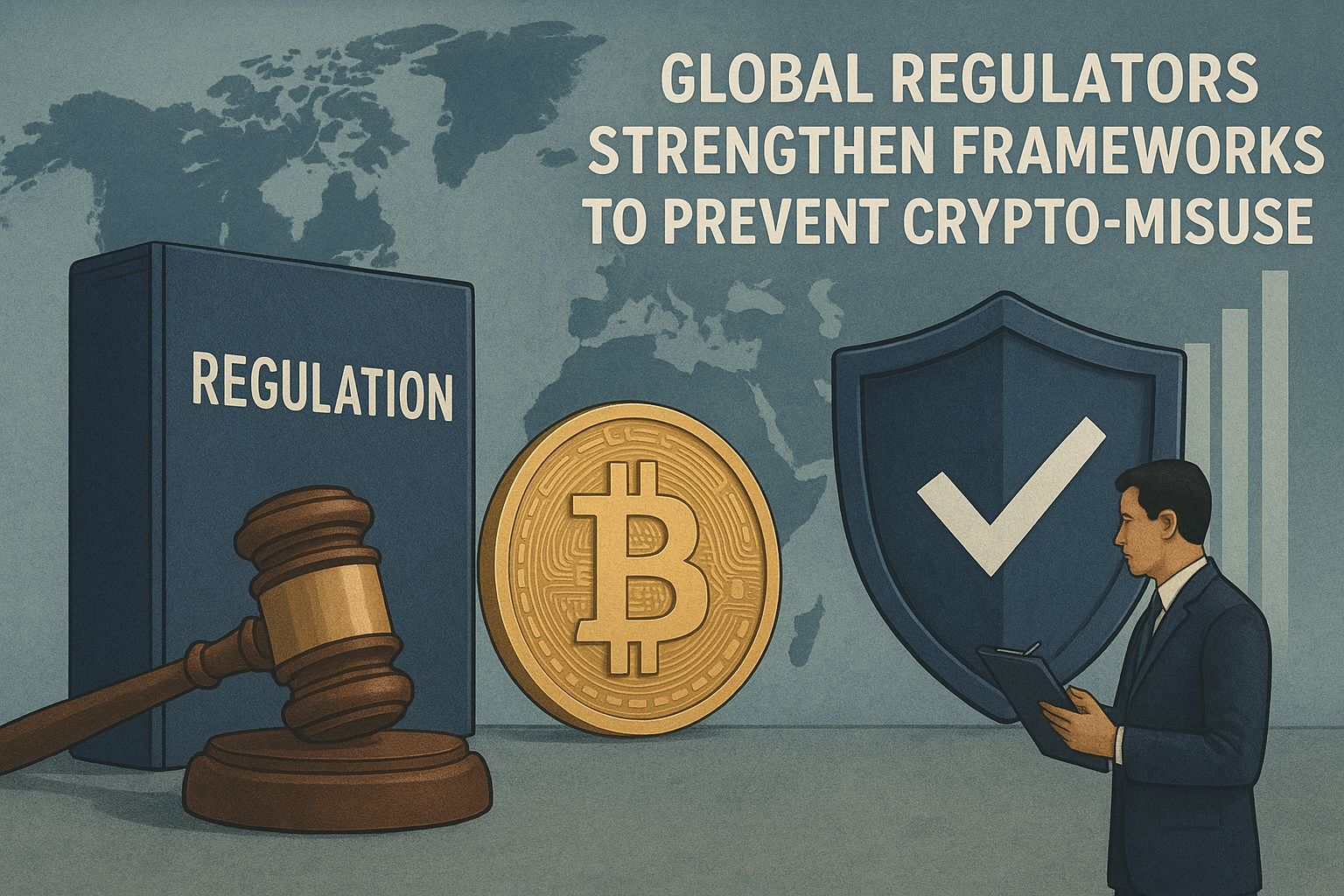
The Year Crypto Grew Up: How Global Regulators Finally Got Serious About Enforcement
When “Setting Rules” Became “Breaking Bad Actors”
The crypto industry just hit a turning point. We’re not talking about another bull run or a new meme coin taking off-this is bigger. Global regulators have moved from writing the rulebook to actively enforcing it, and the shift is reshaping how the entire ecosystem operates[1][2][3].
For years, crypto lived in a gray zone. Regulators were still debating what stablecoins even were. But 2026? That’s the year compliance stops being theoretical and becomes operational reality. And honestly, it’s about time.
Subscribe to our Social Media for Exclusive Crypto News and Insights 24/7!
Key Takeaways
- MiCA is live: The EU’s Markets in Crypto-Assets Regulation has moved from draft to full enforcement, requiring demonstrable controls from crypto-asset service providers, custodians, and issuers[1][2].
- The Travel Rule is everywhere: As of 2026, 85 of 117 jurisdictions have implemented or are actively implementing the Travel Rule for virtual assets-that’s a massive jump from 65 jurisdictions just a year prior[3].
- Sanctions got crypto-native: Illicit actors are no longer just using crypto-they’re embedding themselves in crypto infrastructure itself, forcing exchanges and platforms to rethink their entire operational security playbook[4].
- Stablecoins are the regulatory hot seat: Reserve requirements, custody protections, and redemption guarantees aren’t suggestions anymore-they’re enforceable obligations[1][2].
- DeFi and DAOs are next: Europe’s regulatory lens is shifting toward decentralized finance and decentralized autonomous organizations, bringing legal clarity to spaces that previously existed in regulatory limbo[2].
From Theory to Teeth: What MiCA Actually Means for You

Here’s the thing about MiCA: it’s not some distant EU thing that doesn’t affect you. If your exchange, custodian, or token service touches Europe, it touches you[1].
The regulation introduces a comprehensive regime covering:
- Crypto-asset service providers and issuers
- White paper disclosures and market abuse controls
- Prudential, governance, and conduct requirements
- Strict transparency and consumer protection obligations
What’s wild is the enforcement angle. Supervisors aren’t just checking boxes anymore-they’re demanding demonstrable controls, not just policies gathering digital dust[1]. Think of it like moving from a fire safety pamphlet on your wall to an actual fire inspection where they check your extinguishers, evacuation routes, and staff training.
“During 2026, Europe’s digital asset debate will shift decisively from drafting to delivering supervisory outcomes,” according to PwC Legal’s global analysis[2]. Translation: Europe’s building the infrastructure to actually supervise stablecoins, enforce reserve requirements, and monitor whether custodians are actually segregating customer assets like they claim[2].
The winners in this environment? Firms that built compliance into their DNA from the ground up. Proof of reserves. Operational resilience. Transparent disclosures hardwired into code, not just compliance spreadsheets[2].
The Travel Rule Is Now a Global Phenomenon-Not an Option

Remember when the Travel Rule was treated like optional homework? Those days are gone[3].
The Financial Action Task Force’s 2025 data shows 85 of 117 jurisdictions have either passed or are actively implementing Travel Rule legislation-that’s up from 65 just a year before[3]. Another 14 jurisdictions are working on it. We’re talking about real, tangible movement across nearly the entire regulatory landscape.
Here’s why this matters: the Travel Rule basically requires crypto platforms to collect and share customer information when moving assets between services, much like traditional wire transfers do. It’s anti-money laundering infrastructure for crypto, and it’s becoming unavoidable.
The flip side? There’s still work to be done. The FATF noted that jurisdictions continue to struggle with licensing, registration, and identifying who’s actually conducting virtual asset service provider (VASP) activities[3]. Regulatory arbitrage is still a real vulnerability-but the window for exploiting it is narrowing fast.
Sanctioned Actors Are Now Embedded in Crypto Infrastructure-That’s a Bigger Problem
Here’s where things get genuinely concerning from a market integrity perspective. In 2025, we didn’t just see isolated abuse of crypto rails. Instead, sanctioned actors-especially Russia-linked networks-started embedding themselves within crypto financial infrastructure itself[4].
What does that look like in practice? They’re not just using exchanges to move money. They’re operating within them, posing fundamental questions about platform control, beneficial ownership, and whether traditional compliance approaches are even adequate anymore[4].
The preference? Stablecoins. Sanctioned entities increasingly gravitated toward stablecoin transfers rather than other crypto assets, reflecting a calculated response to more effective enforcement and expanded use of crypto identifiers in sanctions designations[4].
For 2026, the operational imperative is clear: smart contract audits alone don’t cut it anymore. You need hardware-backed key custody, strict signer isolation, withdrawal governance with velocity controls, and tiered approvals to limit the damage if access gets compromised[4]. This isn’t paranoia-it’s the new baseline for operational security.
Stablecoins Are the Regulatory Spotlight-And Reserves Are Under the Microscope
Stablecoins are experiencing a fascinating regulatory moment. They’re simultaneously:
- The most scrutinized asset class
- The gateway to mainstream adoption
- A prime enforcement target
In the EU, stablecoin authorization requirements, reserve composition rules, segregation obligations, and governance standards are now operational[2]. Authorities globally are prioritizing stablecoin risk management across issuance, custody, and payments[2].
The expectation? Reserve quality matters. Redemption at par matters. Robust governance-especially for “significant” tokens-matters. These aren’t negotiable[2].
Why the focus? Because stablecoins bridge crypto and traditional finance. A failure in stablecoin reserves could trigger cascading effects across payment systems and financial infrastructure. Regulators learned their lesson watching how quickly trust can evaporate in the crypto space.
The Global Coordination Play: FATF, FSB, and IOSCO Are Aligning
One of the more underrated developments in 2025 was global regulatory convergence. The Financial Action Task Force, Financial Stability Board, and International Organization of Securities Commissions are pushing for coordinated implementation to reduce cross-border regulatory gaps[3].
Why? Simple: a fragmented ecosystem gets exploited by illicit actors for money laundering and terrorism financing[3].
What does coordinated implementation look like?
- Shared expectations for stablecoin reserves
- Harmonized exchange-custody protections
- Uniform Travel Rule enforcement
- Clearer definitions of what a VASP actually is
Is this the end of regulatory arbitrage? Not quite. But the window’s closing. A jurisdiction that tries to become a “crypto haven” in 2026 isn’t offering opportunity-it’s signaling “we’re a money laundering vulnerability,” and international scrutiny will follow[3].
DeFi and DAOs: The Regulatory Frontier That’s Actually Moving
Here’s something that caught a lot of people off guard: Europe’s regulatory framework is actively shifting toward decentralized finance and DAOs[2].
This is significant because DeFi has lived in a genuine regulatory blind spot. How do you regulate something with no central operator, distributed governance, and code that executes automatically?
Europe’s approach: pair legal certainty with innovation-friendly guardrails. Set baseline requirements for transparency, governance, and consumer protection-then design principles that can adapt to decentralized architectures without stifling experimentation[2].
Whether that actually works remains to be seen. But the signal is clear: 2026 isn’t the year DeFi stays unregulated. It’s the year someone tries to regulate it responsibly.
Enforcement Is the New Narrative
Let’s be direct: 2026 is the year regulators stopped theorizing and started enforcing[1].
Expect increased supervisory scrutiny of governance and internal controls. Expect enforcement action against misleading disclosures and poor consumer outcomes. Expect close examination of stablecoin reserves, custody arrangements, and insolvency protections[1].
Here’s the psychological shift: crypto failures are no longer treated as “experimental mishaps.” They’re treated like failures in traditional financial services[1]. That changes everything about liability, legal consequence, and the stakes for institutional participation.
What This Means for Market Participants
If you’re running a legitimate crypto business, 2026 is the year to get serious about compliance-by-design. Build reserves transparently. Document your governance. Implement operational resilience practices.
If you’re an investor, this regulatory clarity is actually good news for institutional capital. It means less regulatory risk for the platforms you use. It also means less space for the bad actors who’ve been exploiting the gaps.
The crypto industry finally has grown up enough that regulators are taking it seriously. That’s not a threat to legitimate innovation-it’s the foundation for it.
- https://vinciworks.com/blog/what-to-expect-in-2026-for-crypto-law-and-policy/
- https://legal.pwc.de/en/services/pwc-legals-eu-regulatory-compliance-operations/pwcs-global-crypto-regulation-report
- https://sumsub.com/blog/global-crypto-regulations/
- https://www.trmlabs.com/reports-and-whitepapers/2026-crypto-crime-report