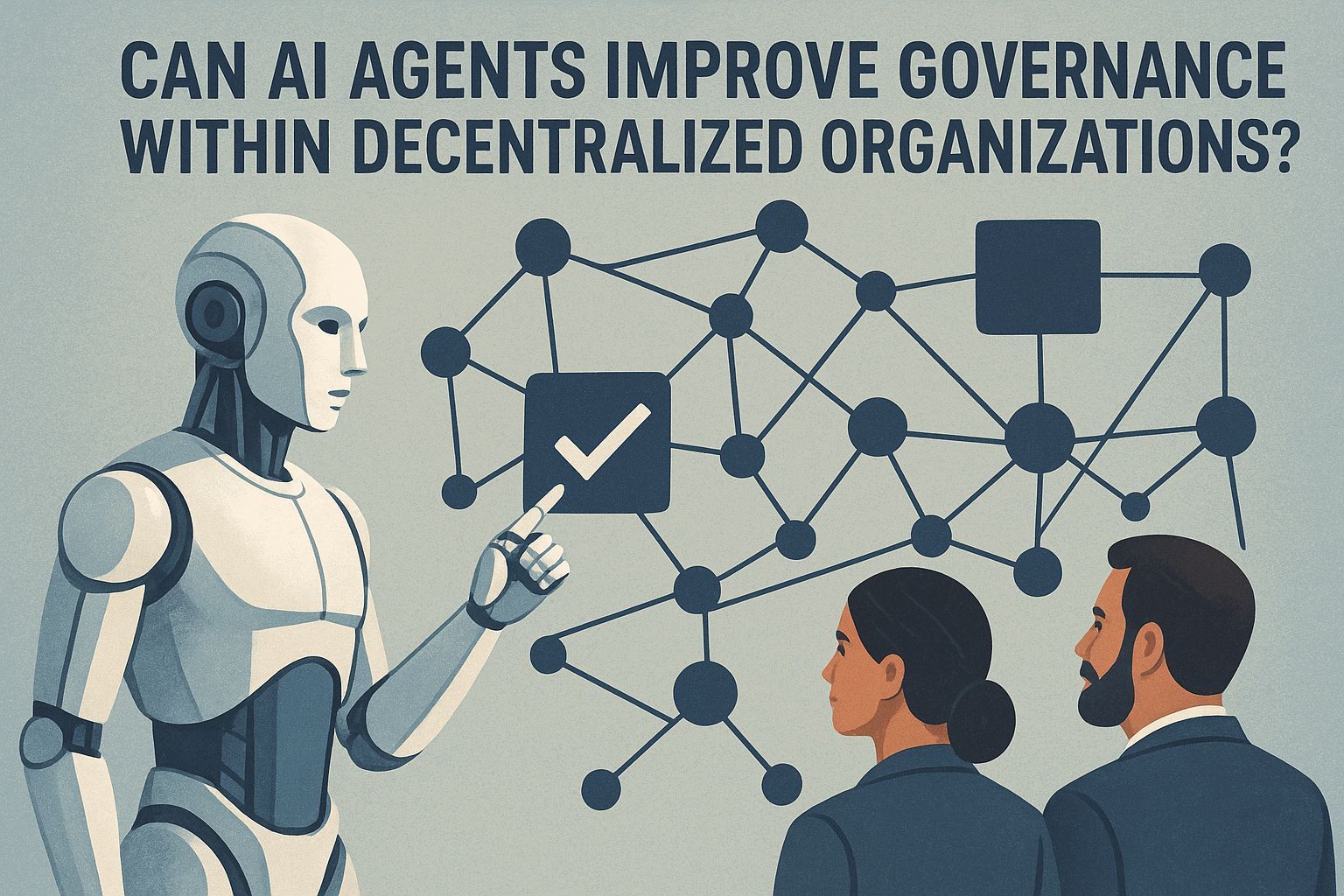
AI Agents: DAO’s New Brain Trust?
Can AI agents improve governance within decentralized organizations? Hell yeah, the sources scream it-decentralized models like DAOs are evolving from human-only clubs to AI-powered decision machines, tackling the mess of coordinating smart, autonomous agents without a boss breathing down their necks.[1][3]
Key Takeaways
- DAOs blueprint AI governance: smart contracts enforce rules, enabling agent voting and transparent logs-think self-policing bots, not chaotic free-for-alls.[1]
- Adaptive frameworks balance central standards with local tweaks, fixing real-world decentralization headaches like inconsistent accountability.[2]
- Web3 reps and federated systems let AI join the vote, boosting fairness and cutting bias in DAOs.[3]
- Challenges persist: governance gets tricky when AI runs wild in autonomous orgs, but blockchain’s the fix.[5][6]
Subscribe to our Social Media for Exclusive Crypto News and Insights 24/7!
Picture this: traditional top-down control? It’s toast when AI agents start acting, learning, and teaming up sans humans. Centralized setups just can’t hack it-too slow, too brittle. Enter blockchain-fueled DAOs, where AI agents don’t just follow orders; they vote, coordinate, and log every move on-chain for all to see.[1] You’ve seen DAOs fumble with voter apathy, right? Now imagine agents filling those gaps, reaching consensus faster than a bull run.
DAOs: From Human Huddles to Agent Armies
DAOs were built for us fleshy types-smart contracts divvy up decisions, bylaws hardcoded, everything transparent. But swap humans for AI agents? Game-changer. They handle multi-agent coordination, voting on ops like pros, all while sticking to the code. Arion Research nails it: “DAOs enable multi-agent coordination and voting for decisions, allowing agent networks to reach consensus on operational questions.”[1] No more endless Discord debates. Agents execute, log, accountable. Brutal efficiency.
Ever wonder why DeSci DAOs are buzzing? They’re funding research with AI assistants sharing data seamlessly. It’s not hype-it’s governance scaling for distributed intelligence.[1] Honestly, that shift caught the old guard off guard, like BTC faking out at resistance one too many times.
Beyond DAOs: Federated Smarts and Web3 Reps
Don’t stop at DAOs. Federated governance? Cross-org protocols where rivals agree on AI ethics, enforced decentralized. Wild, huh? Then Web3 layers in reputation tokens and validation pools-real-time consensus via Weighted Directed Acyclic Graphs (WDAGs). Stanford’s take: “Web3 systems… facilitate a dynamic feedback loop, where AI behaviors are continually monitored and influenced by decentralized consensus.”[3] AI even joins DAO governance, purging biases with formal logic. Power to the pure code, fam.
Challenges? Yeah, they’re real. arXiv’s case study on Responsible AI (RAI) in decentralized orgs spots four killers: group guidance clashing with local spins, principles not operationalizing, regional variations, sloppy accountability.[2] Their fix? ARGO Framework-shared standards, advisory hubs, local flex. Authors like Kiana Jafari Meimandi push modular setups: “balancing central coordination with local autonomy.”[2] Smart. No speculation; this is academic-industry collab gold.
Real-World Kinks: AI in the Trenches
Not all roses. AISnet flags governance challenges of AI-enabled DAOs-key hurdles screaming for research, like corralling agent autonomy without central chokeholds.[5] Informs echoes: decentralization limits old-school IT control, pushing new props for tech production governance.[6] And that PMC mango sim? Quirky micro-story-AI via federated learning (FL) predicts ripeness, smart contracts vote global model updates. Decentralized, serverless, ethical AF. “Ensuring responsible AI use… builds public trust.”[4] Imagine holding through a model’s “crash”-brutal, but it teaches: vote wisely, or eat rotten fruit.
The Road: Scalable, Ethical Agent Swarms
Whales ain’t sleeping; they’re building. Sources converge: we need governance as adaptive as the agents. No yesterday’s tools-decentralized fabrics where agents self-govern, accountable on immutable chains.[1][3] Reflective bit: You’ve seen this before, right? Centralized fails, decentralized rises-like ETH swan-diving then basing forever.
- https://www.arionresearch.com/blog/kmg8kmml28ttqi4i1q0dok7cs1slhv
- https://arxiv.org/abs/2510.03368
- https://stanford-jblp.pubpub.org/pub/aigov-via-web3
- https://pmc.ncbi.nlm.nih.gov/articles/PMC9979213/
- https://aisel.aisnet.org/cgi/viewcontent.cgi?article=1084&context=icis2022
- https://pubsonline.informs.org/doi/10.1287/isre.2023.0588