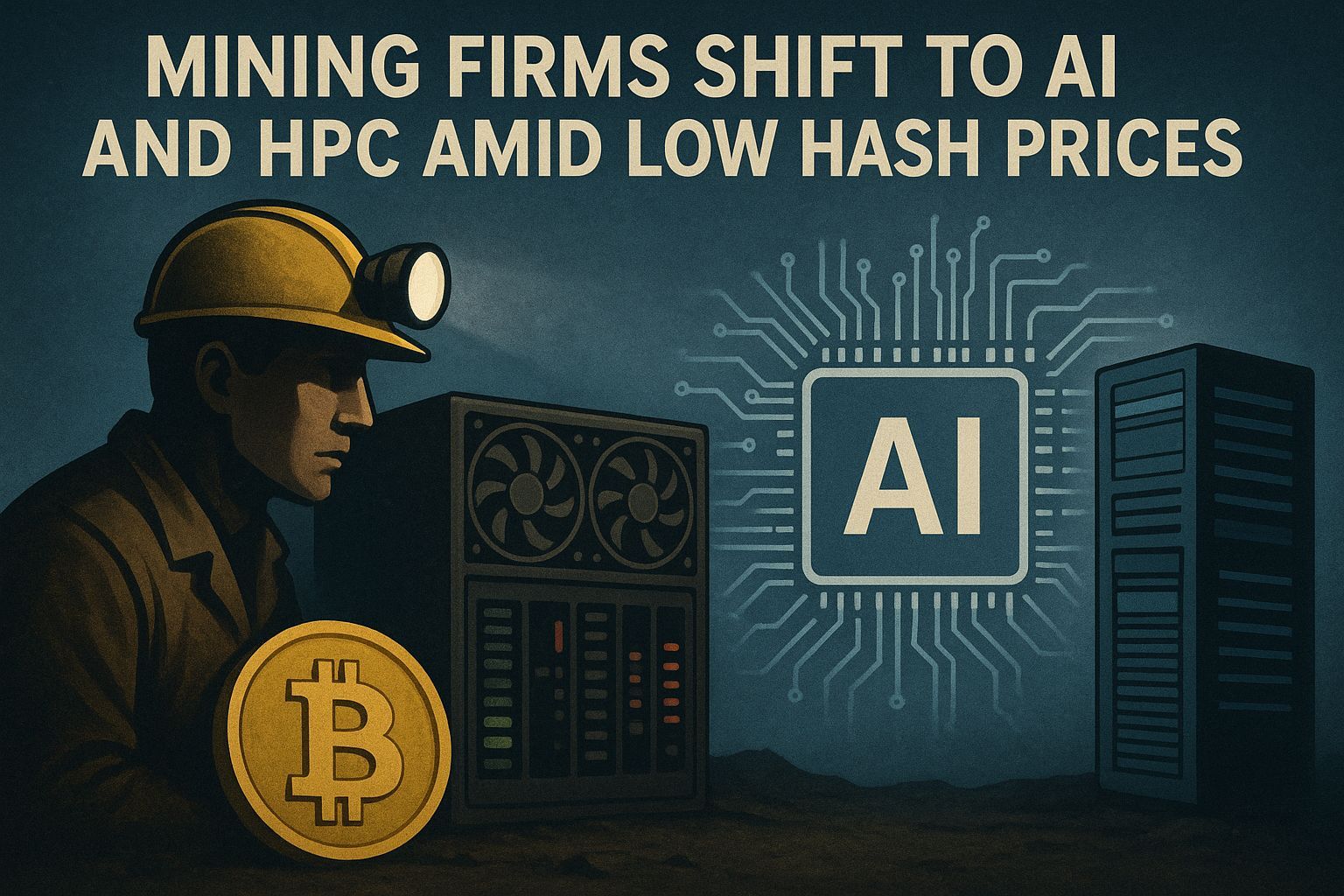
Bitcoin Miners Aren’t Mining Anymore-They’re Becoming AI Infrastructure Providers
When Hash Prices Squeeze, Diversification Becomes Survival
The Bitcoin mining industry is undergoing a fundamental transformation. What started as experimental side projects in 2022 has evolved into a core business strategy by early 2026, as miners face mounting pressure from compressed hashprices and discover that their real asset isn’t hash power-it’s power itself[3]. Publicly traded Bitcoin miners are no longer positioning themselves as digital asset companies. They’re rebranding as digital infrastructure providers, leveraging their existing power access, cooling systems, and land to capture a piece of the AI boom[3].
This isn’t hype. This is capital reallocation at scale.
Subscribe to our Social Media for Exclusive Crypto News and Insights 24/7!
Key Takeaways
- Execution is accelerating: In 2024, only one public miner (Core Scientific) had secured a hyperscaler agreement. By 2025, that number jumped to five[4]. We’re watching a shift from speculation to contracts with Google and Microsoft[2].
- Revenue visibility improves in 2026: HPC/AI revenue contribution remained limited through 2025, but meaningful revenue ramps are expected to begin in 2026 and beyond, driven by phased infrastructure rollouts[4].
- The business model is inverting: For companies like IREN and TeraWulf, Bitcoin mining is no longer the main event-HPC development pipelines are now almost entirely focused on AI infrastructure[4].
- Institutional validation is real: Hedge funds (Citadel, Oaktree, Vanguard) and investment banks (JPMorgan, Goldman Sachs) are backing these pivots with non-dilutive financing at loan-to-cost ratios reaching 85%, enabled by hyperscaler financial guarantees[5].
Why Miners Had to Pivot (And Why Now)
Let’s be honest-Bitcoin mining margins got crushed. The “hashprice squeeze” left traditional mining operations fighting for profitability[7]. Nick Hansen, CEO of the Luxor mining pool, put it bluntly: “resisting the urge to transition to AI” will be Bitcoin miners’ biggest challenge in 2026[2]. And he’s right. The math is hard to ignore.
Here’s the thing: miners already own what AI infrastructure needs most. Permitted land. High-voltage power interconnections. Water access for liquid cooling. Instead of letting that infrastructure sit idle during bear markets, why not rent it to companies training AI models[3]?
The demand metrics are staggering. According to McKinsey analysis cited in the sources, demand for AI-ready data center capacity is projected to grow at an average annual rate of 33% per year between 2023 and 2030[6]. By 2030, nearly 70% of all data center demand will be driven by AI workloads. Global investment in AI-capable data centers reached $24.6 billion in 2023 and is expected to nearly double to $47.7 billion by 2029[6].
That’s the runway. Miners are simply taxiing into position.
The Execution Game: Who’s Actually Doing It
HIVE Digital Technologies was the earliest serious mover, pivoting toward HPC in 2022 and reporting HPC-related revenue in 2023[3]. Fast forward to February 5, 2026: HIVE achieved 290% year-over-year hashrate growth, reaching 25 EH/s[1][5]. The company targets 6,000 next-generation GPUs operational by year-end 2026, with total renewable capacity reaching 540 MW after its Paraguay Phase 3 expansion[1][5]. The company’s partnership with Bell Canada for “Sovereign AI” offers something competitors can’t easily replicate-a credible niche market[1].
But HIVE isn’t alone anymore.
Top miners Terawulf, IREN, and Cipher Mining have signed multi-year HPC contracts with Google and Microsoft[2]. These aren’t handshake deals-they’re institutional relationships with phased infrastructure rollouts designed to ramp revenue significantly in 2026[4].
Core Scientific was the pioneer here, securing the first hyperscaler agreement back in 2024. Hut 8 is now operating a $7 billion Google-backed data center partnership (with Fluidstack and Anthropic), deploying over 1,000 Nvidia H100 GPUs to serve AI clients[8]. Asher Genoot, Hut 8’s CEO, articulated the thesis perfectly: “Scaling frontier AI infrastructure is, at its core, a power challenge. Hut 8’s power-first, innovation-driven development model enables us to originate and develop greenfield data center sites at the pace and scale required by leading model developers”[8].
You’re seeing MARA Holdings, Riot Platforms, and Bitfarms following suit. Some, like Bitfarms, have gone further-signaling that Bitcoin mining itself may be wound down over time[4].
The Credit Unlock Nobody’s Talking About

Here’s where institutional investors really got interested. The old Bitcoin mining business model had a credit problem. Banks were skeptical. Volatility was priced in. Risk premiums were brutal.
Enter the hyperscaler guarantee.
The mechanism is elegant: industry giants like Google and Microsoft provide financial guarantees for lease payments, effectively bridging the credit gap previously associated with mining entities[5]. That guarantee unlocked the vault. Top-tier investment banks-JPMorgan, Goldman Sachs-suddenly had a reason to finance these projects. Loan-to-cost ratios reached 85%, a level you’d see financing traditional infrastructure, not crypto-adjacent businesses[5].
This validation loop has cascading effects. Hedge funds, private equity firms (Citadel, Oaktree, Vanguard)-institutions that once treated mining with skepticism-are now significantly increasing their stakes[5].
The institutional landscape shifted from skepticism to credit-driven validation. That’s a massive rerating.
The Geographic Rebalancing (And Why It Matters)
Here’s something subtle happening underneath the headlines: mining is moving.
While AI data centers are competing ferociously for the best power sites in mature markets-especially North America-Bitcoin miners are being pushed toward places with stranded energy, flared gas, and smaller or off-grid power sources[4]. Paraguay, Ethiopia, Scandinavia. Places where a mining load that once sat on a hyperscale campus in Texas might reappear as modular containers.
Why? Because those environments favor flexibility over scale. Bitcoin mining fleets will still contribute to network security, but with very different economics and risk profiles[4]. HIVE’s Paraguay Phase 3 expansion is a case study in this strategy.
This shift has profound implications. Miners with vast contiguous land and high-voltage interconnections-think Riot Platforms (1.7 GW) and Iris Energy (3 GW)-hold assets that hyperscale providers desperately need[5]. These companies can bypass the lengthy 5-7 year waiting period for new utility substations, becoming de facto infrastructure partners overnight.
The Reality Check: What’s Actually Hard
Don’t let the narrative get too clean. Transitioning from Bitcoin mining to AI infrastructure isn’t a flip-the-switch operation.
AI HPC data centers have different requirements. Liquid cooling needs abundant water. High-speed, low-latency connectivity demands dark fiber. Uptime standards hover around 99.999%-mission-critical reliability that’s different from mining’s tolerance bands[6]. These demands stem from the fact that AI model training is computation- and data-intensive, making uninterrupted performance and reliable data throughput non-negotiable[6].
It’s still “very difficult to balance [both mining and high-performance computing],” according to industry voices[2].
Yet miners are uniquely positioned despite these barriers. They’ve already solved the hard part: power and cooling infrastructure at scale[6].
What to Watch in 2026
The industry had “successfully contracted” as of mid-February 2026, but operational delivery remains the final hurdle[5]. Key monitoring points:
- Construction progress on multi-billion-dollar projects like Black Pearl (CIFR) and Polaris Forge 2 (APLD) hinge entirely on reaching Ready for Service (RFS) dates by mid-2026[5]. Miss those dates, and the narrative fractures fast.
- Revenue ramp timing: Meaningful HPC/AI revenue is expected to begin in 2026 and beyond[4]. Track quarterly earnings for the first material contributions from these initiatives.
- Customer concentration risk: The hyperscale data center backstop plan provides credit but creates high customer concentration-a double-edged sword that could expose miners if a single customer pulls back[5].
- Execution cadence: Watch whether the jump from one hyperscaler agreement (2024) to five (2025) continues accelerating in 2026, or if we’ve hit a plateau.
The Bottom Line
Bitcoin miners discovered their real business wasn’t mining-it was infrastructure. Low hashprices forced the reckoning. Institutional validation and hyperscaler partnerships made the pivot credible. By 2026, the transformation from mining-first to AI-first is no longer experimental diversification. It’s where future capital is flowing[4].
The miners who execute flawlessly on these infrastructure projects will emerge stronger. The ones who can’t balance both? They’ll be pushed toward stranded energy markets or consolidated away. The industry is reshaping itself in real time, and February 2026 is when everyone’s watching to see if the pivots actually work.
- https://insights4vc.substack.com/p/bitcoin-minings-ai-pivot-2026-thesis
- https://www.dlnews.com/articles/deals/bitcoin-miners-ai-2026/
- https://www.tradingview.com/news/cointelegraph:bc9f8c5b1094b:0-bitcoin-mining-s-2026-reckoning-ai-pivots-margin-pressure-and-a-fight-to-survive/
- https://bitcoinminingstock.io/blog/the-acceleration-of-ai-hpc-integration/
- https://news.futunn.com/en/post/68795779/the-ai-transformation-of-bitcoin-mining-new-outlook-for-2026
- https://rsmus.com/insights/industries/financial-services/investor-priorities-shifted-bitcoin-mining-operations.html
- https://www.tradingkey.com/analysis/cryptocurrencies/btc/261582943-bitcoin-miners-aisolo-mining-stocks-discontinues-cloud-legit-bonus-tradingkey
- https://carboncredits.com/hut-8-pivots-from-bitcoin-to-ai-with-7b-google-backed-deal-to-power-data-centers/