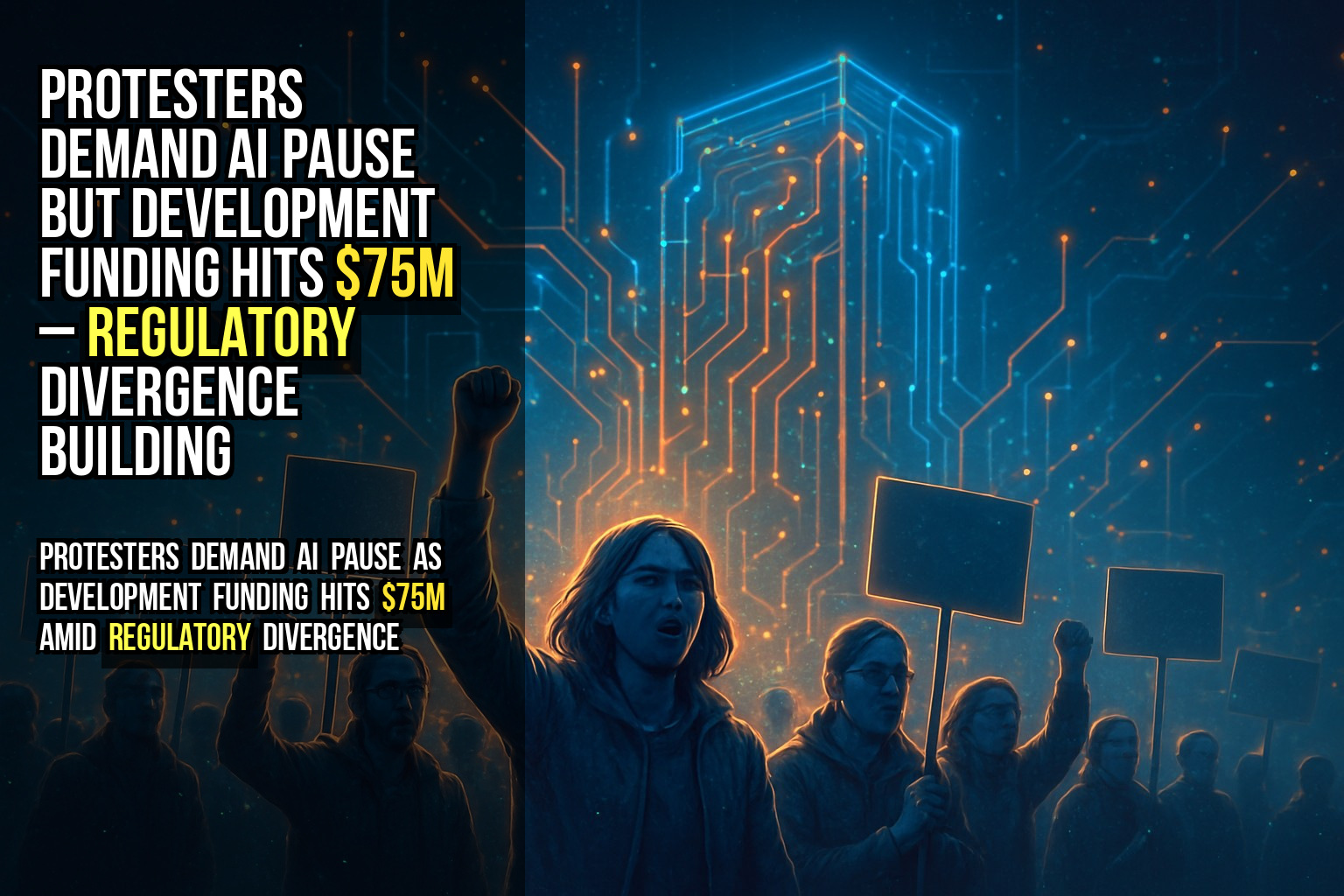
Protesters Demand AI Pause as Development Funding Hits $75M Amid Regulatory Divergence
Dozens of protesters gathered outside Anthropic, OpenAI, and xAI headquarters in San Francisco on Saturday to demand a conditional pause on frontier AI development, yet the sector simultaneously secured $75 million in new development funding as regulatory divergence between the White House and California intensifies[1][4]. This juxtaposition highlights a critical market disconnect: while civil groups urge a halt to advanced AI systems citing safety and job concerns, capital continues flowing into the sector even as the Trump administration pushes liability protections that California is actively challenging with mandatory safety protocols[1][2].
Overview: Key Metrics at a Glance
- Protest Scale: Approximately 200 activists demanded AI CEOs commit to a coordinated pause on frontier development if competitors do the same[4].
- Funding Inflow: The AI development sector secured $75 million in new capital despite public calls to halt progress[1].
- Geographic Scope: Demonstrations urging AI regulation have occurred across 13 nations, signaling global safety concerns[2].
- Federal Policy: The White House released a new AI legislative framework intended to nationalize AI policy and limit liability[1].
- State Opposition: California is challenging the federal approach by introducing mandatory AI safety protocol legislation[4].
- Corporate Targets: Protesters specifically targeted Anthropic, OpenAI, and xAI, demanding public commitments from their CEOs[1].
Subscribe to our Social Media for Exclusive Crypto News and Insights 24/7!
Regulatory Divergence: Federal Liability vs. State Safety

The regulatory landscape is fracturing into two distinct camps, creating a complex compliance environment for AI developers. The Trump administration is advancing a framework that offers Section 230-style liability protections for AI companies, effectively shielding them from certain legal claims related to their outputs[4]. This federal approach aims to accelerate innovation by reducing legal risk, aligning with the administration’s broader pro-growth economic stance.
Conversely, California is pushing a counter-narrative focused on mandatory safety protocols. State legislators are introducing legislation that would require strict safety testing and compliance measures, directly challenging the federal liability shield[4]. This divergence forces companies to navigate conflicting requirements: a federal regime that minimizes liability and a state regime that mandates rigorous safety oversight.
Analysts note that this regulatory split could fragment the AI market, forcing developers to adopt different compliance strategies based on their primary operational jurisdictions[4]. The tension between federal acceleration and state caution is likely to define the sector’s regulatory trajectory for the next 12 to 36 months.
Market Reaction: Capital Flows Despite Public Pressure

Despite the public outcry and the “Pause AI” movement gaining traction in 13 nations, market participants continue to view the sector as a high-growth opportunity[2]. The influx of $75 million in development funding demonstrates that institutional and private capital remains unconvinced by the arguments for a development halt[1].
Investors appear to prioritize the potential for technological advancement and market dominance over the risks highlighted by protesters. The funding round suggests that capital allocation is decoupled from public sentiment regarding AI safety, at least in the short term.
| Factor | Protester Demand | Market Reality |
|---|---|---|
| Development Status | Pause frontier AI | $75M new funding secured |
| Primary Concern | Safety & Job Loss | Innovation & Market Share |
| Geographic Reach | 13 Nations | Global Capital Flows |
| Regulatory View | Mandatory Safety | Liability Protections (Federal) |
Crypto Market Relevance: The AI-Blockchain Convergence
While the protests focus on general AI development, the regulatory divergence and funding surge have significant implications for the crypto market, particularly for projects focused on the AI-blockchain convergence. Decentralized AI networks and compute markets are increasingly positioning themselves as alternatives to centralized, federally protected AI giants.
The push for mandatory safety protocols in California could create a regulatory advantage for decentralized AI protocols that operate without a central corporate entity liable for Section 230-style protections. Market participants view these decentralized networks as potential hedging mechanisms against the regulatory uncertainty surrounding centralized AI firms[2].
Furthermore, the continued flow of capital into AI development, even amidst protests, suggests that the “AI narrative” remains a primary driver for speculative investment in crypto assets. Tokens related to decentralized compute, AI data verification, and machine learning infrastructure are likely to see increased attention as the regulatory battle intensifies.
Risks and Uncertainties

The primary risk to this narrative is the potential for federal intervention to override state-level safety laws, which could invalidate California’s mandatory protocols and accelerate the deployment of frontier AI regardless of protester demands. If the federal liability shield is fully enacted, it could reduce the legal pressure on companies to implement safety measures, potentially exacerbating the concerns raised by the “Stop the AI Race” group.
Additionally, there is uncertainty regarding the long-term sustainability of the $75 million funding round. If public sentiment shifts significantly toward regulation, or if a major AI safety incident occurs, capital flows could reverse rapidly. The lack of a unified global regulatory framework also means that companies may face unpredictable compliance costs as they navigate the 13 nations where demonstrations have occurred[2].
The regulatory divergence creates a “wait-and-see” environment for investors, where the outcome of the federal-state legal battle could determine the future structure of the AI industry. Until clarity emerges, the sector remains exposed to both regulatory shocks and public sentiment volatility.
Source List
- https://abc7news.com/post/sf-protesters-call-ai-pause-anthropic-openai-xai-white-house-pushes-national-framework-trump-seeks-liability-limits/18752242/
- https://www.reddit.com/r/Futurology/comments/1cw605r/why_protesters_around_the_world_are_demanding_a/
- https://www.youtube.com/watch?v=_XSf0vZ1f2o
- https://www.gadgetreview.com/sf-protesters-call-for-ai-pause-as-the-white-house-pushes-new-framework