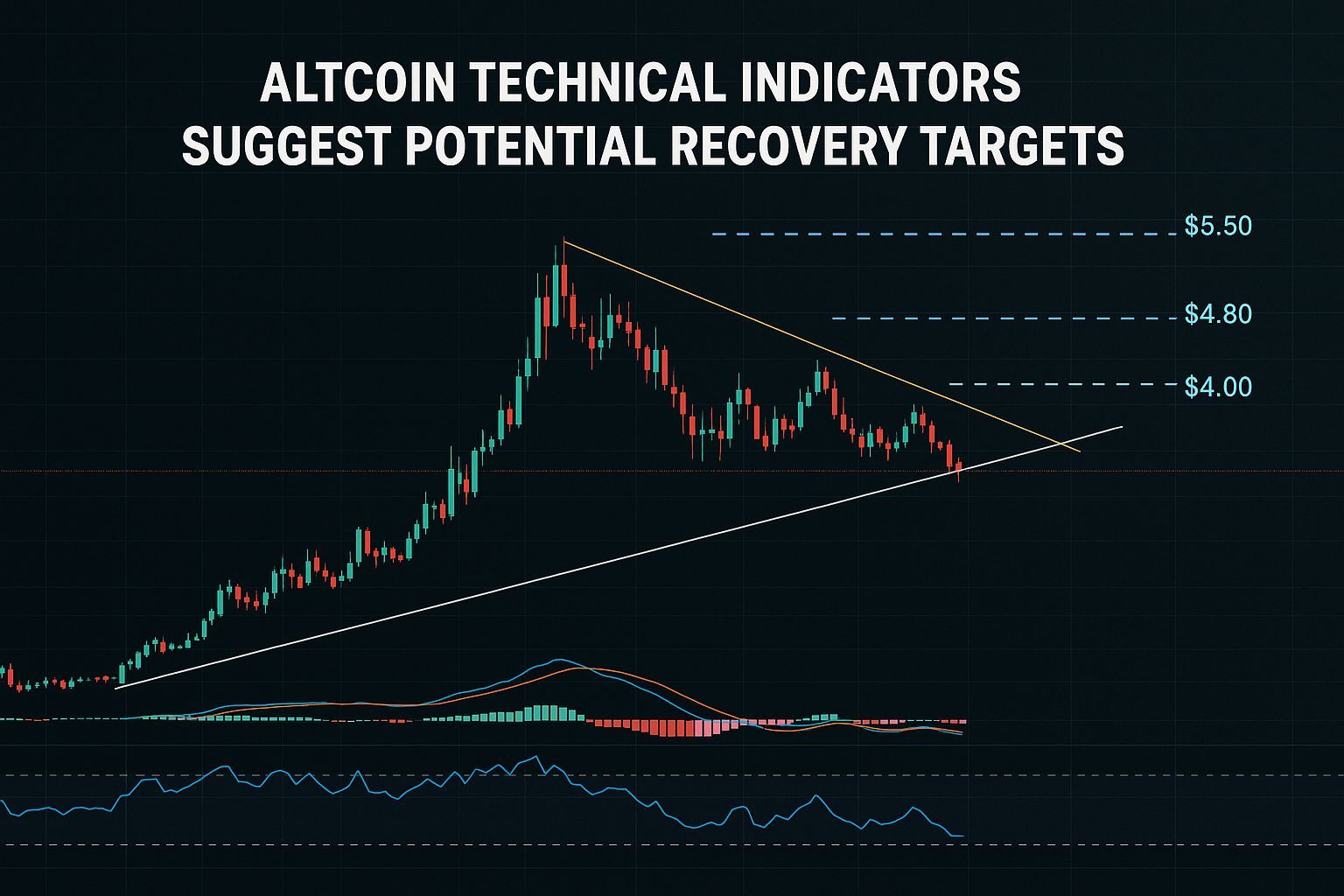
Altcoins at a Crossroads: When Technical Bottoms Meet Macro Uncertainty
The Setup: Why Early 2026 Looks Like a Potential Inflection Point (If You Squint Right)
Here’s the thing about crypto in February 2026 - altcoins are flashing some genuinely interesting technical signals, but the macro backdrop is still decidedly messy[1]. Bitcoin’s sitting around $67,000, down roughly 45-50% from its late-2025 peak of $126,000[1]. That kind of move usually shakes out weak hands and creates the conditions for what comes next. The question isn’t whether altcoins could recover - history says they will. The real question is when, and more importantly, which ones.
Let’s cut through the noise. Altcoin RSI levels are now matching the oversold extremes we saw in 2015, 2018, and 2022[3]. Every single one of those periods eventually transitioned into renewed expansion phases. The pattern’s been consistent enough that serious analysts are starting to ask if 2026 could mark an accumulation year rather than extended capitulation[3].
Subscribe to our Social Media for Exclusive Crypto News and Insights 24/7!
Key Takeaways
- Altcoin RSI indicators are hitting historical cycle lows, mirroring oversold conditions from 2015, 2018, and 2022[3]
- Bitcoin’s technical bounce potential sits at 60-70% toward $70K-$80K before any broader recovery unfolds[1]
- Exchange inflows for altcoins surged 22% in early 2026, signaling distribution and heightened sell-side pressure rather than pure accumulation[4]
- Sentiment remains bearish, but capitulation phases often precede the strongest rallies[3]
- Medium-term holders are absorbing sell pressure, suggesting fragile consolidation between $54.9K-$79K for Bitcoin[4]
The Technical Picture: What the Charts Are Actually Saying
You’ve seen this movie before, right? Bitcoin teases a breakout, fakes everyone out, then consolidates in a tight band while on-chain metrics slowly shift from panic to patience.
That’s basically where we are[4]. Bitcoin’s been range-bound between $54.9K and $79K since late January[4]. It’s not sexy. It’s not a moon-shot setup. But it’s exactly the kind of grinding, sideways action that typically precedes something bigger.
Here’s where it gets interesting for altcoins specifically. The RSI on the OTHERS index - which tracks total altcoin market cap excluding Bitcoin and Ethereum - has compressed down to levels you haven’t seen since major cycle bottoms[3]. In crypto, when RSI gets this low, it usually means two things: selling pressure has exhausted itself, and you’re near an inflection point.
But - and this is crucial - compressed RSI doesn’t guarantee immediate recovery. What it does suggest is that the downside cushion is getting thinner[3]. The market’s not bouncing yet. It’s just getting ready to potentially bounce.
The Liquidity Trap Nobody Wants to Talk About

Here’s where the story gets complicated. While altcoins are flashing oversold technicals, exchange inflows jumped 22% in early 2026, and that’s typically a red flag[4]. When traders move coins from cold storage to centralized exchanges, they’re usually preparing to sell, not accumulate. That’s distribution energy, not accumulation energy.
The broader shift? Capital’s flowing hard into Bitcoin right now[4]. Altcoin trading volumes have cratered, and we’re looking at roughly $209 billion in net selling over the past 13 months[4]. That’s the kind of structural headwind that can keep altcoins compressed even when their technical indicators say “oversold.”
Recovery Timelines: Short-Term Bounces vs. Durable Rallies

Let’s separate two things that get conflated constantly: a technical relief rally and an actual recovery.
A relief rally? That’s 60-70% probable[1]. Bitcoin poking up to $70K-$80K wouldn’t shock anyone, and altcoins would likely follow. That’s the kind of move that happens when liquidations slow, some shorts cover, and momentum traders hop back in. Could happen in weeks.
A durable recovery - where altcoins actually establish new uptrends and hold gains? That’s different. That’s 40-60% probable depending on macro conditions[1]. And that timeline’s fuzzier. Historically, post-peak Bitcoin bear markets average around 365 days[1]. Current estimates suggest potential lows could land in mid-to-late 2026, with recovery spanning 6-12 months[1].
Translation? If we’re bottoming now (mid-February), you’re looking at potential capitulation in Q2-Q3, with real recovery momentum building through Q3-Q4. The analysts who are bullish are throwing around year-end targets of $100,000-$150,000+ for Bitcoin, but that’s contingent on liquidity conditions easing and macro headwinds softening[1].
For altcoins, it’s even more dependent on that Bitcoin recovery and renewed risk appetite.
The Specific Technical Levels That Actually Matter
This is where things get granular. Different altcoins are showing different technicals, but here’s what the sources are flagging:
Arbitrum (ARB) is testing critical structure. For bulls to regain control, it needs a decisive daily close above $0.1447 to signal a broader trend reversal, targeting $0.1758[2]. Below that? Downside risk pushes toward $0.0944[2]. Classic breakdown-or-breakout setup.
Injective (INJ) is sitting at a 0.236 support level around $3.036[2]. If that breaks on a daily close, continuation toward $2.650 becomes probable, with potential extension to $2.500 if bearish momentum builds[2]. The catch? INJ’s got a 0.98 correlation with Bitcoin[2], meaning it’s going to mirror BTC weakness almost perfectly. No independence there.
For bulls to regain control on INJ, you need acceptance above $3.662 to confirm a structural shift, opening targets at $3.937 and $4.287[2].
Broader pattern: These altcoins aren’t showing bottom signals yet. They’re showing vulnerable technical structures where breakdown’s possible but upside’s also available if Bitcoin stabilizes[2].
Why the Sentiment Shift Matters More Than You Think
Here’s something that doesn’t get enough attention. Crypto bottoms aren’t built on optimism. They’re built on capitulation and disbelief[3]. Right now, sentiment is decidedly bearish[3], and honestly, that’s actually constructive for a potential bottom.
Think about 2022. Everyone was convinced crypto was done. Influencers were deleting their profiles. Regulatory FUD was at a crescendo. Then, quietly, the best opportunities started forming. Same script in 2015 and 2018[3].
The analysts who are watching this closest are pointing out that disbelief and pessimism were common before earlier altcoin expansions[3]. When fear dominates and participation dries up, that’s often when smart money starts rotating. It’s not telegraphed. It’s not obvious. It whispers first.
Right now, the whispers are: RSI’s at cycle lows. Volatility’s compressing. Medium-term holders are absorbing selling without panic[4]. These aren’t fireworks. But they’re the dry kindling before the match gets struck.
The Risk That Nobody’s Pricing In
Here’s the uncomfortable truth: downturns can persist longer than expected[3]. Capitulation phases often include extended consolidation before a durable uptrend actually begins[3]. So even if we’re at a technical bottom right now, that doesn’t mean you’re immediately rich.
You could see altcoins consolidate sideways for another 6-8 weeks. New lows could still print. Bitcoin could test $50K if macro conditions deteriorate. It happens[1].
Plus, there’s the macro overlay. Broader factors like liquidity conditions, macroeconomic trends, and regulatory developments continue to influence digital asset prices[3]. A surprise Fed pivot could accelerate recovery. A banking crisis could crush it. Regulatory headlines? They can shift sentiment overnight.
The difference between a recovery that starts in March versus one that starts in July is enormous for your portfolio. Timing beats being right on direction.
The Bottom Line: Not Yet, But Getting Close
Altcoin technical indicators are flashing oversold conditions that historically precede recoveries, but macro headwinds and exchange inflow surge suggest we’re not quite at liftoff yet[1][3][4].
Short-term bounce potential is elevated. You could easily see a 10-15% relief rally in Bitcoin and a corresponding pop in altcoins in the coming weeks[1]. But a sustainable recovery? That requires multiple dominoes to fall in sequence: liquidity conditions to ease, macro tightening to reverse, institutional demand to return[1].
The smart play isn’t trying to catch the exact bottom. The smart play is recognizing that we’re close to inflection points on the technical side, even if the macro backdrop hasn’t fully cooperated yet. When those two things finally align - technical recovery + macro easing - that’s when the real move happens. And if history rhymes, 2026 could mark another accumulation phase before the next expansion cycle[1].
For now? Monitor those support levels. Watch the RSI for confirmation of reversals. And remember: the best altcoin purchases happen when everyone’s scared, not when everyone’s excited. We’re getting closer to that environment.