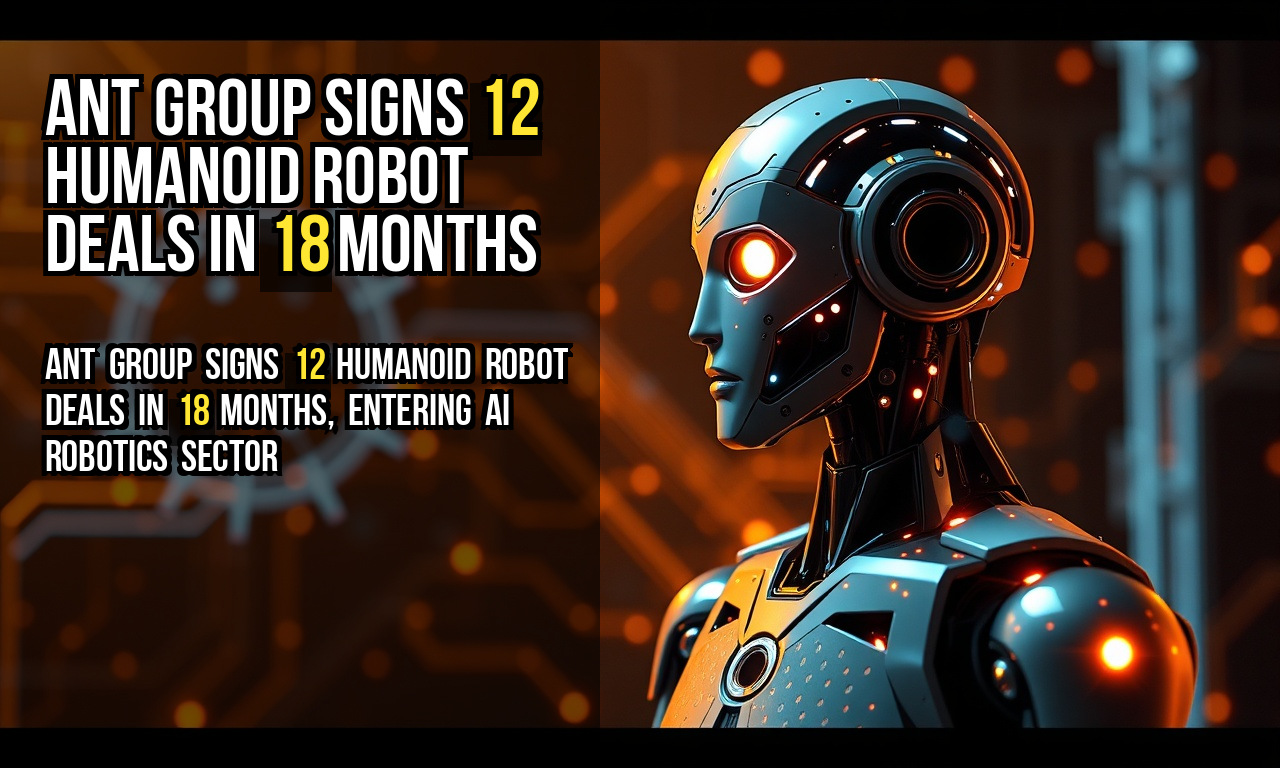
Ant Group Signs 12 Humanoid Robot Deals in 18 Months, Entering AI Robotics Sector
Chinese fintech giant Ant Group, the affiliate of Alibaba (NYSE:BABA), has officially secured 12 strategic deals in the humanoid robotics sector over the past 18 months, marking a decisive pivot from digital finance to embodied intelligence. This rapid expansion places Ant Group among the most aggressive Chinese tech firms entering the booming humanoid robot market, a sector projected to reshape global labor dynamics and industrial automation. The company unveiled its first humanoid robot, the Robbyant R1, and confirmed these deals are facilitated through its subsidiary, Shanghai Ant Lingbo Technology, which registered with 100 million yuan ($13.73 million) at the end of 2024 [1], [6].
The move is not merely theoretical; Ant Group is currently trialing the R1 robot in community care centers and restaurant environments in Shanghai, addressing safety concerns before any commercial price announcement [4]. Analysts note that this 12-deal volume in such a short timeframe signals a coordinated effort to build a “humanoid workforce” for China’s healthcare and domestic service sectors, directly addressing the country’s aging demographic challenges [3], [5].
Key Metrics: Ant Group’s Robotics Pivot
Subscribe to our Social Media for Exclusive Crypto News and Insights 24/7!
- Deal Volume → 12 strategic agreements secured → Indicates rapid market penetration and vendor consolidation within 18 months [1].
- Subsidiary Capital → 100 million yuan ($13.73 million) registered → Provides verified financial backing for the Shanghai Ant Lingbo Technology venture [6].
- Robot Model → Robbyant R1 unveiled → First proprietary humanoid robot now in testing phase for community care and service applications [4].
- Timeline → 18-month execution window → Demonstrates accelerated development cycle compared to traditional hardware firms [1].
- Job Openings → Roles for embodied intelligence systems → Confirms active recruitment for AI and robotics engineering through subsidiary [2], [8].
- Future Scope → Companion and caregiver robots → Long-term roadmap targets healthcare and domestic domestic settings [4].
Strategic Entry into the Humanoid Market

Ant Group’s entry is characterized by a hybrid approach blending financial technology infrastructure with physical robotics. The company has partnered with leading hardware manufacturers, including a notable joint venture with AgiBot focused specifically on AI and robotics integration, launched in late 2025 [7]. This partnership allows Ant Group to leverage existing AI capabilities while bypassing the lengthy process of building mechanical hardware from scratch.
The 12 deals likely encompass supply chain agreements, software licensing, and joint development contracts. Market participants view this strategy as a way to rapidly scale operations without the capital intensity of traditional manufacturing. Data suggests that Ant Group is positioning itself as an integrator rather than a pure hardware producer, focusing on the “intelligence” layer that drives robot behavior [3].
Testing Phase and Commercial Roadmap

The Robbyant R1 is currently in a rigorous testing phase. The company has not yet announced a commercial price, citing ongoing safety validations in real-world environments like restaurants and care centers [4]. This cautious approach reflects the high regulatory and safety standards required for humanoid robots entering public spaces.
Robbyant R1 Development Status
| Feature | Current Status | Future Objective |
|---|---|---|
| Deployment | Testing in Shanghai care centers/restaurants | Public commercial launch |
| Pricing | Unannounced (Safety focus) | Market-competitive rate |
| Application | Community care, service tasks | Companion, caregiver roles |
| AI Integration | Active trialing | Full autonomous operation |
The long-term plan explicitly targets the development of companion and caregiver robots for healthcare and domestic settings [4]. This aligns with China’s national strategy to mitigate the impact of a shrinking workforce and aging population. Analysts note that the success of this rollout could define the standard for social robots in the Asian market [3].
Crypto and Market Structure Implications

While Ant Group is a non-crypto entity, its massive entry into the robotics sector has significant implications for the broader digital asset market and blockchain infrastructure. The integration of AI and robotics often requires secure, decentralized data layering and automated payment systems, which are core use cases for blockchain technology.
Data suggests that the robotics sector is increasingly exploring decentralized autonomous organization (DAO) structures for managing robot fleets and energy grids. If Ant Group adopts blockchain for its supply chain or robot payment networks, it could spur increased institutional adoption of crypto rails in hardware industries. Furthermore, the capital flowing into robotics from traditional tech giants like Ant Group may indirectly impact the liquidity available for AI-focused crypto projects and tokenized real-world asset (RWA) protocols.
Investors in the crypto space may view this as a signal that the convergence of AI, robotics, and finance is accelerating. This convergence often leads to the development of new tokenomic models where robots earn revenue and pay for maintenance autonomously, a concept increasingly popular in decentralized AI protocols.
Risks and Uncertainties
Despite the rapid deal signing, significant risks remain. The testing phase has not yet yielded a commercial price, creating uncertainty regarding the robot’s cost competitiveness [4]. Additionally, the safety of humanoid robots in public spaces remains a critical regulatory hurdle that could delay mass adoption.
There is also uncertainty regarding the specific nature of the 12 deals. While the volume is high, the depth of each partnership-whether strategic joint ventures or minor supply contracts-remains unverified. Market participants caution that deal volume does not always equate to successful market penetration if the technology fails to meet safety standards [6].
Furthermore, the registered capital of 100 million yuan is substantial but may be insufficient for the massive capital intensity required to scale hardware production globally without further financing rounds [6].
Outlook
Ant Group’s signing of 12 humanoid robot deals in 18 months represents a structural shift in the Chinese tech landscape, moving from pure digital finance to embodied AI. The company’s focus on community care and domestic services positions it to address critical demographic challenges, provided it can navigate safety regulations and commercial pricing. As the testing phase progresses, the sector will watch closely for the Robbyant R1’s commercial launch, which could serve as a benchmark for the integration of fintech giants into the physical robotics industry.
Source List
[1] https://www.cnbc.com/2026/07/01/alibaba-affiliate-ant-group-enters-the-humanoid-robot-market-with-12-deals.html[2] https://humanoid.guide/product/robbyant-r1/
[3] https://www.scmp.com/tech/big-tech/article/3299389/ant-group-enters-ai-robotics-sector-build-chinas-humanoid-workforce
[4] https://enterpriseai.economictimes.indiatimes.com/news/industry/jack-mas-ant-group-unveils-r1-humanoid-robot-with-advanced-ai-capabilities-in-shanghai/123850188
[5] https://www.businesstimes.com.sg/companies-markets/telcos-media-tech/ant-group-enters-chinas-growing-humanoid-robot-industry-amid-rising-tech-interest
[6] https://www.investing.com/news/company-news/ant-group-ventures-into-humanoid-robot-industry-93CH-3876551
[7] https://technode.com/2025/11/11/agibot-and-ant-group-launch-joint-venture-focused-on-ai-and-robotics/
[8] https://technode.com/2025/02/20/ant-group-hires-for-development-of-embodied-intelligence-humanoid-robots/