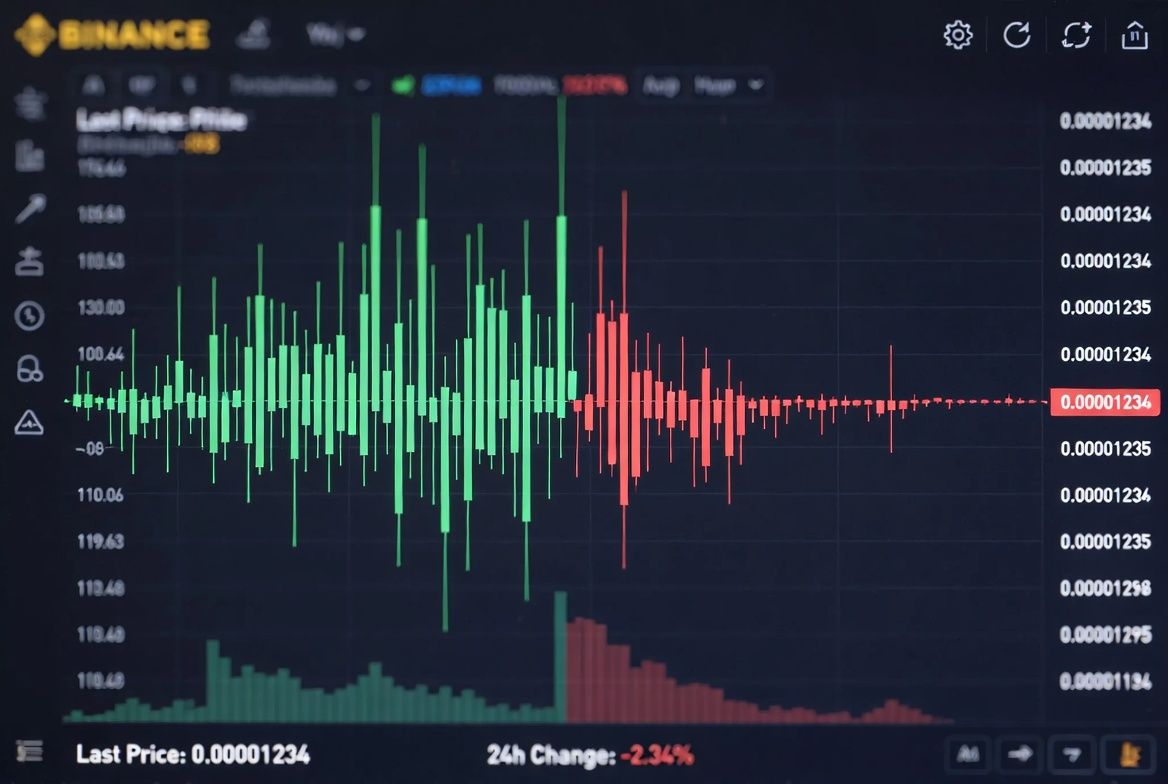
Liquidity Imbalance on Binance: When the Order Book Tells You Where Price Really Wants to Go
The Hidden Language of Bid-Ask Asymmetry
Binance’s order book depth isn’t just another chart indicator-it’s a window into institutional positioning and the invisible forces pushing price around. Bid depth imbalance, the gap between passive demand (bids) and passive supply (asks) within a specified price range, reveals something most retail traders miss: liquidity doesn’t stay put. It clusters, disperses, and telegraphs directional moves before they happen. Right now, crypto markets are showing us exactly how volatile this liquidity landscape has become.
Here’s the thing: when you’ve got significantly more bids stacked at various price levels than asks-or vice versa-you’re looking at an imbalance that can either cushion price drops or enable explosive rallies. The catch? This indicator doesn’t predict direction; it shows you where the structural support and resistance actually live.[1]
Key Takeaways
- Order book depth delta compares passive demand (bids) against passive supply (asks)-revealing liquidity imbalances that signal where price encounters friction or finds runway[1]
- Binance Spot maintains the deepest liquidity across major exchanges, with $109.5M in current depth but facing a 9.9% contraction over the past week[2]
- Temporal patterns create an 87% variation in available liquidity throughout the day, meaning execution quality swings wildly depending on when you trade[3]
- BTC and ETH currently show neutral 50/50 bid-ask splits, indicating market makers aren’t positioning directionally-a sign of cautious consolidation[2]
- SOL is showing ask-heavy imbalance consistent with price weakness, contrasting the steadier positioning in larger-cap assets[2]
The Binance Depth Snapshot: What’s Actually Happening Right Now
Let’s cut through the noise. Binance Spot currently holds roughly $109.5M in order book depth across major pairs[2]. But here’s where it gets interesting-that figure dropped 9.9% over the last week. Bybit’s sitting at $64.9M (down 7.5%), and OKEx at $49.0M (down 14.7%). Cross-venue liquidity contraction? That’s crypto-speak for “market makers are getting cautious.”[2]
The bid-ask split on Binance right now? 55.6% bid-heavy, 44.4% ask-heavy[2]. Compare that to Bybit’s 50.2% split, and you’re seeing regional liquidity patterns emerge. BTC and ETH are showing relatively balanced distributions around 50/50[2], which tells you institutional players aren’t crowding one side. They’re sitting on their hands. Consolidation mode.
Subscribe to our Social Media for Exclusive Crypto News and Insights 24/7!
But SOL? It’s ask-heavy, matching the asset’s recent price weakness[2]. When you see that imbalance-more sell pressure queued up than buy pressure-it usually precedes further downside, especially in alt seasons when conviction hasn’t returned.
Why Depth Matters More Than You Think
Think of order book depth like this: a thick book = many orders = high liquidity = harder to move price. A thin book = fewer orders = low liquidity = easier to move price.[1] It’s mechanical.
Here’s a practical example from the data: when there’s 200 more bids than asks within a specific depth range-say 0% to 10% around mid-price-you’ve got what’s called depth delta of +200[1]. That’s directional imbalance. Markets spend nearly twice as much time in extreme bid states (16.7%) as extreme ask states (9.0%), which aligns with crypto’s overall bullish drift but also suggests systematic accumulation pressure, particularly during US trading hours[3].
The real story emerges when you layer in temporal patterns. At 11:00 UTC on any given day, Binance’s BTC/FDUSD pair shows approximately $3.86M in liquidity within 10 basis points of mid-price. Fast forward to 21:00 UTC-just ten hours later-and you’re looking at $2.71M, a 42% reduction[3]. Same asset. Same day. Fundamentally different trading conditions.
This isn’t random. The first 12 hours of the trading day average a +1.54% imbalance. The second 12 hours? That doubles to +3.18%[3]. What’s happening? Early-session selling pressure gradually morphs into late-session accumulation. Whales ain’t sleeping, fam. They’re rotating.
The Imbalance That Signals Reversals

One analyst using this indicator focused on spotting reversals in BTC, preferring a 25% depth threshold as a strong signal[1]. When significant order book imbalances paired with large filtered-out limit orders, they marked tops and bottoms with reasonable consistency. Not perfect-nothing is-but meaningful.
Here’s the psychological component: markets spend way more time in extreme bid states during US hours (average +0.73% imbalance) versus Asia (+0.32%) or Europe (+0.30%)[3]. That’s institutional money waking up and starting to accumulate. You’ve seen this before, right? BTC teasing a breakout, then faking out, then finally breaking through once the US session kicks into gear.
Right now, watch for depth expansion above $650M in BTC as a returning institutional liquidity confirmation[2]. If bid-ask asymmetry exceeds 55/45 across major pairs, that’s a signal directional flow is developing[2]. We’re not there yet. We’re in the “adequate liquidity conditions with neutral positioning” regime[2]-basically, the market’s infrastructure supports range-bound trading, not directional moves.
The Liquidity Contraction Story Nobody’s Talking About
Here’s what’s actually concerning: cross-venue liquidity is contracting ahead of macro events[2]. Binance down 9.9%. Bybit down 7.5%. OKEx down nearly 15%. Market makers are pulling back. When they pull back, execution slippage increases, volatility can spike unexpectedly, and retail traders get caught holding bags.
The 2026 narrative around crypto liquidity isn’t just about order books-it’s about institutional conviction. Morgan Stanley filed for Bitcoin and Solana trusts, signaling a new phase of Wall Street competition[6]. But here’s the twist: the crypto market’s reaction to that news was muted. Why? Because the market was pricing in “liquidity expansion” but only received “liquidity preservation.”[6] The MicroStrategy MSCI inclusion drama perfectly encapsulates this: fear of forced selling from index removal had everyone on edge. When MSCI suspended the exclusion threat, MSTR rebounded 6% after-hours[6]. But the broader crypto market yawned. That’s the market telling you: liquidity might be returning, but conviction isn’t fully there yet.
Volatility Patterns: The 87% Liquidity Variation Problem
Here’s a mind-bending statistic: market depth exhibits systematic temporal patterns creating an 87% variation in available liquidity[3]. That’s not a rounding error. That’s a chasm. What this means: trying to execute a large order at 3:00 AM UTC is wildly different from executing at noon. The heatmap data reveals when BTC-FDUSD offers optimal execution conditions and when traders face poor liquidity[3].
Imagine holding SOL through that crash back in 2023. The traders who dumped at peak imbalance got slaughtered on slippage. The ones who waited for Binance depth to recover and bid-ask spreads to normalize? They got out with half their hair intact. Timing the liquidity clock matters.
Forward Signals: What’s Next for Imbalance?
Watch for three things:
- Depth expansion above $650M in BTC-that signals returning institutional liquidity[2]
- Bid-ask asymmetry exceeding 55/45-that signals directional flow developing[2]
- SOL’s ask-heavy imbalance reversing-that’s your signal alt conviction is returning[2]
Right now, we’re in consolidation. BTC and ETH are balanced. The liquidity environment is “adequate” but cautious. If macro clarity emerges-and honestly, with all the noise around rate policy and sovereign crypto reserves, clarity’s in short supply-you’ll see depth expansion, asymmetry develop, and the order book will tip one direction decisively.
The current regime supports range-bound trading without crowding warnings[2]. That means there’s still room for positioning before the next directional move. But it also means execution conditions will remain choppy until the bid-ask imbalance tips decisively one way.
Sources
- https://www.binance.com/en-NG/square/post/289656760064322
- https://blog.amberdata.io/institutional-crypto-flows-2026-market-analysis
- https://blog.amberdata.io/the-rhythm-of-liquidity-temporal-patterns-in-market-depth
- https://www.binance.com/en/square/hashtag/2026%E8%A1%8C%E6%83%85
- https://www.binance.com/en/square/post/35890130409865
- https://www.binance.com/research/analysis/weekly-market-commentary-2026-01-09
- https://coinmarketcal.com/en/news/binance-trading-data-reveals-why-bitcoin-prices-are-sliding-even-as-spot-buyers-flood-the-market-with-bids
- https://www.binance.com/en-AE/square/post/34649504571274