
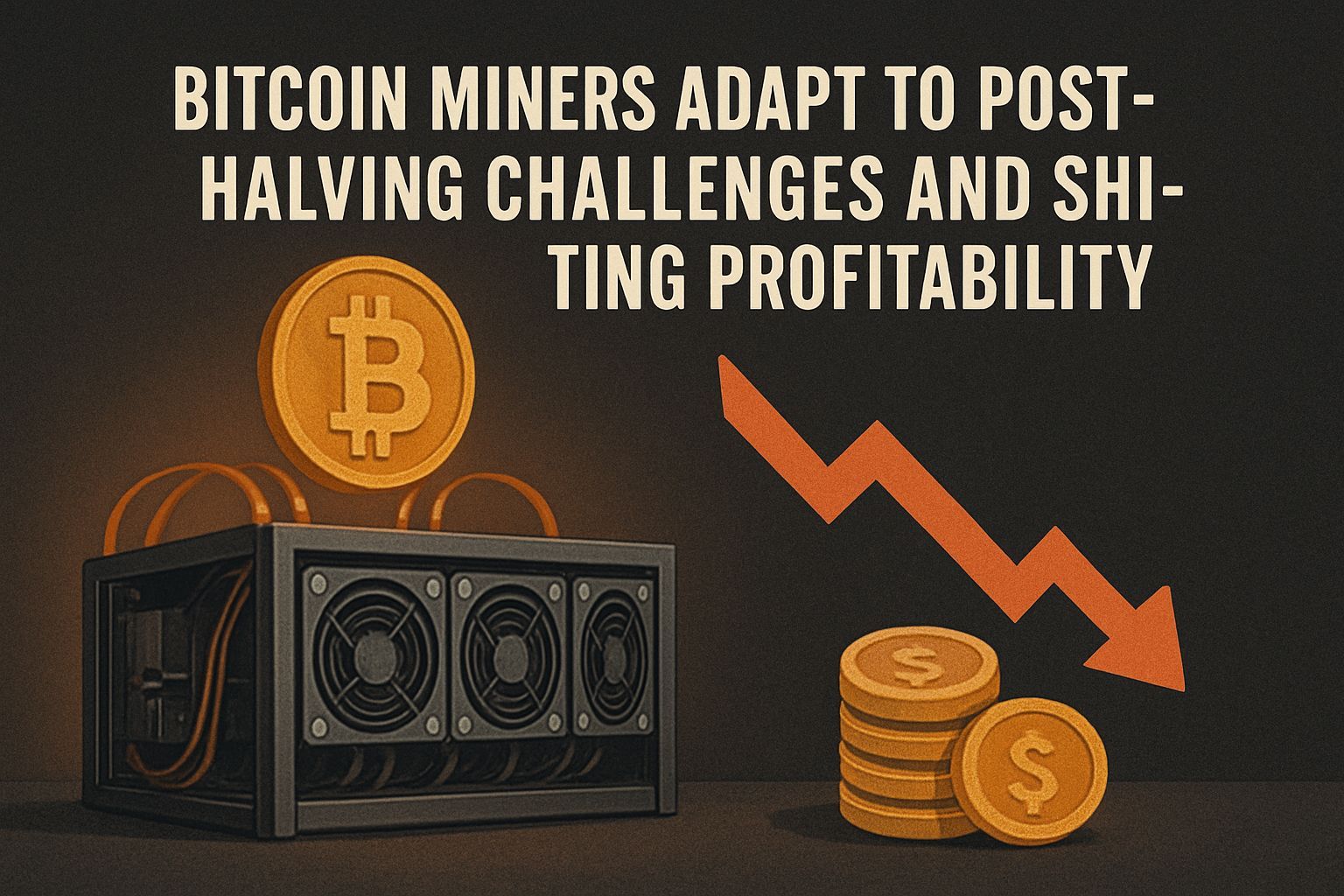
Riding the Storm: How Bitcoin Miners Are Navigating the Post-Halving Profit Squeeze
If you’ve been watching the crypto space closely, you already know how brutal the 2024 Bitcoin halving was on miners. The block rewards got slashed from 6.25 to 3.125 BTC, and suddenly, the game changed. Mining profits faced a serious squeeze while hashing power and energy costs kept climbing. In this article, we’ll unpack how Bitcoin miners are adapting to these post-halving challenges, what shifts in profitability look like, and why it ain’t just about digging coins anymore - it’s a survival game full of strategy, tech upgrades, and market maneuvers.
Key Takeaways
- Bitcoin mining profits dipped sharply after the 2024 halving, but recent months show signs of recovery thanks to BTC price rallies and efficiency gains.[1][2]
- Energy costs remain the biggest hurdle; miners with cheap or subsidized electricity (like in Oman) are winning the profitability race.[1]
- Advanced ASIC upgrades and operational economies of scale are allowing larger miners to outlast smaller players who struggle to keep the lights on.[1][4]
- Transaction fees play an increasing role, hinting at mining profitability evolving beyond simple block rewards.[3]
- Real-time data on hash rates, difficulty, and price dynamics from CoinMarketCap and TradingView reveal a complex interplay between market cycles, miner sentiment, and liquidations.[2]
Subscribe to our Social Media for Exclusive Crypto News and Insights 24/7!
? Cost Wars and Cutting-Edge Machines: Miners Hustling to Stay Profitable
Let’s be real - post-halving, mining revenue took a nosedive. Those halving events cut block rewards by half every four years, and in 2024, that painful chop pushed many miners into precarious territory. The block reward dropped to 3.125 BTC per block, while global mining difficulty hit a record 123 trillion, squeezing hash price (revenue per terahash per second) down to a meager $0.049.[1]
Imagine spending around $137,000 to mine a single Bitcoin in the U.S., but the market price only being $100-111K. That’s sinking money - and energy costs gobble up roughly 80% of expenses for many. Miners outside subsidized zones are feeling the burn badly.[1] Ouch.
Upgrading rigs is the obvious lifeline. Machines like MicroBT’s WhatsMiner M66S+ promise higher efficiency but come with hefty price tags - over $10,000 a pop. So, the smaller fish get squeezed; many fold or get bought out by titans like Marathon Digital, who are scaling up and leveraging economies of scale to blunt the halving’s sting.[1]
? Mining Profitability: Signs of Hope Amid the Squeeze
Yet, it ain’t all doom and gloom. July 2025 saw miners enjoy the highest profitability since the halving, with daily block reward revenue hitting $57,400 per exahash/second (EH/s).[2] The network’s hash rate climbed 4% to 899 EH/s alongside a 9% rise in difficulty during July, showing miners are still hustling hard despite the challenges.
Still, according to JPMorgan analysts Reginald Smith and Charles Pearce, daily revenues and gross profits per EH/s remain 43% and 50% below pre-halving levels.[2] So, the long road to profitability restoration is ongoing - miners are playing a high-stakes endurance race.
? What Keeps Miners Awake at Night? Energy, Market Swings & Liquidation Drama

Think about this: miners don’t just battle market prices and halving events. There’s also a wild card of volatile BTC price swings, which can trigger liquidation cascades of leveraged positions in both mining firms and traders.
Mining costs and revenue streaming shape decisions in real time. When Bitcoin prices fall sharply, you often see miners shutting rigs to stop bleeding cash - lowering hash rate temporarily. Meanwhile, liquidation cascades can exacerbate price drops, creating feedback loops we’ve clearly seen during past dumps (remember 2022’s bloodbath?).
Technical indicators like the Average Directional Index (ADX) help track the strength of market trends - sharp ADX upticks often signal high volatility phases that can turn miner operations on their heads. Also, dominance cycles in BTC relative to altcoins influence where liquidity flows, which can impact transaction fees earned by miners, an increasingly critical revenue stream post-halving.[3][5]
? Mining Technology: The Secret Sauce for Post-Halving Survival
The old rigs? They’re getting shoved to the sidelines. The miners winning 2025 are those embracing newer, more energy-efficient ASICs, and aggressively optimizing operations.
Fact: over 50% of global Bitcoin mining energy now comes from renewables (hydro, wind, etc.), according to Cambridge Centre for Alternative Finance (CCAF). This sustainable shift isn’t just greenwashing - it’s a cost advantage for miners leveraging subsidized or clean energy.[3]
Some mining farms have gone full-on tech nerd: deploying AI for predictive maintenance, heat recycling systems, even negotiating power purchase agreements (PPAs) to lock in low-cost energy for years. This isn’t just mining; it’s industrial-scale energy arbitrage intertwined with game theory.
? A Trader’s Take: “Feels a Bit Like 2021’s Rollercoaster”
I chatted with a trader who’s been in the game since 2017, and he said, “This post-halving landscape looks eerily like the 2021 blow-off top, but with more grit. Miners are no longer just price takers; they’re sophisticated operators fighting for survival with tech and tactics.” He points out that miners’ strategic BTC sales, combined with hashing power shifts, could set the stage for next year’s bull run-or a prolonged bear slog.
? Market Mechanics: The Dance of Hashrate, Difficulty & Fees
Let’s break down a couple things:
Hash rate: Total computational power securing Bitcoin. It climbed post-halving but with some wobbles due to miner shutdowns.
Mining difficulty: Adjusted every ~2 weeks to maintain block time. When hash rate falls, difficulty drops, easing the mining burden - a built-in equilibrium.
Transaction fees: Once a minor slice, fees may become the main source of revenue in the longer term, especially as block rewards approach zero over the coming decades.[3]
Here’s a mini-list analogy: Think of mining profitability like balancing a pyramid of cards -BTC price, hash rate, difficulty, energy costs, and fee income. Knock one card down (say a price dump or rising energy bill), the whole thing can collapse if miners can’t adapt fast enough.
? Why Smaller Miners Are Getting Squeezed (And What That Means)
Let’s face it, not everyone is built for this grind. Smaller operations with higher costs or older rigs are dropping out or selling to bigger players. Data shows firms like Riot Platforms selling $38.8 million in BTC reserves late 2024 to cover operational costs - a vivid sign of financial stress.[1]
Meanwhile, giants like Marathon Digital are gobbling up assets and hashing power, pushing the entire network to be controlled by fewer, more efficient players. The trend isn’t just about survival; it’s consolidation of power - with clear impacts on decentralization debates.
⏳ Looking Forward: What’s Next for Bitcoin Mining?
With roughly 1.32 million BTC left to mine as of 2025 (less than 7% of total supply), the halving-driven scarcity keeps sellers scarce and prices volatile.[3] The inflation rate of Bitcoin now hovers below gold’s, making BTC a rare asset in the digital world.
Mining profitability will likely hinge on:
- Continued BTC price strength
- Further advances in energy efficiency and ASIC tech
- Transaction fees rising to fill shrinking block reward gaps
- Regulatory shifts, especially around energy consumption and sustainability
So if you’re sitting there thinking, “Bitcoin mining sounds like a losing battle post-halving,” remember: this is crypto. Where there’s disruption, there’s always opportunity for those nimble enough to pivot.
? FAQ on Bitcoin Miners Adapting to Post-Halving Challenges and Profit Shifts - Scroll Down for Answers!
Q1: What happens to Bitcoin miner rewards after a halving?
A1: Miner rewards are cut in half every roughly four years, meaning miners get fewer BTC per block. This reduces immediate income but increases scarcity, affecting mining profitability and market dynamics.
Q2: How do energy costs impact Bitcoin mining profitability?
A2: Energy costs make up about 80% of mining operational expenses. Miners in regions with cheap power have a clear advantage, while high energy bills can force less-efficient miners to shut down.
Q3: Why are transaction fees becoming more important for miners?
A3: As block rewards shrink after successive halvings, fees paid by users to get transactions confirmed will eventually be the primary revenue source for miners, securing the network into the future.
Q4: How do mining difficulty and hash rate adjust after the halving?
A4: Difficulty recalibrates every two weeks to maintain roughly 10-minute block times. If hash power drops after a halving due to unprofitable rigs shutting down, difficulty also decreases, balancing mining incentives.
Q5: What strategies are miners using to remain profitable now?
A5: They’re upgrading to more efficient hardware, securing cheaper or renewable energy, scaling operations, and managing BTC sales strategically to cover costs while weathering volatility.
Q6: How could miner consolidation affect Bitcoin’s future decentralization?
A6: Larger firms acquiring smaller miners concentrate hashing power, potentially increasing centralization risks, which could impact network security and governance debates.
Bitcoin mining profitability 2025
Bitcoin halving impact
Bitcoin mining energy costs
- https://coingeek.com/miners-in-tight-spot-as-post-halving-takes-dent-on-revenue/
- https://www.coindesk.com/markets/2025/08/01/bitcoin-mining-profitability-last-month-hit-highest-level-since-the-halving-jpmorgan
- https://www.bleap.finance/blog/how-many-bitcoins-are-left-to-mine
- https://www.bitdeer.com/learn/is-bitcoin-mining-still-profitable-in-2025
- https://ecos.am/en/blog/bitcoin-mining-profitability-2025-is-it-still-worth-it/






