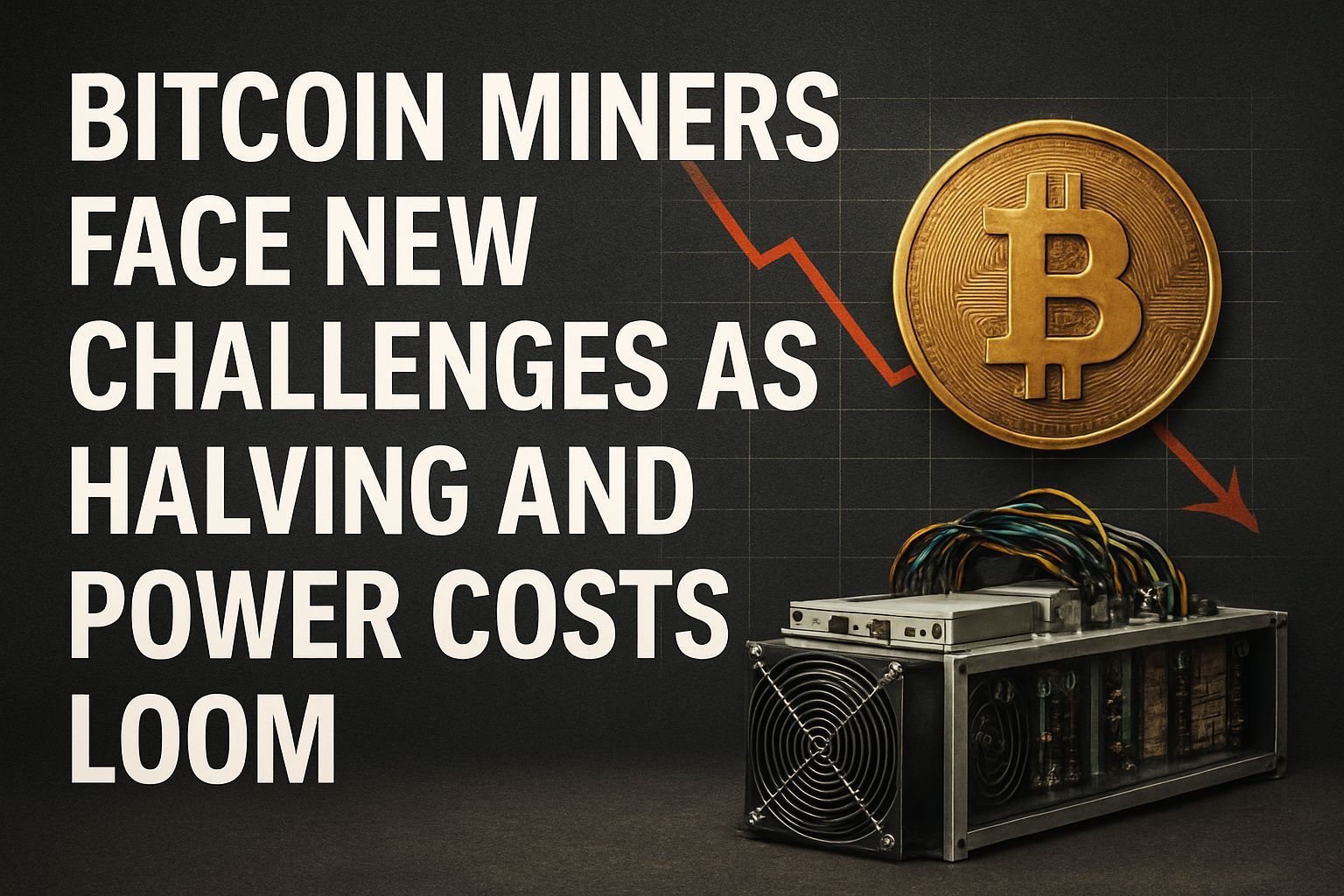
Why Are Bitcoin Miners Facing a Survival Test in 2024?
If you’ve been following the crypto space lately, you’ve probably heard about the looming Bitcoin halving and skyrocketing power costs challenging miners everywhere. These two storms crashing together aren’t just putting the squeeze on miners’ profit margins-they’re reshaping the entire ecosystem. So, what does this mean for the market, investors, and the future of Bitcoin? Let’s unpack it all in detail, with a conversational touch, as if we were just catching up over coffee.
Bitcoin miners face new challenges as halving and power costs loom large in 2024, forcing miners to rethink strategies amid reduced block rewards and rising electricity expenses. These pressures ripple through the crypto market, influencing Bitcoin’s price, the network’s security, and miner behavior. Understanding these changes is crucial for investors and enthusiasts alike to navigate the shifting landscape effectively.
Key Takeaways: What Every Crypto Enthusiast Should Know
Subscribe to our Social Media for Exclusive Crypto News and Insights 24/7!
- Bitcoin halving halves block rewards - miner payouts drop from 6.25 BTC per block to 3.125 BTC, cutting miners’ revenue directly.
- Power costs are spinning out of control, doubling breakeven energy costs and forcing a hunt for cheaper electricity and more efficient hardware.
- Hash rate fluctuations happen - weaker miners drop out, causing temporary hashrate dips but long-term gains from efficiency and network security.
- Transaction fees and Layer 2 protocols become vital new revenue streams.
- This period could shake out weaker miners but ultimately strengthen Bitcoin’s ecosystem.
️ Halving Hits Hard: What the 2024 Bitcoin Halving Really Means for Miners
Every four years, Bitcoin undergoes a halving event that cuts miner rewards in half - this time from 6.25 BTC to 3.125 BTC per mined block[1][6]. This built-in scarcity mechanism is Bitcoin’s secret sauce to controlling inflation and driving demand. But for miners, it’s a gut punch to their business model.
Historically, after each halving:
- Miners’ revenue halves instantly, but Bitcoin’s price does not always adjust immediately[3].
- This discrepancy squeezes profit margins, forcing miners to improve efficiency or risk shutting down[2].
- Many less efficient miners exit the market, causing a temporary dip in the network’s hashrate-essentially the computational muscle of the Bitcoin blockchain[1][5].
The halving is more than a mere paycheck cut; it redefines the economics of mining. Miners not only face smaller block rewards but must also scramble to maintain or grow profitability through lower power costs and better mining hardware, which leads us to the next big challenge…
? Power Costs: The Silent Killer of Mining Margins
Power consumption is the bane and backbone of Bitcoin mining. Running mining rigs is energy-intensive, and with global energy prices on the rise, electricity commands a lion’s share of miners’ operational costs[1][4].
Post-halving, miners face this brutal math: halved revenue but the same or higher power costs per unit of mined Bitcoin, effectively doubling the breakeven cost of electricity per Bitcoin mined[6]. Here’s what miners are doing:
- Hunting aggressively for cheaper sources of electricity, often under $0.05 per kilowatt-hour, through renewable energy or geographical arbitrage[6].
- Improving operational efficiency by investing in next-gen mining rigs with better energy efficiency measured by Joules per Terahash (J/TH)-lower J/TH means less energy to crunch the same number of calculations[6].
- Shutting down older, inefficient equipment to avoid bleeding cash[4].
For miners who can’t pivot fast enough, power costs alone could force shutdowns, decreasing hashrate and opening questions about network security and decentralization. This tug-of-war defines the real test for the industry.
️ The Impact on Network Hashrate and Bitcoin Security
The hashrate is an essential measure of the network’s strength and security. As high-energy-cost miners drop out temporarily after the halving, the hashrate tends to dip, making the network slightly more vulnerable to attacks like the dreaded “51% attack” - where a single entity could theoretically control the blockchain[2][5].
However, history shows resilience. After previous halvings, the network recovered as efficient miners took over, incentivized by higher Bitcoin prices and technological improvements[1][3]. It’s a painful but necessary shakeout that removes weaker players, ultimately reinforcing Bitcoin’s decentralized security[3].
? Beyond Block Rewards: Transaction Fees & Layer 2 Solutions Boosting Miner Revenue
Here’s the silver lining for miners: block rewards aren’t their only income source. With decreasing rewards, transaction fees become increasingly important[6][5]. New protocols, like Ordinals and the rise of Layer 2 solutions (Litecoin’s Lightning Network, for example), ramp up transaction volumes and fees, giving miners additional incentive to stay profitable.
- The recent BRC-20 token standard has spiked on-chain activity, nudging transaction fees higher and offsetting some of the revenue lost from the halving[5][6].
- Miners now need to optimize their operations to capture high-fee transactions effectively, balancing block templates dynamically[6].
This evolving revenue mix demands miners become more tech-savvy and nimble, blending efficiency with strategic fee capture.
?️ Practical Tips for Bitcoin Miners Navigating Halving and Power Cost Challenges
If you’re an investor or a miner looking to weather this storm, here are some down-to-earth strategies to consider:
- Invest in Energy Efficiency: Seek the most power-efficient hardware available and retire outdated rigs with poor J/TH ratios[6].
- Negotiate Power Deals: Secure contracts with cheaper, preferably renewable energy providers to slash operational costs[4][6].
- Diversify Revenue Streams: Explore opportunities in capturing transaction fees through participation in growing Layer 2 and token protocols[5][6].
- Capitalize Reserves: Build capital reserves ahead of the halving to survive the immediate revenue crunch and maintain operations[3].
- Monitor Hashrate & Competition: Stay alert on network hashrate trends to anticipate competitive shifts and adjust mining strategies accordingly[1][5].
Investors shouldn’t overlook these factors either - understanding miners’ cost pressures and operational health can serve as a barometer for the Bitcoin market’s near-term strength.
? Personal Insights: Why This Challenge Could Be a Blessing in Disguise
Here’s my take: while the halving combined with rising power costs sounds like a doom scenario for miners, it’s actually a natural evolutionary checkpoint that strengthens Bitcoin over time. It weeds out inefficiency and forces innovation, leading to:
- Increased concentration of mining in areas with cheap and clean energy, potentially making Bitcoin greener.
- Greater network resilience as only serious, well-capitalized miners remain, stabilizing the blockchain’s security.
- Incentives for protocol upgrades and Layer 2 adoption, enhancing Bitcoin’s usability beyond just a store of value.
For investors, this means watching miner health closely offers clues about Bitcoin’s underlying strength. It’s not for the faint-hearted, but the market usually rewards endurance and innovation.
So, as the 2024 halving reshapes Bitcoin mining economics and power costs continue their upward climb, the question isn’t whether miners will feel pain - they clearly will. The real question is: Who will adapt best and come out stronger, and how will these shifts ripple throughout the crypto landscape?
Explore more about these critical themes here:
Bitcoin halving
Bitcoin miners
Power costs in Bitcoin mining
Sources:
- https://www.vaneck.com/us/en/blogs/digital-assets/matthew-sigel-bitcoin-halving-explained-history-impact-and-2024-predictions/
- https://www.halborn.com/blog/post/bitcoin-halving-2024-what-are-the-security-implications
- https://www.fidelitydigitalassets.com/research-and-insights/economics-bitcoin-halvinga-miners-perspective
- https://www.wisdomtree.com/investments/blog/2024/07/22/bitcoin-halving-and-mining-update-mid-2024-perspective
- https://www.lseg.com/en/ftse-russell/research/bitcoin-halving
- https://www.miners1688.com/the-2024-bitcoin-halving-is-over-for-miners-the-real-work-begins-now/