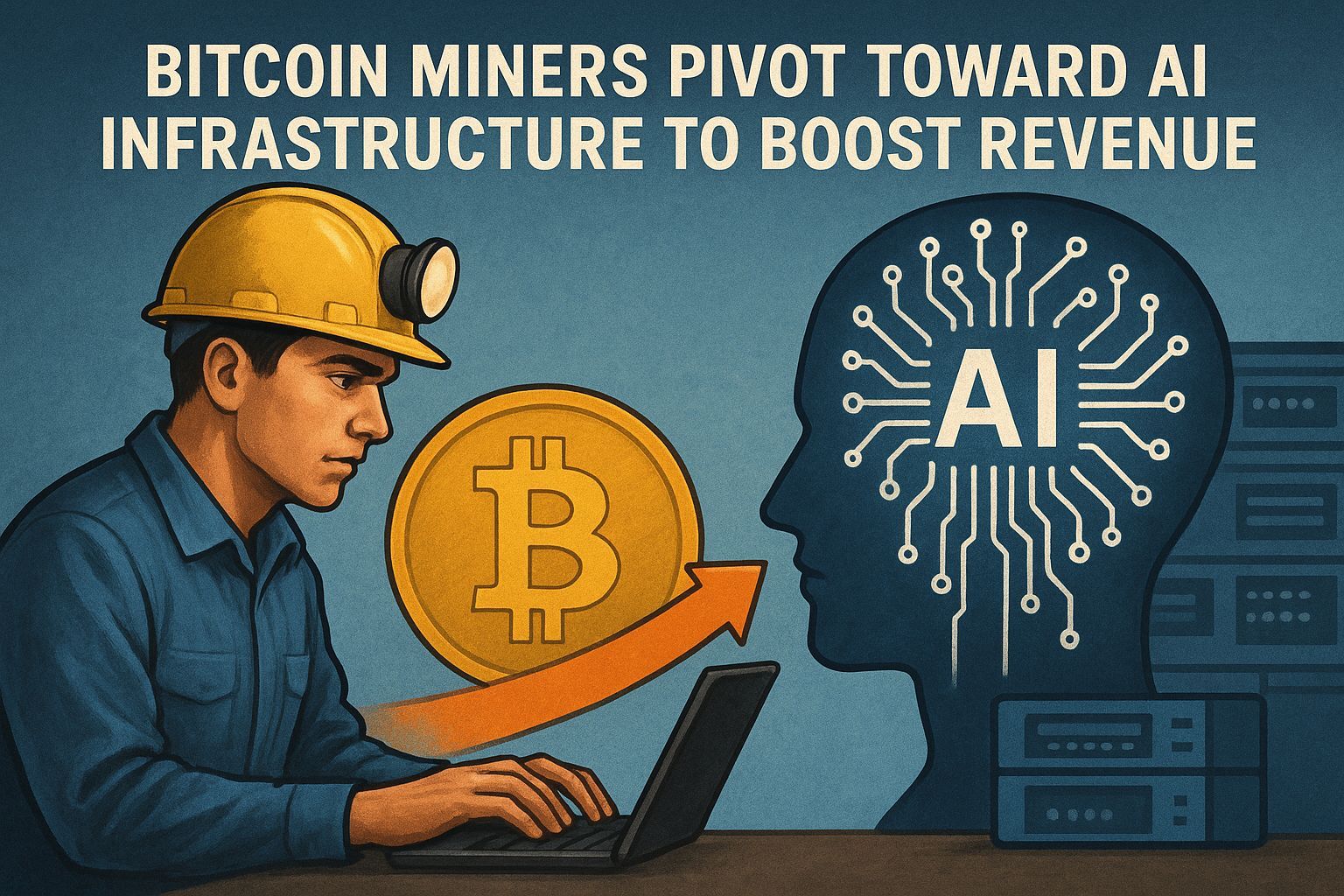
The Great Infrastructure Pivot: How Bitcoin Miners Are Cashing In on the AI Data Center Gold Rush
When Your Mining Rig Becomes Tomorrow’s Data Center
Bitcoin miners are making a calculated bet that could reshape how they survive in 2026 and beyond. They’re not just tweaking their operations-they’re fundamentally reinventing themselves as infrastructure landlords for artificial intelligence, leveraging existing power capacity and grid connections that took years to build. This pivot isn’t theoretical anymore. It’s happening, and the numbers suggest it could be the difference between obsolescence and billion-dollar valuations.
Let’s be real: Bitcoin mining margins have gotten squeezed hard.[2] Every four years, the rewards miners receive get cut in half, and competition on the network has grown exponentially. Rising operating costs and dwindling profitability mean that staying purely focused on crypto is increasingly risky. But here’s the twist-the infrastructure these mining operations already own? It’s exactly what Big Tech desperately needs right now.
Subscribe to our Social Media for Exclusive Crypto News and Insights 24/7!
Key Takeaways: The Real Play Here
- Megawatts matter more than hash rate now. Analysts are completely reframing how they value these companies-it’s no longer about Exahash (mining speed), but about Megawatts of power capacity.[3][4]
- An $11 billion leasing backlog has already materialized from AI companies desperate for reliable power infrastructure.[3][4]
- Execution risk is real and brutal. Companies like Applied Digital are deploying 140,000 GPUs-logistically insane and capital-intensive before revenue even hits.[3]
- The power grid advantage is massive. New high-voltage transmission lines take four to six years to build. Bitcoin miners already own energized, grid-connected sites. That time-to-power advantage? It’s the most valuable asset in the industry right now.[3][4]
The Perfect Storm: Why Miners Are Suddenly Valuable Again
Here’s the setup: The U.S. power grid is increasingly congested. Every major cloud provider and AI company is scrambling to secure computational capacity, but there’s a bottleneck nobody saw coming-electricity itself. While everyone’s focused on GPU shortages and chip allocation, the real constraint is stable, reliable power delivery at scale.
This is where Cipher Mining (CIFR) and TeraWulf (WULF) enter the picture. Morgan Stanley analysts flagged these two as prime candidates for over 150% stock appreciation, driven by their pivot from volatile cryptocurrency mining into the high-demand AI data center market.[1] The thesis is elegant: these former Bitcoin miners can transform into infrastructure-like businesses, almost like toll roads, generating predictable cash flows instead of gambling on crypto prices swinging 20% in a weekend.
That “overweight” rating signals serious conviction, and for good reason. The global AI data center market is projected to hit over $150 billion by 2031.[1] That’s not a typo. That’s opportunity.
The Hybrid Model: Have Your Bitcoin and Your AI Too

Some miners aren’t going all-in on one strategy. Instead, they’re running what’s being called the Hybrid Model-continuing to mine Bitcoin with surplus power while dedicating their most stable energy tiers to AI clients.[3][4] This approach hedges bets. You’re not abandoning a revenue stream that still works; you’re just adding a more stable one on top.
Think about it like this: Bitcoin mining can scale back or pause when electricity prices spike. You flip the switch, and miners pause. But AI data centers? They run 24/7/365. GPUs don’t take vacation. That continuous demand means fixed-rate revenue contracts that investors absolutely love.[3][4]
As one expert quoted in the sources noted, there’s a fundamental difference: “It’s not like you’re turning off a webpage. If I turn off a Bitcoin miner, Google doesn’t go offline.”[2] That distinction matters enormously for valuation multiples.
The Brutal Reality: This Pivot Ain’t Easy

Here’s where you need to keep your eyes open. The operational hurdles here are legitimately gnarly.[1]
Bitcoin mining used to be about ASIC machines-hardware purpose-built for one job: validating blockchain transactions. But AI workloads demand something entirely different: high-performance GPUs, advanced networking, and sophisticated cooling systems.[1][2] You can’t just swap out the hardware. You’re essentially gutting your entire facility and rebuilding it.
Mining facilities were optimized for one thing: low cost. But AI at scale demands high-performance networking and cooling standards that mining operations were never designed to handle.[2] That means massive capital expenditures for upgrades, advanced energy storage systems, and meticulous engineering.
Then there’s the execution risk angle. Companies like Applied Digital already have a long-term deal with Microsoft validating the business model, but they also just had an earnings miss that highlighted something critical: this transition is unimaginably complex.[3] Deploying 140,000 GPUs? Logistics nightmare. Billions in upfront spending before the rent checks start clearing? Brutal. Construction delays that miss quarterly targets? That’s the game right now.
The established players-Digital Realty Trust (DLR) and Equinix (EQIX)-operate with P/E ratios ranging from 40-77 and way more financial maturity.[1] Meanwhile, CIFR and WULF are contending with negative profit margins and still need to prove they can execute consistently.[1] That’s a gap, and it matters.
The Timeline: 2026 Is Make-or-Break

Here’s what you need to circle on your calendar: Both Cipher Mining and TeraWulf need to deliver large-scale infrastructure commitments by 2026, and failure to do so could tank their theses entirely.[1] We’re literally in that window right now. This isn’t five-year speculation-this is now.
The analyst sentiment remains largely positive, with both stocks holding “Buy” or “Strong Buy” ratings from multiple institutions.[1] But those ratings are conditional. They’re betting on execution. And execution in infrastructure is where overconfident companies go to die.
The Valuation Shift: Why This Matters for Your Portfolio
Investors need to understand something fundamental: the valuation metrics have completely changed.[3][4]
Used to be, you looked at Bitcoin miners and thought about hash rate, profitability per coin, electricity costs. That whole framework is being replaced. Now the conversation is about Megawatts of power capacity and the ability to provide cooling, networking, and physical infrastructure to AI workloads.
That $11 billion leasing backlog? That’s not speculative future revenue. That’s committed demand waiting for capacity to come online.[3][4] These companies are acting as hyperscale landlords-providing the physical shell, power, and cooling while companies like CoreWeave install the expensive servers.[3][4]
But here’s the catch: being the first mover costs money. Applied Digital is carrying significant debt to finance this rapid construction.[3][4] That’s fine as long as revenue starts flowing on schedule. But if you’re delayed? If deployment gets pushed six months? The interest on that debt keeps compounding while revenue stays flat.
What’s Actually Happening Right Now
Bitcoin mining companies are capitalizing on a natural advantage: they already own sites with energized, grid-connected infrastructure. In a race to build data centers where bringing new transmission lines online takes four to six years due to regulatory hurdles and supply chain issues, this time-to-power advantage is the most valuable asset in the industry.[3][4]
The strategy is diversification wrapped in infrastructure. Mining companies generate different income streams-Bitcoin rewards plus AI colocation fees. That reduces single-point-of-failure risk. And for investors, it’s compelling because infrastructure-like businesses command different multiples than speculative crypto operations.
The Bottom Line for Savvy Investors
The pivot from Bitcoin mining to AI infrastructure isn’t just a survival tactic-it’s potentially the most lucrative reinvention these companies could attempt. Morgan Stanley’s projections, the $11 billion backlog, and the structural power grid constraints all point in the same direction: these assets are becoming genuinely scarce.
But this isn’t a gimme. Execution risk is real. Capital requirements are massive. Timeline pressure is building. And the competition from established data center operators with deeper pockets and cleaner balance sheets is fierce.
If you’re watching this space, the next 12 months matter. A lot.
- https://www.whalesbook.com/news/English/Tech/Bitcoin-Miners-Pivot-to-AI-High-Stakes-High-Risk/698a86dc757d40c781847236
- https://technical.ly/entrepreneurship/bitcoin-miners-ai-data-centers/
- https://www.barchart.com/story/news/88221/the-great-pivot-bitcoin-miners-are-becoming-ais-landlords
- https://www.marketbeat.com/stock-ideas/the-great-pivot-bitcoin-miners-are-becoming-ais-landlords/