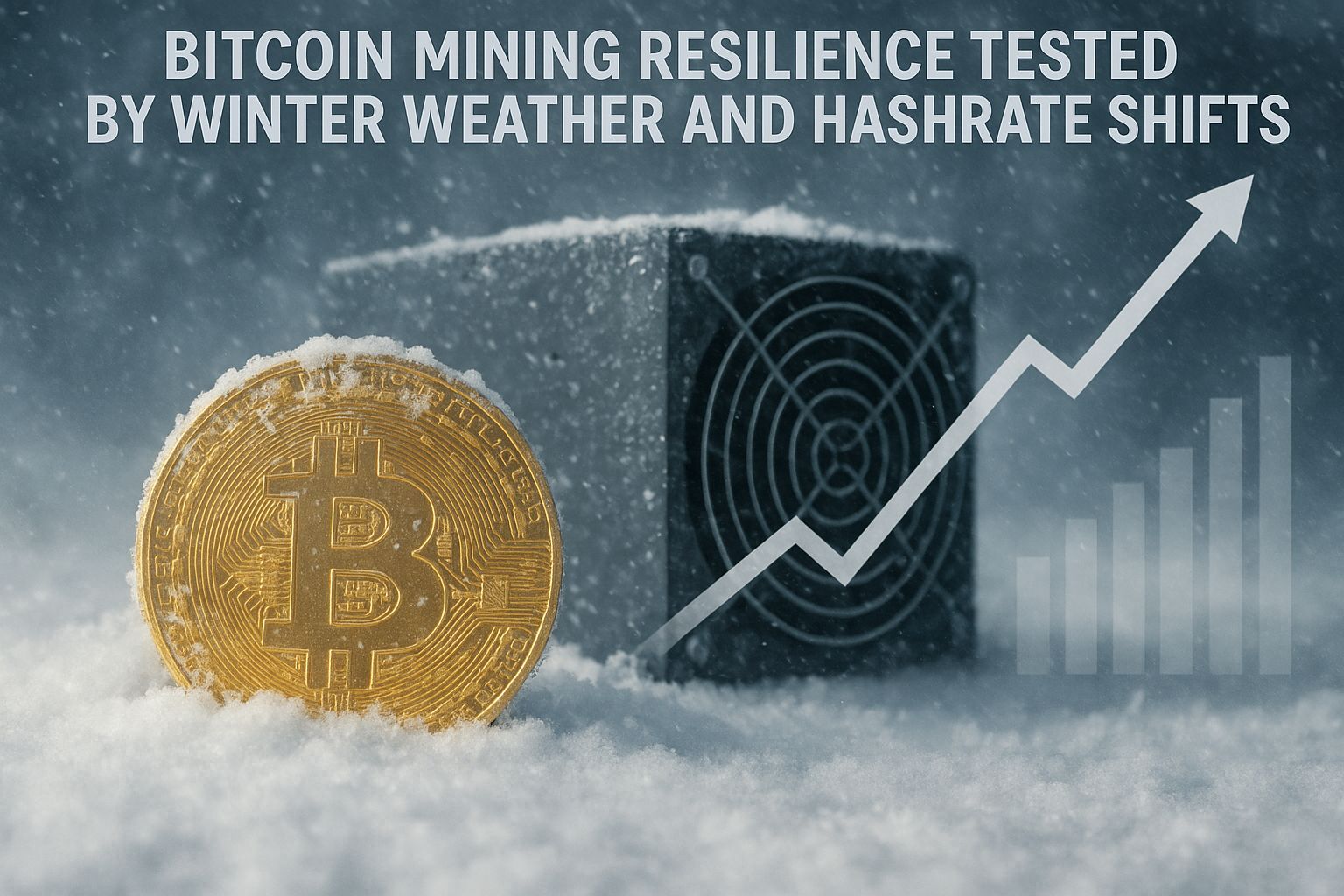
When Winter Hits the Hash: How a Brutal US Storm Exposed Bitcoin Mining’s Achilles Heel
The Network’s Reality Check
Bitcoin’s hashrate just got a hard lesson in climate vulnerability. A severe winter storm-dubbed “Fernan”-swept across the United States in late January, forcing some of the world’s largest Bitcoin mining operations to power down en masse. The result? A 15-25% collapse in network hashrate, with some analytics pointing to drops as steep as 25% within just three days[1][6]. This wasn’t a glitch. It was a stress test the network didn’t exactly volunteer for.
What made this event particularly jarring is where it hit. Texas, Wyoming, and Pennsylvania-three states that collectively control nearly 40% of US Bitcoin mining capacity-saw the most brutal operational reductions[1]. Major players like Foundry USA watched their hashrate plummet from 328 EH/s down to 139 EH/s, and the network went offline by roughly 200 exahashes per second[4]. For context, that’s like suddenly losing a quarter of a small nation’s computing power overnight.
Subscribe to our Social Media for Exclusive Crypto News and Insights 24/7!
Key Takeaways
- A winter storm forced US miners to voluntarily curtail operations, triggering a 15-25% hashrate decline-the biggest weather-related hit since China’s 2021 mining ban[1]
- Block generation times stretched beyond 12 minutes, temporarily slowing transaction processing across the network[1][2]
- Mining difficulty is expected to drop by 15% at the next recalibration to stabilize block times[4]
- Despite network disruption, Bitcoin’s price held steady near $88,000, proving market resilience[6]
- The storm affected three dozen US states and nearly one million energy customers, underscoring how deeply crypto infrastructure is now woven into America’s power grid[3]
The Storm That Showed Us What We Didn’t Want to See
Here’s the uncomfortable truth: Bitcoin mining has become so concentrated in grid-vulnerable regions that extreme weather can now meaningfully disrupt network security. When miners in Texas and Pennsylvania started receiving grid stress alerts-the kind that say “hey, we need you to back off or the lights go out”-they didn’t hesitate. They powered down.
This is actually a feature, not a bug. Grid demand response has become a defining characteristic of large-scale US mining operations[3]. Miners absorb excess power during low-demand periods and curtail when grids tighten. During Fernan, that flexibility kicked in hard. But here’s what’s wild: approximately 40% of global Bitcoin mining capacity went offline in 24 hours[7]. Not because of equipment failure or financial collapse, but because of weather.
The block time data tells the story vividly. Normal Bitcoin blocks land every 10 minutes. During the storm’s peak, block times ballooned to 12-12.4 minutes[1][2][4]. That might sound like nothing, but it compounds across millions of transactions. People waiting longer for settlement. Mining pools scrambling to adjust strategies. It’s the kind of friction that matters when you’re building financial infrastructure.
Where the Real Vulnerability Lives

Let’s talk about what this storm actually exposed.
The US has become a major Bitcoin mining hub, with some of the world’s largest operations clustering in crypto-friendly states like Texas and Georgia[5]. This concentration made sense economically-cheaper power, regulatory clarity, existing infrastructure. But it also created a single point of failure: climate risk.
Consider Foundry USA, which commands 23% of global hashrate. When it went from 328 EH/s to 139 EH/s, the network felt it[4]. Similarly, Luxor saw drops exceeding 50% during the weekend[5]. These aren’t small players adjusting margins. These are titans of the mining world forced to the sidelines by weather.
The energy grid strain tells you something else: Bitcoin mining now directly competes with residential and critical infrastructure demand[3]. When nearly one million energy customers lose power, and utilities have to prioritize homes over data centers, the economic calculus becomes brutally simple. Miners shut down. The grid stabilizes. Bitcoin’s network gets slower.
There’s historical precedent here. Back in 2022, a severe winter storm in Texas forced miners to voluntarily reduce operations[4]. But that was before AI data centers exploded onto the scene. Today, the rapid rise of artificial intelligence infrastructure has exacerbated both power shortages and grid strain[5]. Bitcoin mining now shares grid real estate with the hottest sector in tech. That’s a crowded dance floor.
The Difficulty Adjustment: Bitcoin’s Built-In Shock Absorber

Here’s where the protocol saves the day-at least temporarily.
When hashrate plummeted, block times stretched. The network detected this. And like clockwork, mining difficulty is expected to decrease by approximately 15% at the next recalibration[2][4]. This is Bitcoin’s automatic stabilizer. Fewer miners online? Difficulty drops. Easier to mine. Economics shift. Miners come back online. Difficulty rises again.
But-and this is important-this mechanism only works if the network survives the shock. The resilience held this time. Hashrate rebounded quickly as weather improved[3]. Block production normalized. Bitcoin’s price didn’t crater. The market stayed steady near $88,000 despite the disruption[6].
Still, analysts are noting something sobering: this event highlighted vulnerabilities in the energy grid under adverse weather conditions[2]. It’s not just about mining. It’s about whether US power infrastructure can actually support the energy demands of both crypto mining and emerging AI workloads simultaneously.
What the Data Really Shows

Let’s ground this in numbers, because that’s where truth lives.
Marathon Digital dropped from producing 45 BTC per day to just 7[3]. IREN fell from 18 BTC to 6[3]. These production collapses were sharp, sudden, and involuntary. Miners couldn’t have ramped back up even if they wanted to-grid operators had essentially said, “Not now.”
The network-wide impact? Bitcoin’s total hashrate fell from 1.077 zettahashes per second on Friday to 808.99 exahashes per second by Monday-a roughly 25% decline in three days[6]. For comparison, that’s like losing the equivalent computing power of some entire national mining operations overnight.
Block times told the secondary story. Exceeding 12 minutes means transactions take longer to confirm[1][2]. In a world where retail investors check their portfolio every five minutes, that matters psychologically. It feels like the network is struggling.
But here’s what didn’t happen: Bitcoin didn’t tank. Price remained relatively stable, even edging toward $89,010 intraday[6]. Stablecoins didn’t cascade into collapse. The network didn’t fork. This suggests something important: the market has begun pricing in weather-related mining disruptions as a known risk factor rather than an existential threat.
The Bigger Picture: Mining’s Growing Entanglement with Energy Markets
What Fernan really exposed is how deeply integrated Bitcoin mining has become with US energy markets.
Miners near wind and solar installations now absorb excess power during low demand and curtail during peak periods[3]. This makes them valuable to grid operators-they’re flexible loads in an increasingly stressed system. Daniel Batten, a Bitcoin ESG researcher, noted that mining operations in Texas coordinated with grid operators during the storm, helping prevent wider system instability[3].
This is actually economically elegant. Miners get paid to provide grid services. Grids get flexibility. Everyone wins-until everyone doesn’t.
The unspoken risk? As AI data centers proliferate, competing for the same power resources, miners might lose their negotiating advantage. They’ll still be the most flexible load, but there could be fewer reasons for grid operators to keep them online. Imagine a scenario where Tesla’s energy demands, Microsoft’s AI clusters, and Bitcoin miners all compete for the same kilowatt-hour. Who wins? The one paying more.
The Precedent Problem
You’ve seen this before, right? Back in 2021, when China banned crypto mining, Bitcoin’s hashrate tanked. The network adjusted. Difficulty dropped. Miners relocated. Life went on. Fernan felt similar-sudden, disruptive, but survivable[1].
The difference? That was a policy shock affecting millions of miners. Fernan was a weather shock affecting regional operations. If climate volatility becomes more frequent-and the data suggests it will-these events might start piling up. One winter storm in January, a summer heat wave in July, another cold snap in December. Suddenly, you’re looking at 3-4 major disruptions annually.
Mining difficulty adjusts every two weeks. But if disruptions arrive every few months, the network never quite settles into equilibrium. Block times remain variable. Confirmation uncertainty creeps in. And that uncertainty, compounded across billions of dollars in transaction value, starts looking like systemic risk.
What Happens Next?
Production levels are expected to normalize as mining operations gradually resume full capacity[3]. We’re already seeing hashrate recovery. The network did what it’s supposed to do-flex, adjust, stabilize.
But the lesson sticks. Bitcoin mining’s future viability in the US depends on three things: reliable energy infrastructure, geographic diversification beyond Texas/Pennsylvania/Wyoming, and a frank assessment of climate risk.
The market clearly isn’t panicking. Bitcoin held $88,000 through this whole affair[6]. That’s either profound confidence or complacency. Maybe both.
One thing’s certain: the next winter won’t be the last. And the next storm will teach us whether Fernan was a blip or a preview.
- https://cryptorank.io/news/feed/41d7b-bitcoin-hashrate-winter-storm-mining
- https://intellectia.ai/news/crypto/bitcoin-hash-rate-drops-amid-us-winter-storm
- https://www.binance.com/en-IN/square/post/01-27-2026-bitcoin-news-bitcoin-hashrate-drops-to-mid-2025-levels-as-us-winter-storm-forces-miner-shutdowns-35635065467217
- https://www.mexc.co/en-IN/news/562474
- https://www.ndtvprofit.com/business/bitcoin-miners-power-down-us-operations-in-wake-of-winter-storm-10890034
- https://www.fxstreet.com/cryptocurrencies/news/bitcoin-price-forecast-btc-steadies-as-winter-storm-drops-hashrate-blackrock-files-for-premium-income-etf-202601271109
- https://www.tradingview.com/news/cointelegraph:1fa3c01c1094b:0-bitcoin-hashrate-briefly-drops-to-mid-2025-levels-amid-us-winter-storm/