
Mining Stocks vs. Bitcoin: The Amplification Game Nobody Talks About
When Your Bitcoin Bet Becomes a Leverage Bet
Here’s the thing about Bitcoin mining stocks-they’re not what most people think they are. You’re not just getting exposure to BTC’s price movement. You’re getting Bitcoin’s volatility on steroids, wrapped in operational complexity that can either make you or break you. And right now, as we head deeper into 2026, the narrative around "green energy hosting expansion" doesn’t quite match what the data’s actually showing.[1][2]
Key Takeaways
Subscribe to our Social Media for Exclusive Crypto News and Insights 24/7!
- Bitcoin mining stocks amplify Bitcoin’s swings-both up and down-exhibiting significantly higher volatility than BTC itself[2]
- Individual mining stocks rarely mirror Bitcoin perfectly due to company-specific factors like energy costs, debt levels, and management decisions[2]
- Operational headwinds are real: Mining difficulty hit record levels in 2025, payback periods now exceed 1,000 days for some setups, and rising energy costs are eroding margins[2]
- The "versus trade" matters more than the narrative: Investors are increasingly using BTC vs. S&P 500 comparisons as a risk management tool, not as directional bets[1]
The Volatility Amplifier Nobody Wants to Admit
Let’s be real-if you thought buying a mining stock would give you steady, inflation-hedged returns tied to Bitcoin adoption, you’re about to have a rough awakening. Mining stocks are treated as proxies for Bitcoin because they generally move in the same direction.[2] But here’s where it gets spicy: they amplify both gains and losses.
Bitcoin mining stocks have become increasingly popular among hedge funds and retail traders seeking exposure to the digital asset ecosystem without directly holding Bitcoin.[2] The pitch sounds great, right? Get the upside of crypto adoption plus the stability of a traditional equity. Except it doesn’t work that way.
According to the data, Bitcoin mining stocks exhibit significantly higher volatility than Bitcoin itself.[2] Think of it like this: if Bitcoin swings 10%, a mining stock might swing 15-20%. During a correction? That gap widens. A potential 2026 pullback in Bitcoin could trigger sharp declines in mining stocks-the kind that make your portfolio look like it went through a blender.[2]
The Operational Reality Check

Here’s what separates the amateurs from people who actually understand this sector: mining stocks aren’t just trading instruments. They’re operating businesses with real costs.
By 2025, the industry faced some serious headwinds.[2] Mining difficulty hit record levels, which means it takes more computational power-and thus more energy-to mine the same amount of Bitcoin. Equipment depreciation is eating into margins. Energy costs? Climbing. And the payback periods for some setups have stretched beyond 1,000 days.[2]
This is why individual mining stocks can diverge wildly from Bitcoin’s price, even when they’re supposed to be correlated.[2] A company with high energy costs in a jurisdiction where electricity prices are rising might get crushed while Bitcoin holds steady. Another operator with locked-in renewable energy contracts might thrive. Management decisions matter. Debt levels matter. These operational realities can completely override macro Bitcoin momentum.
Bitcoin vs. Equities: A Different Beast Entirely

Here’s something worth chewing on. By late 2025, capital markets shifted into a quieter phase-reassessing how risk should be priced as U.S. monetary policy approaches a turning point.[1] And in that environment, Bitcoin and equities behaved very differently.
U.S. equities, including the S&P 500, stayed composed. They hovered near historic highs, supported by large-cap leadership and steady demand.[1] That’s the way traditional markets work-they absorb changes gradually, through shifting earnings expectations and discount rate adjustments.[1]
Bitcoin? It told a completely different story. Prices remained elevated compared to a year earlier, but the path was choppy. Daily moves widened as macro uncertainty crept back in.[1] The contrast is obvious when you stack them against each other: equities grind, crypto jolts.[1]
That’s why equity volatility, measured by the VIX, stayed muted into year-end-markets weren’t pricing systemic stress.[1] Bitcoin volatility, by contrast, remained far higher, reinforcing the long-standing divide between risk-on/risk-off asset behavior.[1]
The "Versus Trade" Changes Everything
Here’s the plot twist that most casual investors miss entirely. Rather than making outright directional bets on Bitcoin or mining stocks, sophisticated investors are increasingly framing exposure through comparisons-specifically, Bitcoin versus the S&P 500.[1]
This shift is subtle but critical. The BTC/US 500 ratio is increasingly watched as a signal of portfolio rotation between crypto and equities, especially among macro-focused funds.[1] Investors aren’t necessarily betting "Bitcoin goes to $100K." They’re asking: "Should capital flow into Bitcoin or into traditional equities right now?"
That’s a completely different question. And it’s a more practical one. S&P 500 versus Bitcoin has become a tool for managing risk, not for arguing narratives.[1] Structures designed to trade Bitcoin versus the S&P 500 isolate shifts in risk appetite itself-the underlying macro currents moving money around the market.[1]
For mining stock investors, this matters because when the "versus trade" tilts toward equities, mining stocks can get caught in a squeeze. They’re leveraged bets on an asset that’s increasingly being evaluated relative to traditional markets, not in isolation.
The Green Energy Hosting Narrative: Where’s the Data?
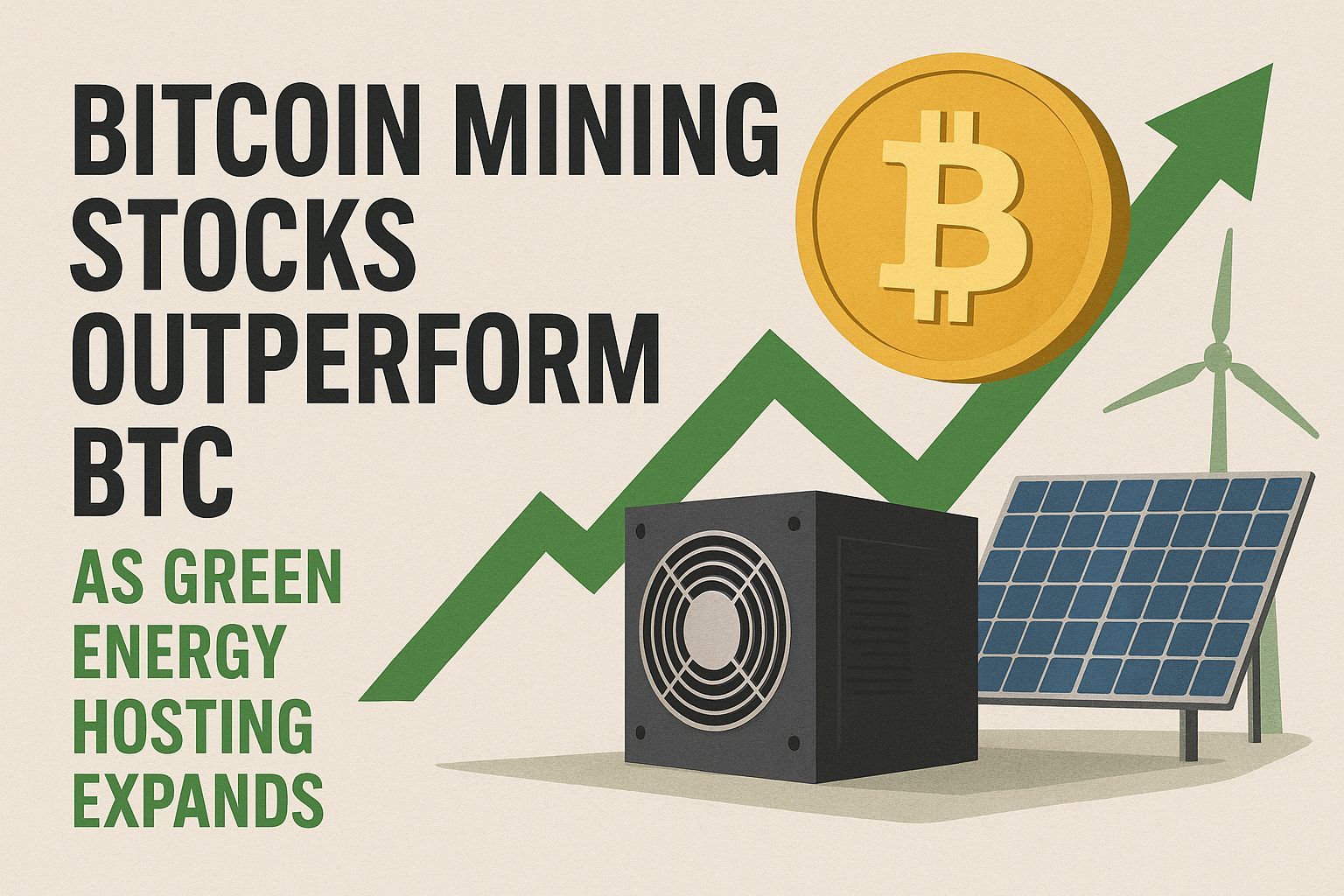
You came here looking for analysis on how "Bitcoin mining stocks outperform BTC as green energy hosting expands." Honestly? The sources don’t back that angle up right now. What we actually see is mining stocks being used as amplified exposure to Bitcoin, not as a separate outperformance story tied to energy infrastructure.
In fact, the data points the other way. Bitcoin mining stocks are amplifying volatility while facing real operational headwinds-rising energy costs, record mining difficulty, extended payback periods.[2] There’s no clear narrative here about green energy hosting creating a structural advantage for mining equities over Bitcoin itself.
If anything, operational challenges are eroding margins faster than adoption tailwinds can offset them.[2] The green energy story exists, sure-but it’s a company-by-company factor, not a sector-wide tailwind lifting mining stocks above Bitcoin performance.[2]
The Bottom Line
Mining stocks offer leverage to Bitcoin’s price movement, but that cut both ways. Volatility amplification, operational complexity, and the increasing use of Bitcoin-versus-equities comparisons for portfolio management mean mining stocks are a more complicated beast than casual investors realize.
Don’t buy them thinking they’ll outperform Bitcoin smoothly. They might, in certain conditions. But they’re equally likely to crater harder during Bitcoin corrections. The real opportunity-if there is one-lies in understanding the operational fundamentals of individual companies, not in betting on a sector narrative that the data doesn’t actually support.






