
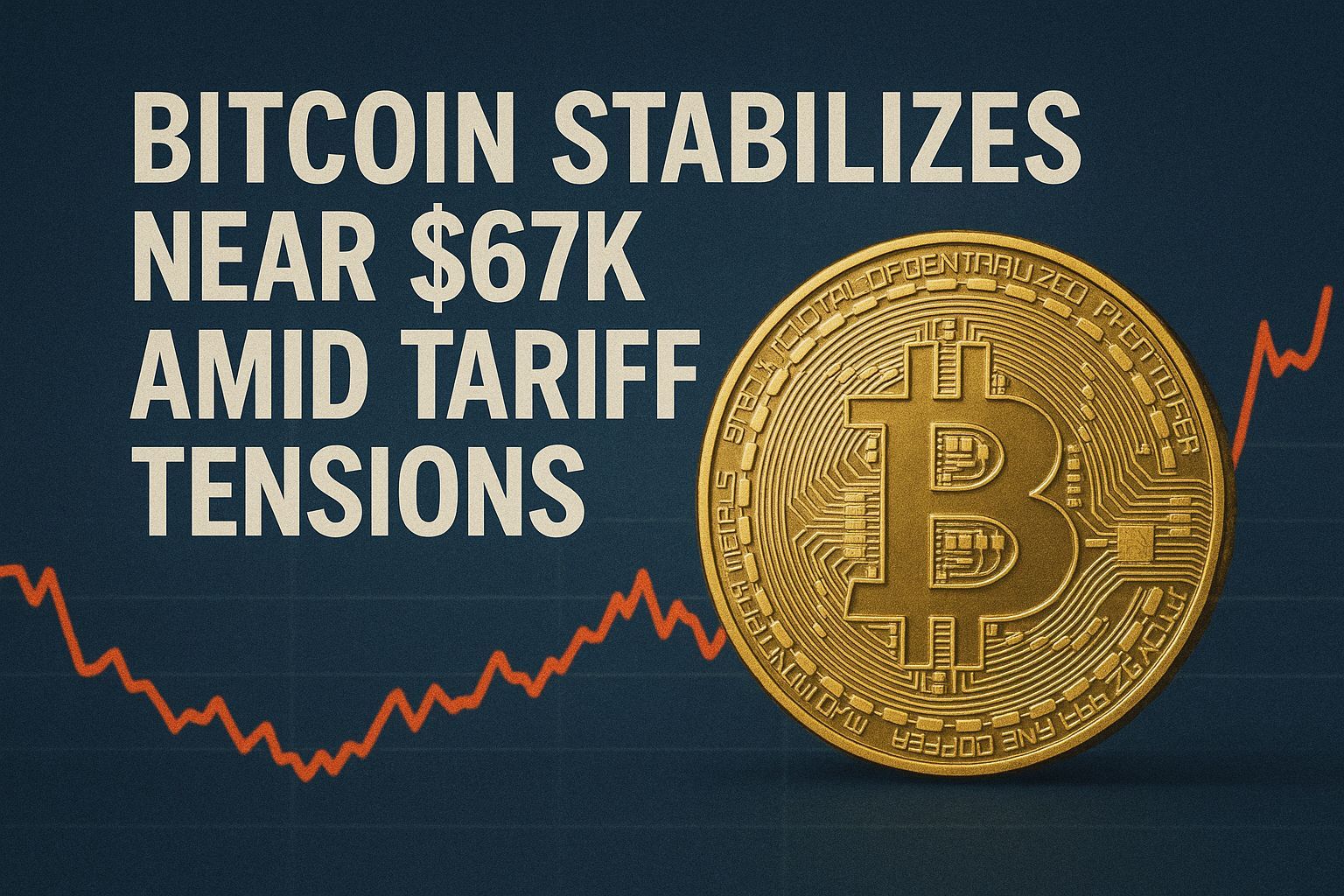
Bitcoin’s $67K Gridlock: When Macro Chaos Meets Technical Indecision
The Waiting Game Nobody Wants to Play
Bitcoin’s stuck in purgatory right now, and honestly, it’s the kind of limbo that keeps traders up at night. The world’s largest cryptocurrency is hovering near $67,000, caught between a rock (downside support) and a hard place (overhead resistance), with the broader market essentially hitting pause while institutional money watches the macro tea leaves[1]. We’re talking about a narrow but crucial trading band between roughly $65,100 and $72,000-the kind of range that breeds frustration because nobody knows which way this thing’s actually headed[1].
Here’s the thing: Bitcoin’s having its worst year-to-date performance on record, down nearly 24% since January 1[5]. That’s the kind of stat that makes you wonder if something fundamental shifted, except-and this is wild-there’s been no obvious catastrophic trigger, no FTX-style collapse to point fingers at[5]. The crypto industry’s actually in better regulatory standing than ever before, yet here we are, grinding sideways.
Subscribe to our Social Media for Exclusive Crypto News and Insights 24/7!
Key Takeaways
- Bitcoin’s trapped in a $65K-$72K range, waiting for macro catalysts to break the gridlock
- A U.S. Supreme Court decision on tariffs expected Friday could be the catalyst that moves markets more than traditional Fed signals
- Technical support near $60,000 represents a long-term ascending channel floor; breaking below could trigger deeper retracements
- Institutional investors are quietly accumulating despite volatility-Robert Kiyosaki just bought another full Bitcoin at $67,000
- Market sentiment remains bearish in the short term, but long-term structure still favors higher prices if key support holds
Why Bitcoin’s Price Action Feels Like Technical Quicksand
Let’s break down what’s actually happening on the charts. Bitcoin bounced from around $60,000 but failed to reclaim the $71,800 resistance level, instead dipping back down to support near $65,650 before settling around $67,000[1]. That’s textbook rejection energy-the kind of price action that tells you bulls don’t have conviction right now.
According to technical analysis embedded in the sources, bears are still in control[1]. Buyers have shown zero follow-through, which means that $60,000 level everyone’s watching? If Bitcoin closes daily below $65,650, it could cascade down to $63,000 and potentially trigger a deeper retracement toward the Fibonacci level near $57,800[1]. Ugly territory if we go there.
On the flip side, if bulls can muster the strength to reclaim $71,800, the next targets sit at $74,500 and resistance around $79,000[1]. But that’s a big “if”-right now, the bias stays bearish, with the asset likely stuck ranging in the low $60,000s to mid-$70,000s unless something breaks[1].
The weekly chart tells a more interesting story, though. Bitcoin’s been moving inside a long-term ascending channel that’s guided price action for years[2]. The lower boundary of that channel sits near $60,000, and here’s the kicker: every time Bitcoin’s touched that base in the past, a rebound followed[2]. We’re at that inflection point again, with early stabilization signals showing up on the candles[2]. That’s not nothing-it suggests structural support is real.
The Macro Catalyst Nobody Saw Coming: Tariffs Over Fed Minutes

Here’s where it gets interesting-and slightly ridiculous. You’d think the Federal Reserve’s meeting minutes or upcoming inflation data would be the headline movers for Bitcoin[1]. Wrong. According to Paul Howard, senior director at market maker Wincent, a U.S. Supreme Court decision on tariffs expected Friday could have a bigger impact than traditional Fed signals[1].
Think about that for a second. Crypto’s been closely correlated with broader macro risk sentiment over the last 12 months[1]. If tariffs spike, it changes the entire inflation narrative, dollar strength, and asset allocation picture. Suddenly, Bitcoin-traditionally a hedge against monetary instability-becomes relevant again.
Howard’s thesis is that Bitcoin’s entering a consolidation phase while hunting for new catalysts[1]. Translation: until we get that tariff ruling or another macro catalyst, expect more of this sideways chop. It’s not exciting, but it’s real.
The Quiet Accumulation: When Institutions and Icons Buy the Dip

Here’s what separates this downturn from pure panic: big institutions are still buying[1]. The most visible example? Robert Kiyosaki, the author of Rich Dad Poor Dad, just bought another whole Bitcoin at $67,000 while the market was actively crashing[2].
Kiyosaki’s got two reasons. First, he believes a major wave of money printing will begin if U.S. debt pressures the dollar[2]. Second, and more importantly, his conviction is showing at exactly the right moment-when fear is loudest and conviction is quietest. That’s exactly when smart money moves.
Kiyosaki’s play reflects something deeper: he’s less focused on short-term volatility and more locked in on supply mechanics and macro backdrop[2]. He’s essentially saying, “I know the chart looks ugly. I know we’re down 46% from early October. I don’t care. I’m buying anyway.” That’s the kind of contrarian move that separates survivors from panic sellers.
The Structure vs. Sentiment Disconnect

Here’s what’s genuinely fascinating: chart structure and macro narrative have converged at the same point[2]. The $60,000 zone acts as both psychological and structural support[2]. As long as Bitcoin stays inside that long-term ascending channel, the broader bullish framework remains intact[2]. But break below? You’re challenging years of uptrend structure.
Think of it this way: Bitcoin’s at a technical crossroads[2]. Hold $60,000 and the channel, and you’re still in an uptrend. Fail to hold? Deeper retracement levels get tested, and the narrative flips bearish.
The Year-to-Date Bloodbath and Why It Might Matter Less Than You Think
Let’s not sugar-coat it: Bitcoin’s down almost 24% year-to-date, and Ethereum’s collapsed 34% to around $2,000[5]. Those are historically terrible starts to a year. The cryptocurrency industry’s been getting absolutely demolished while the stock market’s basically shrugging (S&P 500 up 0.4%, Dow up 2.3%)[5].
Even crypto exchange operators are feeling it. Coinbase and Gemini reported poor results for their fourth quarters[5]. And some players got liquidated hard-BlockFills, a crypto lender and hedge fund, suspended customer withdrawals in early February with losses exceeding $75 million[5].
But here’s the counter-narrative that’s gaining traction: crypto’s reality is getting stronger, according to Nelson, a research analyst at Bitwise[5]. The regulatory environment’s unprecedentedly friendly. Wall Street’s leaning in harder. And Tom Lee, cofounder of Fundstrat, dropped this in recent commentary: “We’re really close to the end”[5]-implying the bottom’s near.
What’s Really At Stake Right Now
The tariff decision Friday could be everything. If it signals inflation resurgence, Bitcoin gets relevant as a hedge again. If it signals trade war escalation, capital rotation into risk assets gets complicated. If it’s a nothingburger? We stay in this range, grinding, testing patience.
Meanwhile, that $60,000 support level is the line in the sand. Hold it, and you’re still in an uptrend structurally. Break it, and you’re re-testing the broader conviction thesis that got us here in the first place.
Institutional accumulation is real. Icon-level conviction (Kiyosaki buying at $67K) is real. Technical support structure is real. But so is the bearish bias, the lack of buyer follow-through, and the risk of cascade liquidations if support cracks.
You’ve seen this pattern before, right? Bitcoin teasing a breakout, faking out, grinding sideways. Then-out of nowhere-a macro catalyst changes everything. That’s the setup we’re in. The question isn’t whether Bitcoin recovers; historically, it always does. The question is what catalyst finally forces this market to pick a direction.
For now? Stay patient. Watch Friday’s tariff ruling. Watch that $60K support. And remember what Kiyosaki’s already priced in: when fear is loudest, that’s often when conviction matters most.






