
Bitcoin’s Post-Halving Reality: The Diminishing Returns Paradox
When Supply Shock Meets Market Maturity
Here’s the thing about Bitcoin’s 2024 halving-it didn’t play out like the script promised. Yes, the mining reward got slashed in half (from 6.25 BTC to 3.125 BTC per block)[2], the supply mechanics tightened dramatically, and the scarcity narrative hit all the talking points. But the actual price performance? That’s where the story gets interesting, and honestly, way more nuanced than “halving = moon.”
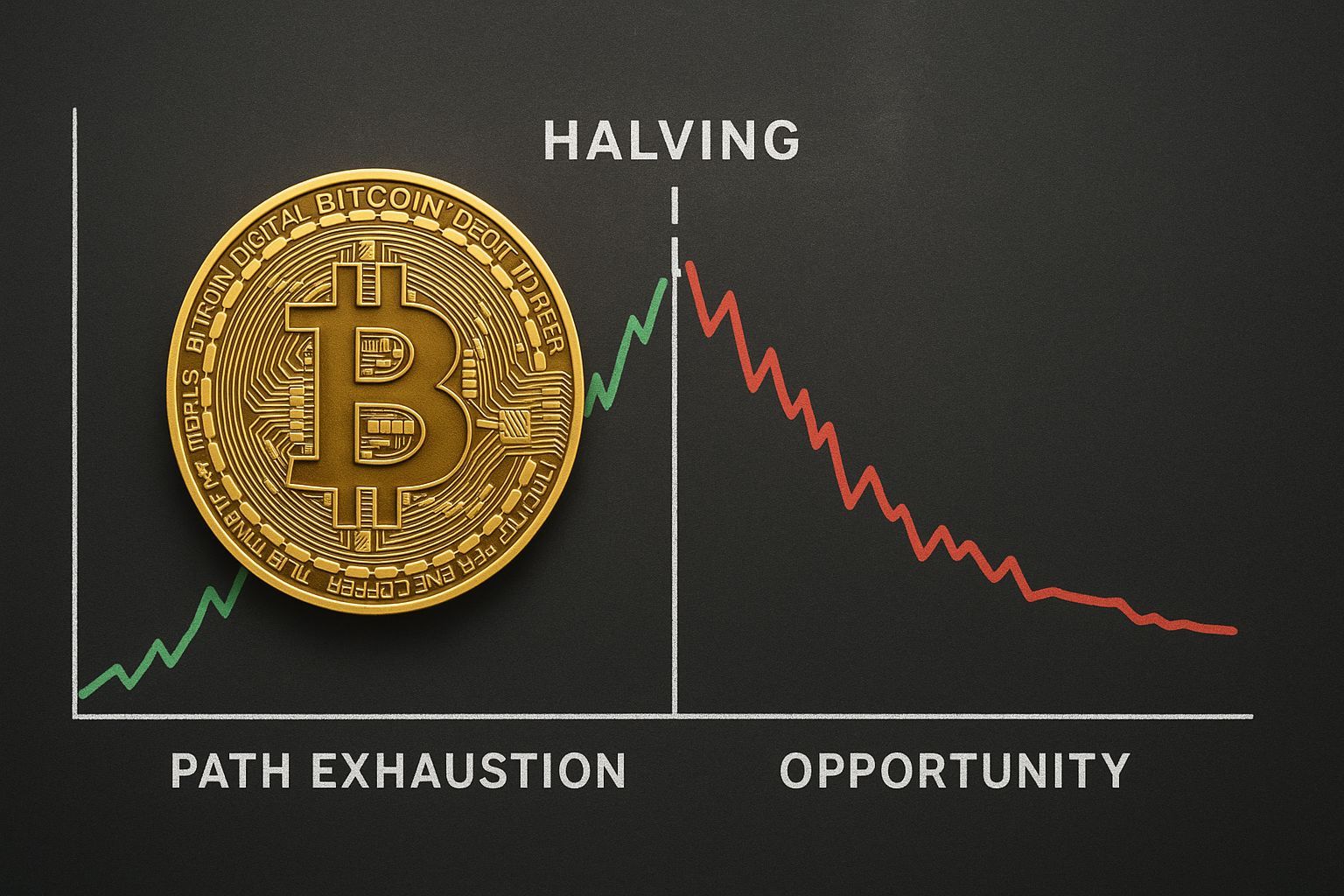
The original premise of “Bitcoin’s Post-Halving Path: Exhaustion or Opportunity” needs a reframe. What the data actually shows is something more like “Bitcoin Halving 2024: When Institutional Demand Clashes With Diminishing Returns”-because that’s what happened. The opportunity existed, sure, but it looked radically different than it did in 2016 or 2020.
Subscribe to our Social Media for Exclusive Crypto News and Insights 24/7!
Key Takeaways
- Bitcoin gained just 31% in the year following April 19, 2024 halving, marking the lowest post-halving return ever recorded[6]
- Institutional adoption via ETFs fundamentally altered traditional halving dynamics, absorbing over 1.13 million BTC[4]
- Mining economics deteriorated sharply-hash price fell roughly 60% since April 2024, even as network difficulty climbed 40%[6]
- The “diminishing returns” pattern is real: first halving yielded 8,858% gains, second 294%, third 540%, fourth just 31%[4]
- Despite sluggish immediate gains, Bitcoin’s deflationary trajectory and government strategic reserve discussions hint at longer-term structural support[2][5]
The Numbers Don’t Lie: When Halving Loses Its Magic
Remember when Bitcoin halvings were basically cheat codes for price action? Those days are over.
Look at the historical progression[4]:
- 2012 halving: 8,858% gain in 12 months
- 2016 halving: 294% gain
- 2020 halving: 540% gain
- 2024 halving: 31% gain
That’s not a trend-that’s a cliff. And the culprit isn’t complicated: market maturity. As Bitcoin’s market cap ballooned, the same supply reduction that once moved the needle like a lever just… doesn’t move it as hard anymore. The asset is too large, too distributed, too institutional for raw scarcity mechanics alone to dictate price action.
By mid-April 2025, Bitcoin was trading at $83,671-up from $63,762 on halving day (April 19, 2024)[6]. That 31% return? Solid for most assets, sure. But for a halving cycle? That’s not “opportunity”-that’s exhaustion wearing a three-piece suit.
For context[5], the previous halving cycles saw:
- 283% in the 12 months following July 2016
- 527% in the 12 months following May 2020
We’re talking about a 94% reduction in post-halving upside. That’s the story nobody wanted to tell.
The Plot Twist: Institutions Changed the Game

Here’s where it gets spicy. The 2024 halving didn’t fail because scarcity stopped working-it failed because scarcity got weaponized by the wrong players.
Spot Bitcoin ETFs got approved in 2024[4], and what happened next reshaped the entire halving thesis. These institutional vehicles absorbed over 1.13 million BTC[4]. Think about that for a second. That’s not retail FOMO buying-that’s algorithmic accumulation at scale. Pension funds. Insurance companies. Family offices. They didn’t care about the halving narrative. They cared about holdings.
The brilliance? Also the problem. Institutional demand created a floor, absolutely. It sustained price above $100,000 even as other asset classes stagnated[6]. But it also priced in the scarcity in advance. By the time miners’ rewards got cut, the market had already baked in the supply reduction. No shock. No surprise. No explosive repricing.
This wasn’t exhaustion in the traditional sense. It was efficiency. The market got smarter. The information got priced faster. The opportunity compressed.
Mining Economics: The Quiet Crisis Nobody’s Talking About
While analysts obsessed over price targets and chart patterns, something darker was happening in the mining sector-and it matters way more than most traders realize.
Hash price-the expected return per unit of computing power[6]-tanked roughly 60% since April 2024[6]. Meanwhile, difficulty and hash rate climbed 40%[6]. Translation? Miners are working harder, burning more electricity, and making less per unit of work. That’s a margin squeeze that’ll force capitulation.
Before the halving, roughly 900 new bitcoins entered circulation daily[4]. Post-halving, that number dropped to 450[4]. On paper, that’s perfect-scarcity is increasing. In practice? Miners are stuck choosing between three bad options:
- Upgrade mining rigs (expensive, cutting-edge ASICs cost six figures)
- Increase scale (more electricity, more operational complexity)
- Exit the game (accept defeat and sell holdings to cover losses)
Most chose option three, at least partially. And when miners are forced sellers into a soft market, guess what happens? Selling pressure that no amount of institutional demand can fully absorb.
Here’s the kicker[3]: in the long run, if Bitcoin’s price doesn’t appreciate enough to match the reduction in mining rewards, a decrease in miners could make the network more vulnerable to manipulation or attacks, such as a 51% attack. It’s not an immediate risk, but it’s a real risk if price stays sideways while difficulty stays elevated.
The Supply-Demand Disconnect: Why Textbooks Failed
Economic theory says: less supply + same (or higher) demand = higher prices.
Bitcoin in 2024 said: hold my stablecoin.
The halving did reduce supply[1]-by cutting the daily new Bitcoin issuance in half[4]. That’s undeniable. Demand also remained healthy, especially from institutions. So why didn’t price explode?
Because demand didn’t exceed supply in the way that matters.
Think of it this way[5]: previous halvings happened when Bitcoin was either nascent (2012-2016) or in a clear bull-market conviction phase (2020-2021). Demand outpaced the slower supply growth, and prices ripped. In 2024, you had institutional buyers steadily accumulating while miners remained forced sellers due to margin pressure. It balanced out. Equilibrium. No fireworks.
Goldman Sachs’ analysts nailed it[2]: the main factor affecting price performance wasn’t the halving itself-it was the increased demand from Bitcoin ETFs and broader market conditions. The halving was a footnote in a bigger story about institutional adoption and macroeconomic uncertainty.
Deflationary Design Meets Reality: Is This Actually Bullish?
Here’s the philosophical part, and honestly, it matters for your long-term thesis.
Bitcoin’s annual inflation rate dropped dramatically with the 2024 halving[4]. We’re talking sub-1.8% now-lower than most developed nations’ target inflation rates[4]. By some measures, Bitcoin is now deflationary relative to traditional currency creation.
That’s the vision Satoshi embedded in the protocol. A monetary asset that becomes scarcer over time, resistant to debasement, a hedge against the printer going BRRR forever.
Problem is: that vision only works if adoption keeps growing[1]. If demand stagnates while supply slows, you don’t get rising prices-you get a deflationary death spiral where holders hoard and liquidity evaporates.
But here’s the counterplay: governments are talking about Bitcoin strategic reserves[4]. El Salvador’s already accumulating. Brazil floated it. The US might be next. If major institutions and governments treat Bitcoin like they treat gold reserves-as a long-term store of value rather than a trading vehicle-then the halving’s scarcity effect activates over years, not months.
That’s the opportunity that got overshadowed by the 31% disappointment. Not exhaustion. Just longer timelines than traders wanted.
The Verdict: Neither Exhaustion Nor Opportunity-It’s Transition
The honest take? Bitcoin’s post-halving path was neither completely exhausted nor obviously opportune-it was transitional.
The 2024 halving marked the moment when Bitcoin stopped being primarily a retail sentiment machine and became increasingly an institutional settlement layer. That transition is actually bullish long-term (bigger money, more stability, less manipulation), but it’s bearish short-term (less volatility, less FOMO upside, more efficient pricing).
Miners got hit hard. Retail traders got disappointed. Institutions accumulated calmly. The network kept humming along.
For traders and swing investors, the 31% post-halving return was exhaustion compared to historical precedent. For long-term hodlers betting on government adoption and hyperinflation hedges, it was just another chapter in a multi-decade story about monetary transformation.
The real opportunity? It wasn’t the halving. It was recognizing that Bitcoin’s path forward looks less like a boom-bust cycle and more like the slow, grinding accumulation phase that gold went through when central banks stopped using it as official currency and started hoarding it instead.
- https://www.blockpit.io/blog/bitcoin-halving
- https://www.bitcoinmagazinepro.com/blog/examining-the-2024-bitcoin-halving-effect-on-price-movements/
- https://www.lseg.com/en/ftse-russell/research/bitcoin-halving
- https://cash2bitcoin.com/blog/bitcoin-halving/
- https://www.cmegroup.com/articles/2024/bitcoin-halving-2024-this-time-its-different.html
- https://www.fidelitydigitalassets.com/research-and-insights/2024-bitcoin-halving-one-year-later






