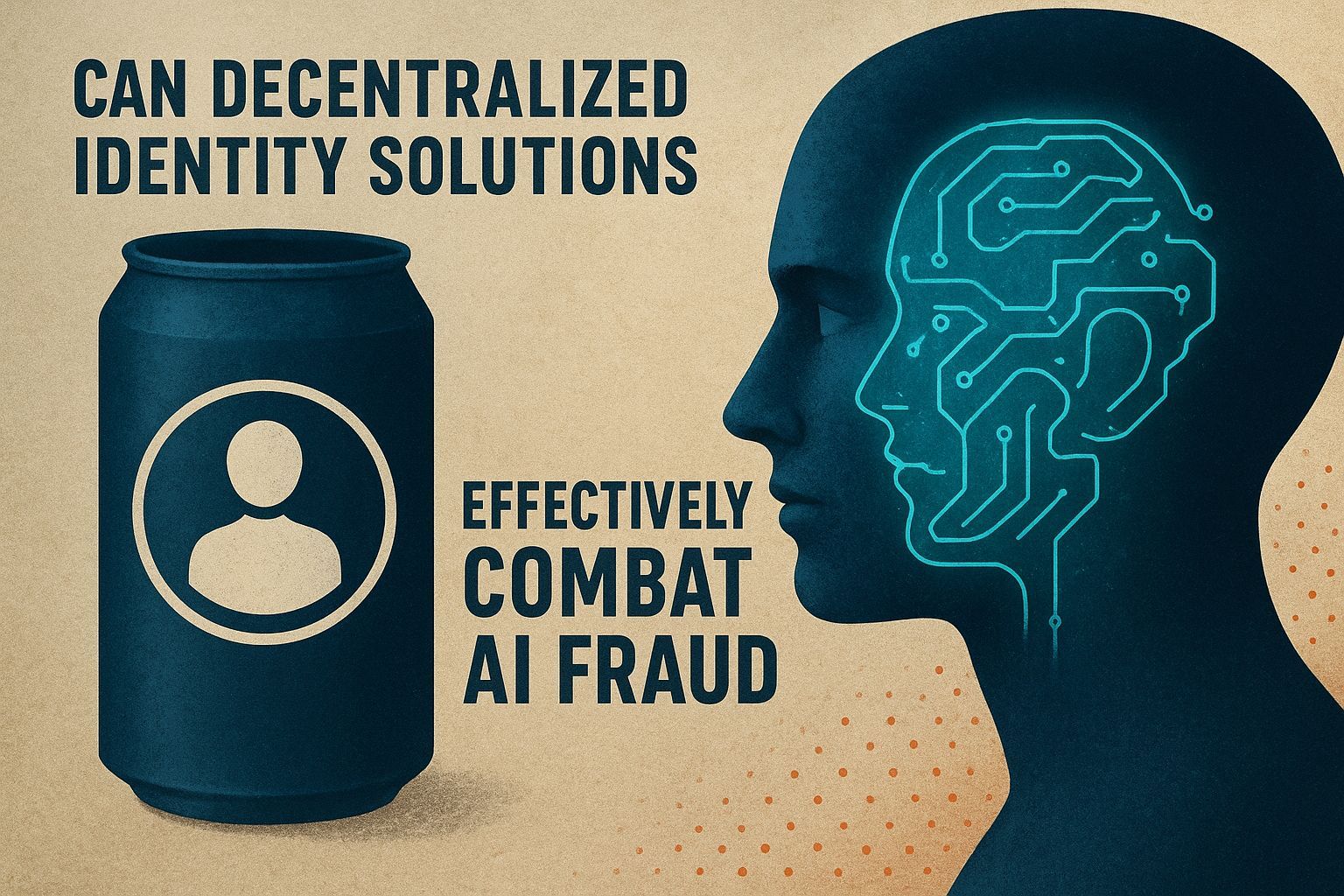
How Decentralized Identity and AI Are Rewriting the Rules of Digital Trust
When Your Identity Becomes Unhackable
Here’s the uncomfortable truth: centralized identity systems are basically sitting ducks for fraud. Passwords fail. Databases get breached. AI deepfakes are getting scary good at fooling legacy verification systems.[7] But what if your identity couldn’t be stolen because you never uploaded it to some corporation’s server in the first place?
That’s where decentralized identity solutions paired with AI fraud detection come in-and they’re genuinely reshaping how we think about verification, especially in finance.
Subscribe to our Social Media for Exclusive Crypto News and Insights 24/7!
Key Takeaways
Decentralized identity removes the honeypot: Instead of storing personal data in vulnerable central repositories, users keep cryptographically verified credentials in digital wallets, eliminating the single point of failure that attracts hackers.[1][3]
AI + Blockchain = fraud detection on steroids: When AI analyzes blockchain’s immutable ledger in real time, it spots anomalies, suspicious transaction patterns, and fraud attempts that traditional rule-based systems would miss.[2][4]
Selective disclosure changes the game for compliance: Banks can now verify KYC/AML requirements using cryptographic proof without customers exposing their full personal details-less friction, lower costs, stronger security.[3]
Behavioral pattern analysis catches fraud before it happens: AI agents monitor wallet activity and transaction histories across the blockchain, flagging suspicious behavior like sudden high-volume trading after long inactivity.[1]
The Problem With How We’ve Been Doing This

Let’s be real: the current identity verification playbook is broken. You want to open a bank account? Upload your driver’s license. Apply for a loan? Hand over your SSN, address, and basically your entire life story to a company that’s probably going to store it in a database they won’t even let you audit.
Then what happens? Data breaches. Identity theft. Compliance nightmares. Companies spending millions just to try to keep your info safe.[7]
Worse, AI deepfakes are getting disturbingly good at defeating legacy authentication.[7] A fake video of your face? A spoofed biometric scan? Traditional systems weren’t built for this threat level.
The Decentralized Identity Flip: You Own Your Credentials

Here’s where decentralized identity flips the script entirely. Instead of institutions holding your data, you hold verifiable credentials-digital attestations issued by trusted entities (governments, banks, universities) and cryptographically signed so they’re portable and tamper-proof.[3]
Imagine applying for a bank account online. Instead of uploading a scanned ID and waiting for manual review, you share cryptographic proof that you’re at least 18 years old-nothing more. The bank validates the signature. Done.[1] Your address? Your full name details? None of that gets exposed.
This isn’t just privacy theater. It’s fundamentally different architecture:
No central database = no honeypot for hackers. Each breach in traditional systems exposes millions. Decentralized? There’s nothing to breach.[1][3]
Cryptographic verification beats forged documents. Blockchain technology makes it cryptographically difficult-practically impossible-to alter or forge identity data.[1]
Users retain complete control. You decide what gets shared, with whom, and when. It’s your wallet. It’s your key.[3]
For financial services specifically, this is a game-changer. Banks could streamline onboarding using government-issued digital credentials, cutting KYC/AML friction while strengthening security against account takeovers.[3]
Where AI Enters the Ring: Real-Time Fraud Detection

Here’s where it gets powerful: decentralized identity alone is solid. But bolt AI onto it, and you’ve got something genuinely formidable.[2][4]
AI fraud prevention systems do three things traditional systems can’t:
1. Pattern Recognition at Scale

AI analyzes massive datasets and identifies anomalies that manual systems miss. A wallet suddenly performing high-volume transactions after months of inactivity? Flagged. A login attempt from a location previously linked to fraud? Blocked immediately. This isn’t based on static rules-it’s predictive analytics that adapts.[1][2]
2. Continuous, Adaptive Learning
Rule-based systems are brittle. They look for known fraud patterns, then hackers just evolve. AI models use machine learning to continuously adapt and evolve, detecting new fraud techniques as they emerge.[2] Think of it as the difference between hiring one security guard versus an entire team that learns from every single incident.
3. Behavioral Analysis Across the Blockchain
This one’s slick: AI agents monitor your entire transaction history and interaction patterns on-chain to assess credibility.[1] If your wallet suddenly acts out of character-different trading patterns, unusual counterparties, timing that doesn’t match your historical behavior-the system flags it for review. It’s like having a behavioral detective built into the ledger.
The Blockchain + AI Symbiosis
Here’s the synergy everyone’s sleeping on: blockchain provides the immutable, transparent ledger. AI provides the brains to interpret it.[2]
Blockchain records every transaction permanently. AI analyzes that ledger in real time, detecting repeated failed transaction attempts, unauthorized access patterns, double-spending schemes, and manipulated data.[2][4] The collaboration isn’t just additive-it’s multiplicative.
Because blockchain is decentralized, you also eliminate the privacy erosion that comes with centralized monitoring. Traditional systems force companies to spy on you from a central database. Decentralized systems let you maintain privacy while getting robust fraud detection.[2]
Real-World Application: Financial Services
Financial institutions are genuinely interested. Here’s why:
The Current Pain: Every bank independently verifies identity documents. Customers repeat the same verification across institutions. It’s costly, slow, and security-light.[3]
The Decentralized Future: A customer presents a verified digital credential from their government. Banks validate the cryptographic signature, fulfill KYC/AML requirements, and onboard the customer faster with lower friction and reduced cost.[3]
Even better-AI agents running in the background can catch fraud in real-time as transactions flow through the system. Instead of waiting weeks for compliance teams to review suspicious activity, detection is instantaneous.[1]
The Deeper Security Win: Selective Disclosure
You don’t need to prove your entire identity to prove a single fact. This matters more than it sounds.
Want to access an age-restricted service? Prove you’re over 21. That’s it. Not your name, address, license number-just the cryptographic proof of age.[3] This is called selective disclosure, and it’s a fundamental shift from “show us everything” to “show us what we need.”
This reduces your exposure profile. The fewer platforms holding pieces of your identity, the fewer attack surfaces for hackers. Fewer compliance headaches for institutions. Fewer regulatory nightmares across borders.[3]
Where This Gets Tested: Anti-Manipulation Learning
Here’s a detail that matters: AI systems integrated with decentralized identity frameworks aren’t bulletproof. They need to be stress-tested constantly.
Anti-Manipulation Learning (AML) frameworks test how fraud detection models respond to manipulated inputs-spoofed biometrics, tampered transaction records, deepfaked verification data. By proactively addressing vulnerabilities, these systems become more robust over time.[2] It’s continuous hardening.
The implication? As AI deepfakes get better, decentralized identity systems with AI agents are getting exponentially better at detecting them.
The Honesty Check: What’s Still Unproven
The search results don’t pull from major traditional finance sources (Bank of America research, audit documents, or exchange reports weren’t available in this pull). That’s a limitation worth noting. The analysis here draws from identity security specialists and blockchain-focused platforms, which are deeply knowledgeable but aren’t the same as institutional finance research.
What we don’t see yet: large-scale adoption numbers. Real-world case studies from major banks fully live on these systems. Regulatory clarity across all jurisdictions. These are emerging solutions, not yet battle-tested at institutional scale.
The Bottom Line
Decentralized identity solutions, especially when combined with AI fraud detection, legitimately solve problems that centralized systems can’t.[1][2][3][4] They eliminate the honeypot, enable selective disclosure, reduce compliance friction, and let AI do what it does best-detect anomalies at scale and speed that humans can’t match.
But they’re not magic. They’re infrastructure. And like all infrastructure, they’re still being built, tested, and refined.
For crypto audiences who understand the power of decentralization and the appeal of user sovereignty, this is the next frontier. For traditional finance, it’s a competitive threat they’re going to have to reckon with.
- https://www.resonance.security/blog-posts/ai-agents-as-decentralized-identity-verifiers
- https://identitymanagementinstitute.org/ai-fraud-prevention-and-identity-verification/
- https://www.iddataweb.com/universal-identity-proofing/
- https://www.loginradius.com/blog/identity/ai-fraud-detection-prevention
- https://indicio.tech/blog/decentralized-identity-2026/