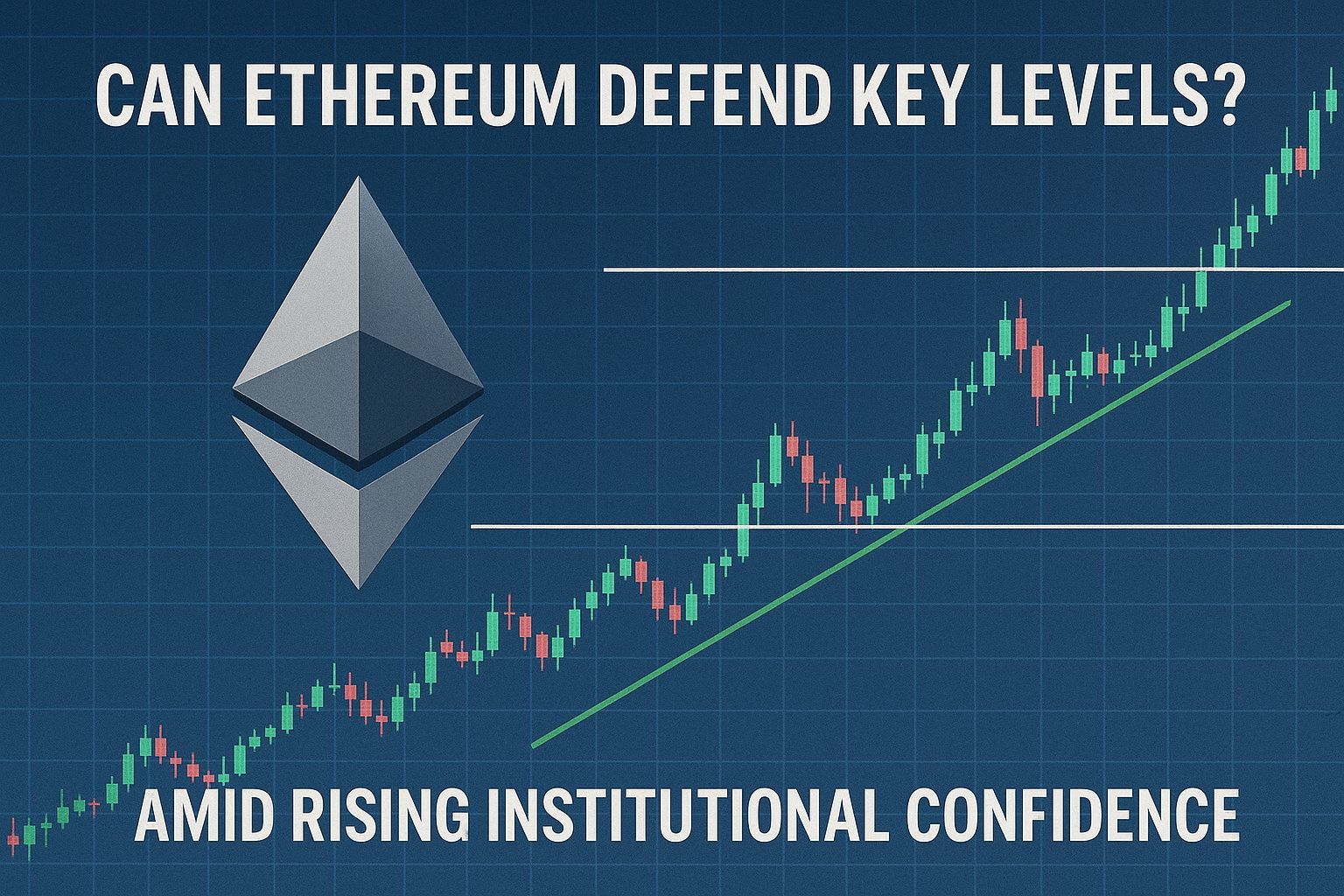
Ethereum’s Institutional Inflection Point: Why the Smart Money Isn’t Worried About Support Levels
When Fundamentals and Price Get Out of Sync
Here’s the thing about Ethereum right now-institutions are loading up while the market’s still skeptical. You’re watching a disconnect that doesn’t happen often, and it’s worth paying attention to. BitMine’s aggressive accumulation strategy, combined with regulatory tailwinds and stablecoin infrastructure buildout, is painting a picture that retail price action hasn’t quite caught up to yet.[1][2][5]
The narrative around “can ETH defend key support?” misses the real story. It’s not about whether Ethereum holds a technical level this week or next month. It’s about whether the asset can justify the conviction that institutional players are already showing-and the data suggests they’re seeing something the charts haven’t reflected yet.
Key Takeaways
- Institutional ownership is expanding, not retreating. BitMine’s 3.52% Ethereum ownership paired with a $5.73B staking portfolio signals serious long-term confidence, not short-term trading.[1]
- Ethereum captured 80% of institutional trading volume in 2026, driven by DeFi dominance and real-world asset (RWA) tokenization.[1]
- Price targets from major banks range from $5,000 to $5,440, reflecting analyst optimism despite current market caution.[2][3]
- The real risk isn’t support levels-it’s whether Ethereum can solve its structural economic challenges around value capture and sustainability at the protocol level.[2]
- Stablecoin infrastructure and regulatory clarity are becoming actual catalysts, not just talking points.[3][5]
The Institutional Story Nobody’s Talking About
Look, when a firm like BitMine commits to a hybrid staking model that generates $374M in annual rewards, they’re not hedging their bets.[1] That’s conviction. That’s capital deployment that says “we’re holding this for years, not weeks.”
Subscribe to our Social Media for Exclusive Crypto News and Insights 24/7!
What’s really interesting here? The timing. As the Trump administration’s pro-crypto policies-including major stablecoin legislation-hit the books, you’re seeing regulatory clarity that actually enables large-scale adoption rather than suffocating it.[1] This isn’t speculation. Ethereum’s already consolidated its role as what institutions are calling “the default institutional settlement layer.”[2] Think about what that means: settlement infrastructure for trillions in assets eventually.
Jesus Perez, CEO of Posidonia 21 Capital Partners, laid it out bluntly: “By 2026, Ethereum is also likely to consolidate its role as the default institutional settlement layer, maintaining leadership in Total Value Locked and reinforcing its position as the core infrastructure of decentralized finance.”[2] That’s not price prediction-that’s structural market positioning.
Why Support Levels Matter Less Than You Think

Here’s where most traders get it wrong. They’re obsessing over whether ETH holds $2,400 or breaks $2,000, but institutional capital doesn’t move that way. It moves through infrastructure upgrades, regulatory frameworks, and ecosystem maturation. And on those metrics? Ethereum’s firing on all cylinders.
The technical breakthroughs are real. PeerDAS and ZKEVMs are solving the blockchain trilemma-that long-standing tension between decentralization, security, and scalability.[5] Meanwhile, layer-1 metrics like transaction volumes and active users are hitting all-time highs.[4] You’re not looking at a network in decline. You’re looking at one quietly building the plumbing for mass adoption.
The stablecoin revolution is accelerating. Circle’s USDC is seriously gaining on Tether as institutions demand regulated digital dollars. You’ve got Franklin Templeton issuing assets on decentralized rails. Wyoming’s launching FRNT stablecoin on Solana. This isn’t random-it’s the infrastructure layer that makes real institutional participation possible.[5]
The Price-to-Fundamentals Disconnect
Here’s what’s keeping smart investors up at night (and it’s not support levels): Ethereum’s got institutional demand, regulatory clarity, and technical breakthroughs-but the price action hasn’t reflected it yet. That gap is either a huge opportunity or a warning sign, depending on your perspective.
Perez nails the core tension: “A key challenge remains ensuring that ETH sustains dual demand: both as a monetary asset and as a productive financial asset used extensively within DeFi protocols.”[2] Translation? ETH needs to work as both a store of value and a yield-generating tool within protocols. That’s harder than it sounds.
More structurally, “Ethereum currently lacks a clearly defined objective around financial sustainability at the protocol level.”[2] You hear that? No clear framework for long-term economic resilience. It’s not about whether the network works. It’s about whether the token economics actually align with the infrastructure’s value creation.
But here’s Perez’s kicker: “If Ethereum succeeds in aligning scalability, economic sustainability, and asset-level demand, the case for prices above $5,000 in 2026 becomes compelling. Failure to do so would leave the asset exposed to continued volatility and underperformance relative to its strategic relevance.”[2]
That’s not bullshit speak. That’s a roadmap.
The Analyst Consensus Isn’t Shy
Citi forecasts Ethereum hitting $5,440 within 12 months, based on sustained ETF inflows and institutional demand.[3] That’s not a fringe prediction from a YouTube pumper. That’s Citi, sending notes to clients. The bank’s explicit about it: “We are updating our forecasts for Bitcoin and ether, establishing 12-month price targets and anticipating modest upside into year-end, with further gains expected next year due to investor demand.”[3]
The SEC Chair’s literally citing Ethereum standards as a model for on-chain regulation. The ERC-3643 framework is getting serious institutional attention because it could solve compliance at the code level.[3] That’s the kind of regulatory tailwind that doesn’t show up overnight-it compounds over months and years.
And globally, the UK’s FCA gave retail investors access to Bitcoin and ether ETPs on the London Stock Exchange with consumer protections baked in.[3] That’s broadening the funnel for serious capital.
The Real Risk Factor
You want to know what actually threatens support levels? It’s not a market crash (though that’s always possible). It’s the structural questions Ethereum hasn’t fully answered. Can the protocol maintain value capture while scaling? Will institutional demand for yield and settlement actually exceed the frictions of custody and regulatory complexity?
The data from institutional flows and staking portfolio sizes says yes. But the price action still whispers doubt. That’s your signal that the repricing-if it comes-could be sharp.
The Takeaway
Ethereum’s defending key levels because institutions are already positioned. They’re not worried about a breakdown to $1,500 because they’re thinking in terms of infrastructure value, not price discovery. BitMine’s $5.73B staking portfolio isn’t hedged for a crash-it’s positioned for steady, long-term protocol revenue.
The real test isn’t support this quarter. It’s whether Ethereum can thread the needle: scaling without sacrificing security, capturing token value without alienating users, and maintaining institutional confidence while proving the economics actually work at scale.
The whales ain’t sleeping, and they’re not panic-selling. That tells you something.
- https://www.ainvest.com/news/ethereum-strategic-dominance-2026-implications-institutional-investors-analyzing-bitmine-aggressive-eth-accumulation-staking-strategy-barometer-long-term-institutional-confidence-2601/
- https://uabonline.org/english-news/can-ethereum-price-beat-bitcoin-in-2026-experts-still-see-upside/
- https://www.devere-group.com/ethereum-price-prediction-2026-ether-poised-to-exceed-5000/
- https://www.youtube.com/watch?v=k8OffaI-iFA
- https://www.youtube.com/watch?v=Uq1n7gbeh08