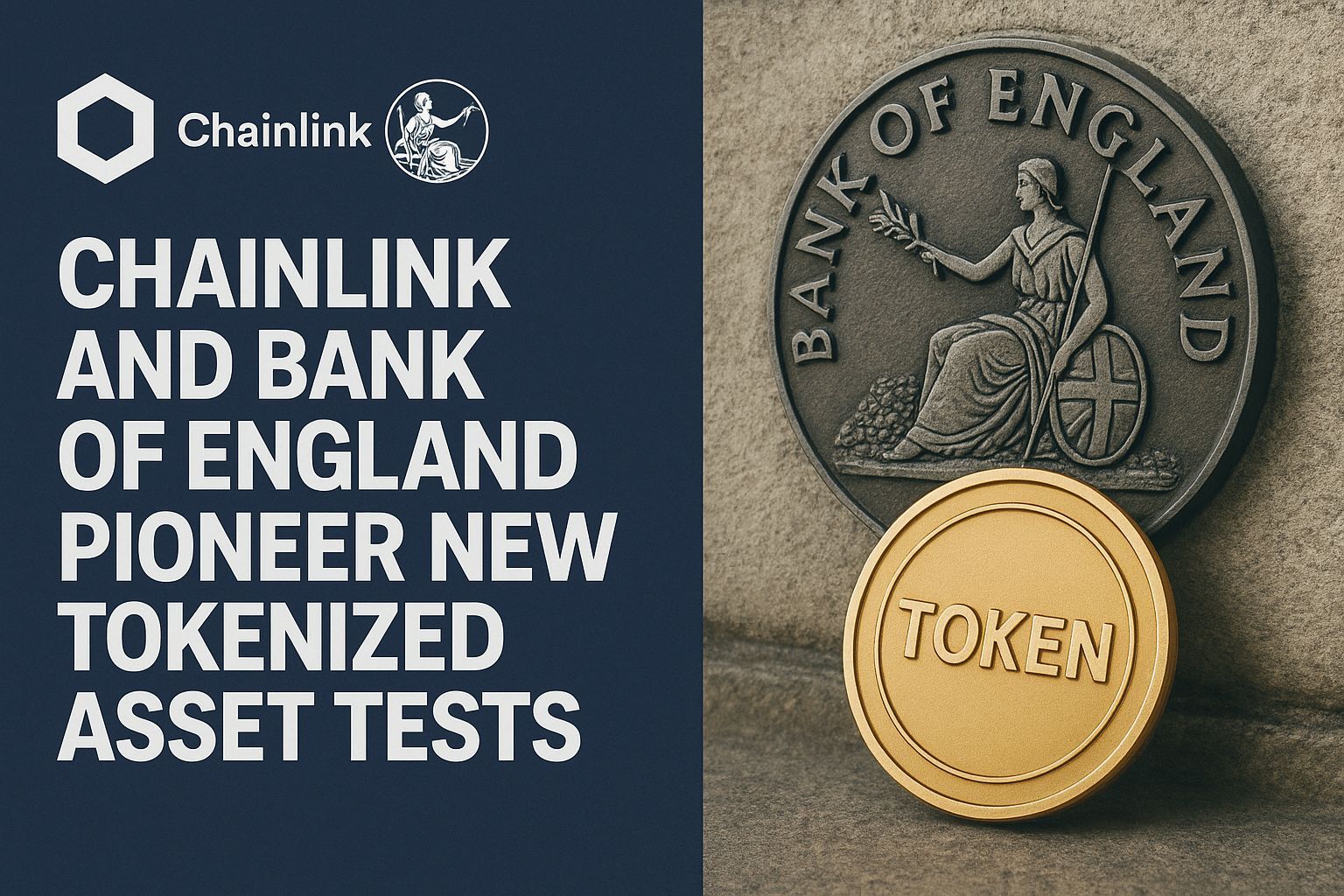
The Bank of England’s Bold Gambit: How Chainlink Is Reshaping Central Bank Settlement for the Blockchain Era
When Traditional Finance Meets Decentralized Infrastructure-And Nobody’s Sure Who’ll Win
The Bank of England just made a move that signals something seismic is happening beneath the surface of traditional finance. Today, they officially confirmed that Chainlink, the decentralized oracle network, will anchor a critical experiment called the Synchronisation Lab-a pilot designed to test how tokenized assets can settle in real-time using central bank money across blockchain networks[4].
Here’s what’s actually happening: 18 firms-including heavyweight names like Swift, the London Stock Exchange Group (LSEG), and Partior-are joining the Bank of England to explore something that seemed impossible just a few years ago: making on-chain securities move in lockstep with sterling balances held at the central bank itself[5]. And Chainlink’s the oracle pulling the strings, providing the decentralized settlement infrastructure that bridges the gap between digital ledgers and traditional payment systems[2].
Subscribe to our Social Media for Exclusive Crypto News and Insights 24/7!
Key Takeaways
- Spring 2026 Launch: The Synchronisation Lab kicks off in spring 2026 and runs for roughly six months, with live operations expected to begin imminently[4].
- Atomic Settlement is the Goal: The entire experiment hinges on achieving “atomic” settlement-where tokenized assets and central bank money transfer simultaneously or not at all, eliminating settlement risk[2].
- No Real Money Yet: This is still a sandbox. No production systems connect during the trial, and actual funds don’t move[4][5].
- Chainlink’s Role: Chainlink’s Cross-Chain Interoperability Protocol (CCIP) enables secure messaging and token transfers between blockchain networks and traditional systems, making it the technical backbone of the test[2].
The Architecture: How Central Bank Money Meets Blockchain
Let’s break down what makes this experiment different from the usual fintech theater. Tokenization converts rights to physical or financial assets-think government bonds, equities, even real estate-into digital tokens on a blockchain[2]. But here’s the rub: settling these tokens with central bank money requires what’s called a “secure, atomic link”-a transaction where both the asset and the payment transfer at exactly the same moment or not at all[2].
Why does this matter? Because in traditional settlement, there’s always a gap. Asset moves on Monday, payment clears Tuesday, and suddenly you’ve got counterparty risk hanging over your head like a guillotine. Atomic settlement kills that gap[2].
The Bank of England’s upgrading its Real-Time Gross Settlement infrastructure-RT2-and the Synchronisation Lab lets participants interact with a simulated version through dedicated APIs and a user interface[5]. Think of it as a digital twin where market participants can stress-test their platforms without actually putting pension funds or corporate treasuries at risk.
The Bigger Picture: Tokenization Isn’t Fringe Anymore

This isn’t some crypto startup’s fever dream anymore. The Bank of England has been building toward this for years[1]. In January 2025, BoE officials were already talking about pushing forward work on regulated stablecoins and testing their use as settlement assets in the Digital Securities Sandbox (DSS)[1]. They were also clarifying policy on tokenised collateral under UK European Market Infrastructure Regulation (EMIR)[1].
The market got the message. Respondents to the Bank’s consultation supported the thinking on tokenized collateral, though they urged the regulators to get crystal clear on how rights to those assets are assured and enforceable when things go sideways[1]. That’s the real sticking point-not the technology, but the legal framework and risk management.
Enter the Synchronisation Lab. It’s basically the Bank of England saying: “Okay, here’s a sandbox. Show us your use cases. Show us where this breaks. Then we’ll design the real system based on what we learn.”[3]
The Participants and Their Play

Chainlink isn’t flying solo here. The lineup reads like a who’s-who of traditional finance meeting crypto infrastructure:
- Chainlink and UAC Labs AG are building the decentralized settlement execution layer[5].
- Swift, the global payments backbone, is testing how blockchain integrates with existing messaging infrastructure[5].
- LSEG (London Stock Exchange Group) and Partior are exploring tokenized bonds and foreign-exchange use cases[5].
- Other participants include ClearToken and Nuvante[7].
Each firm gets roughly six months to build working prototypes and demonstrate how their platform would coordinate with both payment providers and asset registries[5]. At the end, they’re expected to present findings at an industry showcase, and the Bank will publish a comprehensive report summarizing the key insights[3].
Why This Matters (And Why Markets Are Sleeping on It)
Here’s the thing that caught observers off guard: Chainlink’s LINK token actually dropped after the announcement[7]. At the time of the announcement, LINK was trading around $8.60, down 70% from its peak in 2025[7]. Even major institutional validation didn’t pump the bags-which tells you something about crypto market sentiment right now.
But that’s also the opening. When central banks start moving the infrastructure, retail traders and analysts are usually still half-asleep. The BoE testing Chainlink for settlement isn’t hype-it’s validation that decentralized oracles are solving actual problems in institutional plumbing. No theater. Just work.
The Road Ahead: What Gets Built in Spring?
The participants will be testing whether synchronization truly works at scale. Can on-chain records actually interact with central bank money while maintaining existing risk controls? Can you avoid connecting production systems and still gather meaningful data? How do you handle edge cases-failed transactions, network congestion, regulatory updates mid-test?[4]
The answers to those questions could reshape how the UK’s financial system moves on-chain over the next five to ten years. We’re talking wholesale securities settlement, digital cash-backed instruments, maybe even programmable central bank money that respects smart contract logic[4].
That’s not incremental change. That’s infrastructure evolution.
The Bottom Line
The Chainlink-Bank of England partnership isn’t a marketing stunt. It’s a central bank testing whether decentralized oracle networks can reliably bridge traditional finance and blockchain infrastructure at scale[4][5]. If the Synchronisation Lab succeeds, you’re looking at a template that other central banks will copy. If it stumbles, the tech gets refined and tested again.
Either way, the experiment’s on. Spring 2026. 18 firms. One goal: prove that atomic settlement between central bank money and tokenized assets isn’t sci-fi. It’s viable.
- https://www.bankofengland.co.uk/speech/2025/january/sasha-mills-speech-at-the-tokenisation-summit
- https://cryptorank.io/news/feed/765e3-bank-england-chainlink-tokenized-settlement
- https://www.cryptopolitan.com/boe-taps-chainlink-for-atomic-settlement/
- https://en.cryptonomist.ch/2026/02/10/chainlink-settlement-boe-lab/
- https://cryptobriefing.com/bank-england-onchain-securities-settlement/
- https://www.binance.com/en/square/post/290167170101457
- https://crypto.news/link-price-slips-as-bank-of-england-selects-chainlink-for-its-synchronization-lab/