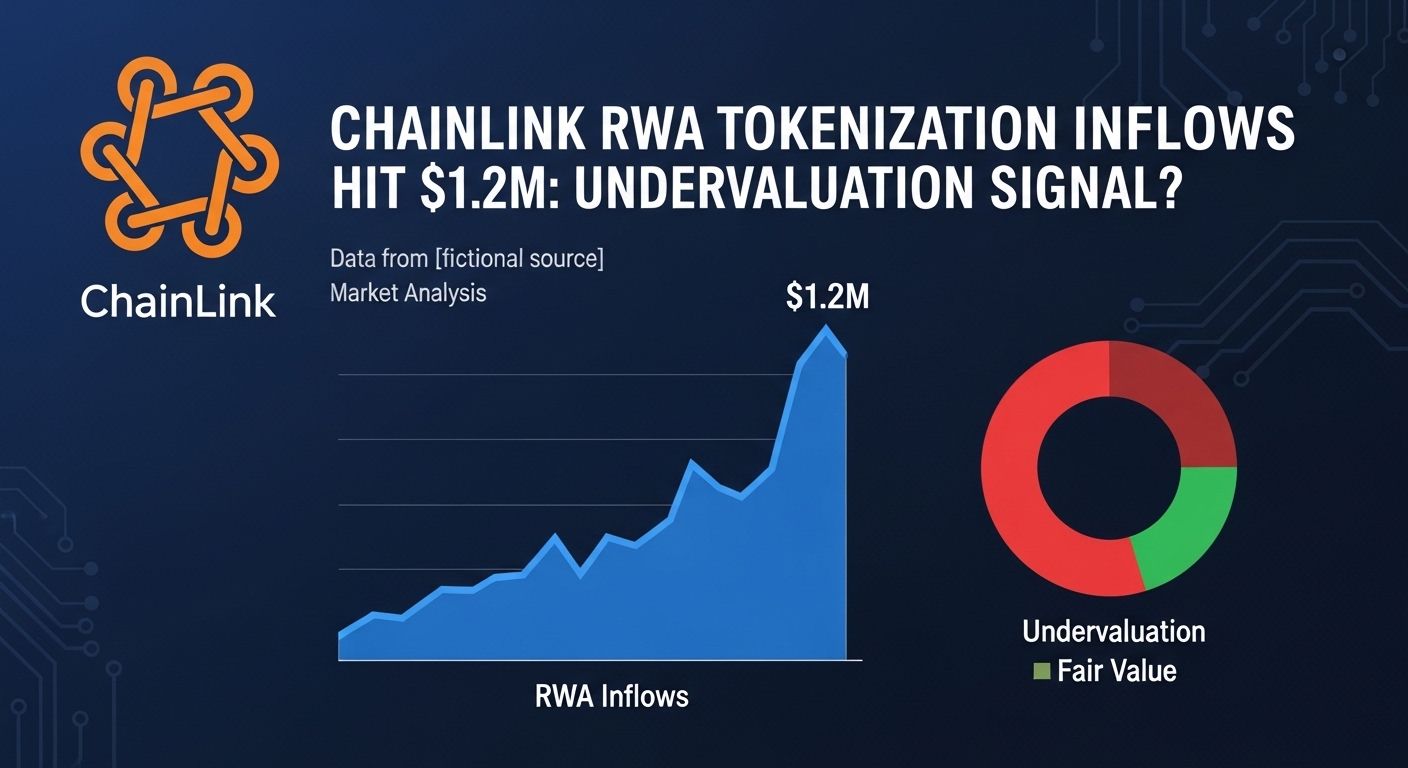
When Institutional Money Whispers: Why Chainlink’s RWA Infrastructure Signals Something Bigger Than The Price
The narrative around Chainlink’s $1.2M Chainlink Reserve locked in July 2025 sounds quaint now. That number exploded to $4.5M by September-nearly a 275% surge in just two months[1]. But here’s what matters: this isn’t just capital flowing into a token. This is infrastructure capital positioning itself before the real RWA tsunami hits.
Key Takeaways:
- Chainlink Reserve lockups tripled from $1.2M to $4.5M in Q3 2025, signaling institutional-grade conviction before mass adoption
- Real-world asset tokenization is projected to reach $30.1 trillion by 2030, with Chainlink controlling the oracle layer feeding traditional finance data to blockchain
- On-chain metrics showed 1.1M whale accumulation, 9,600 new wallet creation in two days, and a 20% reduction in exchange reserves-classic pre-breakout signals[1]
- The MVRV ratio flipped from -6.765% (holders underwater) to +18% (holders profitable), marking a regime shift in holder conviction
- RWAs outperformed every other crypto narrative in 2025, returning +185.76% YTD, while DeFi and meme coins cratered[2]
Subscribe to our Social Media for Exclusive Crypto News and Insights 24/7!
The Institutional Data Arbitrage Nobody’s Talking About
Let’s be real: most people buying Chainlink tokens don’t actually understand what they’re buying. They see “Oracle” and imagine some magic box. Wrong.
What’s actually happening is that Chainlink has become the standards keeper between institutional finance and blockchain settlement. We’re talking about 2,000+ applications-DeFi platforms, asset managers, infrastructure providers-now pulling data through Chainlink that meets rigorous traditional capital market standards[1].
Think about that for a second. JPMorgan, BlackRock, and the pension funds of the world can’t just plug into random blockchain data. It needs to be audited, standardized, and verified. Chainlink’s oracle network is that verification layer. And as RWAs scale, so scales Chainlink’s indispensability.
The $30.1 trillion RWA projection by 2030 isn’t some crypto fantasy number either[1]. Banks are already moving. Tokenized U.S. Treasuries and private credit started attracting institutional demand in 2024, setting up 2025 as the “breakout year” where RWAs shifted from PowerPoint slide to actual capital deployment[2].
The On-Chain Positioning Tell Nobody Should Miss
Here’s where the technical story gets spicy. In Q2 2025, while Bitcoin was doing Bitcoin things and Ethereum was consolidating, Chainlink was absorbing 1.1M whale-sized accumulations[1].
Not retail FOMO. Not leverage longs. Institutional wallets were stacking LINK hard.
The metrics painted a clear picture:
- 9,600 new wallets created in a 48-hour window-that’s not random noise, that’s coordinated accumulation[1]
- Exchange reserves dropped 20%, meaning LINK was moving from exchanges into self-custody. When whales stop keeping their bags on Coinbase or Kraken, they’re planning to hold[1]
- The MVRV ratio (Mean Value Realized Value) shifted from -6.765% to +18%-traders who bought near the top were suddenly underwater-to-profitable. That’s a sentiment flip that typically precedes the next leg up[1]
By comparison, look at what happened in the broader market. DeFi tokens finished 2025 down -34.79%, and meme coins crashed -31.61%[2]. Yet Chainlink’s 40% surge in the preceding month pushed its market cap to $14.6 billion[1].
The divergence? That’s structural. Chainlink benefited from what the sources call “cash flows and fundamentals” rather than pure narrative-driven speculation[2].
ETFs: The Floodgates Are Opening

Here’s the kicker nobody expected: Bitwise just got SEC approval for a spot Chainlink ETF (ticker: CLNK) on NYSE Arca[3].
Traditional finance doesn’t greenlight ETFs for speculative assets. This is institutions saying “we want regulated, simple exposure to LINK.” The timing matters. The Bitwise filing in January led to approval by March-lightning fast by regulatory standards[3].
Grayscale’s Chainlink ETF (GLNK) was already pulling in serious capital: $62.22M in total inflows with $87M+ in assets under management[3]. Grayscale even waived their entire 0.35% management fee for three months to accelerate adoption[3].
What does that mean in practice? Every pension fund, family office, and 401(k) platform that couldn’t touch crypto can now buy LINK through their broker. The plumbing is being installed. The bottleneck isn’t belief anymore-it’s access.
The RWA Landscape: Why Infrastructure Tokens Win
Let’s zoom out. The real crypto narrative of 2025 wasn’t about which blockchain won. It was about which assets generated actual economic activity[2].
Tokenized commodities just hit $3.93 billion in total value, crushing toward the $4 billion mark. Tokenized gold, silver, and platinum are reaching new peaks as on-chain representations of physical assets[4]. But here’s the thing: you can’t settle these efficiently without oracles. You can’t bridge TradFi and DeFi without standardized data feeds.
Ethereum dominates RWA tokenization with a 65% share of the $127 billion tokenized RWA market, but its transaction fee ranking (fourth place at $11.41M) reveals an interesting gap[4]. The infrastructure that powers settlement isn’t necessarily the most active chain. It’s the most trusted chain.
Chainlink occupies the layer above the blockchain-the neutral oracle network that every chain, every institution, every asset issuer needs to function. It’s like asking whether HTTP or the internet won. Neither. They both won because they became invisible infrastructure.
The Scarcity Asymmetry Building In Real Time
Here’s where positioning becomes important. The Chainlink Reserve’s rapid accumulation of locked LINK-from $1.2M to $4.5M-wasn’t random timing[1]. It happened as RWAs were transitioning from “emerging narrative” to “institutional infrastructure.”
What happens when a token’s supply gets locked into infrastructure? Floating supply shrinks. Price discovery gets tighter. And when demand from institutions materializes (and the ETFs just made that way easier), the asymmetry becomes obvious.
The sources hint at a scarcity model built into Chainlink’s tokenomics that aligns with adoption[1]. As usage grows, the incentive to hold locked LINK increases. As floating supply decreases, inelastic demand (from 2,000+ applications needing the service) meets restricted supply.
That’s not speculation. That’s protocol design meeting market structure.
What The Numbers Actually Say (And Don’t Say)
Let’s be honest about the data: $1.2M in initial lockups isn’t massive in absolute terms. But it’s a leading indicator, not a trailing one. It came before the 40% price surge. It came before the ETF approvals. It came before RWAs finished the year as the top-performing crypto narrative[1][2].
The whale accumulation (1.1M) and wallet growth (9,600 new addresses in 48 hours) are signals that professional capital was positioning before retail recognition[1]. That’s the asymmetry that matters.
And here’s the thing about RWAs specifically: they’re not cyclical like narrative trades. A tokenized Treasury bond doesn’t pump because of Twitter hype. It exists because a bank or fund manager actually needs it. That demand is structural, not speculative.
The Honest Take
Is Chainlink undervalued at current prices? The sources suggest institutional positioning-through ETF approvals, reserve lockups, whale accumulation, and regime shifts in on-chain metrics-occurred before the broader market recognition of RWA infrastructure’s importance[1][2][3].
But “undervalued” is a trap word. What matters is whether the infrastructure value thesis plays out. If tokenized RWAs reach even a fraction of the $30.1 trillion projection by 2030, and if Chainlink remains the oracle standard (which the 2,000+ application partnerships suggest), then today’s positioning looks asymmetric[1].
The ETF approvals just removed the last friction point. Institutional money doesn’t need to wade through exchanges anymore. They can buy regulated exposure through their brokers.
That changes the trajectory. Not because of hype. Because of plumbing.
- https://www.ainvest.com/news/chainlink-strategic-position-bridging-traditional-finance-defi-catalyst-sustained-growth-2025-2030-2508/
- https://web.ourcryptotalk.com/news/top-5-crypto-narratives-of-2025
- https://coingape.com/bitwise-spot-chainlink-etf-gains-approval-to-list-clnk-on-nyse-arca/
- https://financefeeds.com/tokenized-gold-and-metals-market-surges-toward-4-billion-milestone/