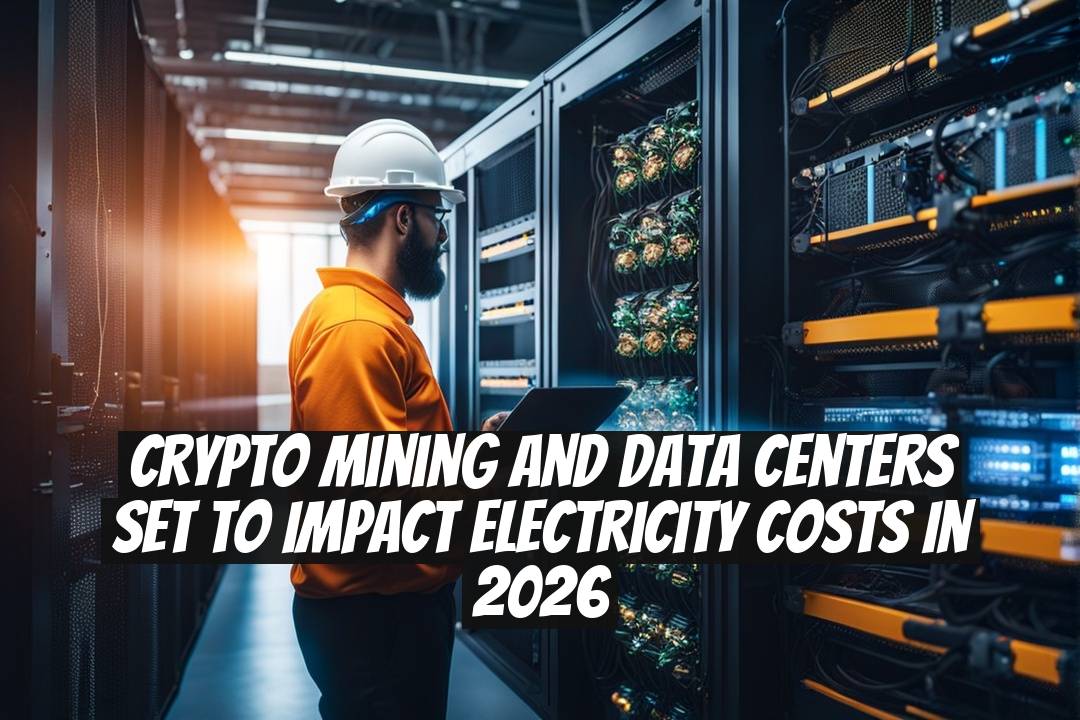
When Crypto Mining Meets Data Centers: Your Electric Bill’s Next Plot Twist ️
If you think your electricity bill’s already a monster, buckle up, because crypto mining and data centers are gearing up to smash those costs even higher in 2026. Yep, the digital gold rush and the ever-expanding data warehouses running the internet’s backbone are demanding juice like never before. It’s not just tech nerds worrying about this - your wallet and the grids powering millions of homes will feel the sting.
Data centers-those vast, humming complexes storing and processing petabytes of info-and crypto miners, the cool kids in the know who turn computational power into coins, are driving electricity consumption sky-high. A recent International Energy Agency (IEA) report forecasts that these two sectors alone will double the energy consumption of data centers to over 1000 terawatt-hours (TWh) by 2026-that’s roughly Japan’s entire electricity use![1] Meanwhile, U.S. energy watchdogs warn wholesale prices will rise sharply, with Texas data centers and crypto farms leading the charge.[3]
Sounds like a perfect storm brewing, doesn’t it? Let’s unpack why this surge is happening, what it means for investors like you, and why understanding market mechanics here isn’t just for the engineers but savvy crypto players trying to read the next big shift.
Key Takeaways
- Data centers and crypto mining will double electricity demand by 2026, as AI and blockchain-based services explode in scale.[1]
- Bitcoin remains a huge energy hog, consuming upwards of 120 TWh per year, while Ethereum’s switch to proof-of-stake slashed its usage by 99% in 2022.[1]
- Wholesale electricity prices, especially in data-center-heavy regions like Texas, are expected to climb 8.5% in 2026, driven by surging demand and tight supply.[3]
- Cooling and GPU-powered AI workloads are major drivers of energy consumption within the data centers, making efficiency upgrades critical but insufficient to fully curb demand.[1]
- Historical price and demand dynamics hint at ripple effects on market liquidity and dominance cycles in crypto trading during these stress periods.
? Data Centers & Crypto Miners: Why They’re Energy Gluttons
Imagine a giant warehouse packed wall-to-wall with servers spinning at full throttle 24/7-this is your typical data center. But unlike grandma’s old desktop, these beasts pack graphics CPUs (GPUs) designed to run complex AI models or crunch huge blockchain calculations. AI applications alone are fueling a voracious appetite, with NVIDIA sporting a 95% market share in AI server chips and pushing out over 100,000 units a year, each guzzling massive power. Throw in crypto miners-that specialized subset of data centers competing to verify transactions and secure blockchain ledgers-and you get a potent recipe for higher electricity demand.[1]
Bitcoin mining, with its proof-of-work mechanism, is notoriously energy-intensive. The IEA estimates Bitcoin alone will consume about 120 TWh annually by 2023, contributing majorly to the collective tally of crypto energy use. Ethereum’s pivot to a much leaner proof-of-stake protocol slashed their demand dramatically-down by 99% in 2022-offering a beacon of hope for energy-conscious crypto enthusiasts.[1]
But here’s the kick: the efficiency gain in one crypto can be offset by growing demand in others. Plus, the servers running AI and other blockchain-related tech keep multiplying. Altogether, IEA forecasts that data centers’ electricity use will soar, roughly doubling from 460 TWh in 2022 to over 1000 TWh by 2026.[1]
? Market Mechanics: The Domino Effect on Electricity Prices

You might ask-okay, why should I care about electricity prices spiking? Because this affects crypto mining profitability, data center operations, and even the broader energy market.
Subscribe to our Social Media for Exclusive Crypto News and Insights 24/7!
The U.S. Energy Information Administration (EIA) points out that wholesale electricity prices are rising nationwide, led by Texas, Oklahoma, and other energy-heavy states, where data centers and mining farms flex their power-hungry muscles.[3] For instance, the Electric Reliability Council of Texas (ERCOT) pricing hub expects prices to increase 45% in 2026 with summer demand spikes ringing the alarm.[3]
Let’s break down the interaction with crypto market behavior:
- Dominance cycles: When energy costs ramp up, miners with thin margins often get squeezed out. Historically, we’ve seen Bitcoin dominance spike during such crunch periods because smaller altcoin miners pause operations, reducing supply and liquidity.
- ADX (Average Directional Index) shifts: Surge in electricity costs often correlates with increased volatility or directional trends in crypto prices as market participants price in mining difficulties and hash rate drops.
- Liquidation cascades: Rapid changes in mining profitability or infrastructure costs can trigger forced selling among over-leveraged miners, cascading into broader market liquidations (think of margin calls on massive miner-held positions).
A trader I chatted with pointed out, "The current setup looks eerily like 2021’s blow-off top followed by aggressive corrections when power prices hiked. Miners folding then triggered cascading sell-offs that crushed altcoins hard." Flashbacks to December 2017’s Bitcoin dominance spike after miners struggled through a price plunge are still vivid.[1][3]
? Deep Dive: The Data Center Landscape Where It Matters Most
Not all states-and by extension, not all power grids-are created equal. Most U.S. data centers cluster in a handful of states like Virginia, Illinois, Ohio, and Texas, each wrestling with capacity auction prices skyrocketing just to keep the lights on.[4] Capacity auction prices for 2025-2026 in PJM Interconnection states hit a staggering $16.1 billion, with data centers as prime drivers.[4]
This concentration means the stress isn’t uniform but localized spikes could provoke bouts of energy insecurity, forcing utilities to raise prices to manage demand. In some markets, energy costs spike hourly, especially during hot summer afternoons when cooling demand shoots through the roof.
The bigger picture? If your favorite altcoin’s network is mostly mined in these hot zones, expect mining difficulty and profitability oscillations to follow suit. Managing crypto portfolios without factoring in underlying energy economics in these zones? That’d be like trading commodities blindfolded.
? Bonus Insights: How AI’s Burgeoning Role Amplifies the Demand Game

AI is rapidly becoming a key player in this energy saga. Beyond crypto mining, massive AI workloads inside data centers need heaps of GPU power. NVIDIA’s near-monopoly means any growth in AI server sales spells more electricity consumption. The IEA’s numbers show AI will drive a significant portion of the doubling in power demand as sectors embed AI deeper into their software stacks.[1]
For crypto traders, the intertwining of AI and blockchain isn’t just about tech trends. AI-powered trading bots, predictive analytics, and on-chain intelligence tools all run on this electrified infrastructure. The data center load and crypto mining energy demand growth are two sides of the same coin, each feeding the ecosystem’s complexity and liquidity.
Wrapping Up With a Bit of Real Talk
Back in 2022, I held ADA through a 60% dump. It was brutal. But it taught me one lesson-market stress isn’t always about greed or fear; sometimes, it’s about things nobody sees directly: infrastructure costs, energy crunch, and cooling bills. Now, looking at 2026, it’s pretty clear that electricity in crypto-land isn’t just a line item - it’s a strategic battleground for who stays profitable and who folds.
The whales ain’t sleeping, fam. They’re rotating assets, hedging bets on energy trends, and pushing markets in sly ways.
If you’re holding crypto or eyeing that mining rig, watch energy pricing closely. This isn’t just gridlock; it’s the engine driving the next big crypto shakeout.
FAQ About Crypto Mining, Data Centers & Electricity Cost Impact in 2026
Q1: What role do data centers play in increasing electricity demand linked to crypto mining?
A1: Data centers house the servers needed for both AI and crypto mining operations, drawing huge amounts of electricity. As both industries grow, their combined energy consumption is expected to double by 2026, significantly impacting electricity demand and costs.
Q2: How has Ethereum’s energy use changed recently, and why does that matter?
A2: Ethereum cut its electricity consumption by 99% in 2022 by moving from proof-of-work to proof-of-stake consensus, dramatically lowering its impact on energy demand compared to Bitcoin, which still consumes very large amounts of power.
Q3: Why are electricity prices rising more in places like Texas compared to other states?
A3: Texas hosts many data centers and crypto mining farms, boosting electricity demand. Combined with natural gas price fluctuations and summer demand spikes, this causes wholesale electricity prices there to rise faster than in other regions.
Q4: How do rising electricity costs affect cryptocurrency market dynamics?
A4: Higher energy prices increase mining costs, often causing less efficient miners to drop out. This can shift dominance cycles towards Bitcoin, alter volatility indexes like ADX, and trigger liquidation cascades affecting overall market liquidity.
Q5: What is the connection between AI technology growth and data center electricity demand?
A5: AI workloads require powerful GPUs, which consume significant electricity inside data centers. Proliferation of AI applications is a major factor driving the projected doubling of electricity used by data centers by 2026.
crypto mining energy consumption
data center electricity cost
cryptocurrency electricity prices 2026
- https://www.datacenterfrontier.com/energy/article/33038469/iea-study-sees-ai-cryptocurrency-doubling-data-center-energy-consumption-by-2026
- https://calstart.org/data-centers-crypto-mining-forbes-current-climate-news-michael-berube/
- https://www.utilitydive.com/news/electricity-prices-demand-to-continue-rising-in-2026-eia/805395/
- https://energynewsbeat.co/data-centers-are-concentrated-in-a-handful-of-states-and-heres-whats-happening-to-electricity-prices/
- https://economictimes.com/news/international/us/is-the-us-facing-a-massive-electricity-shortage-heres-the-reason-and-why-americans-should-take-note/articleshow/125391655.cms