
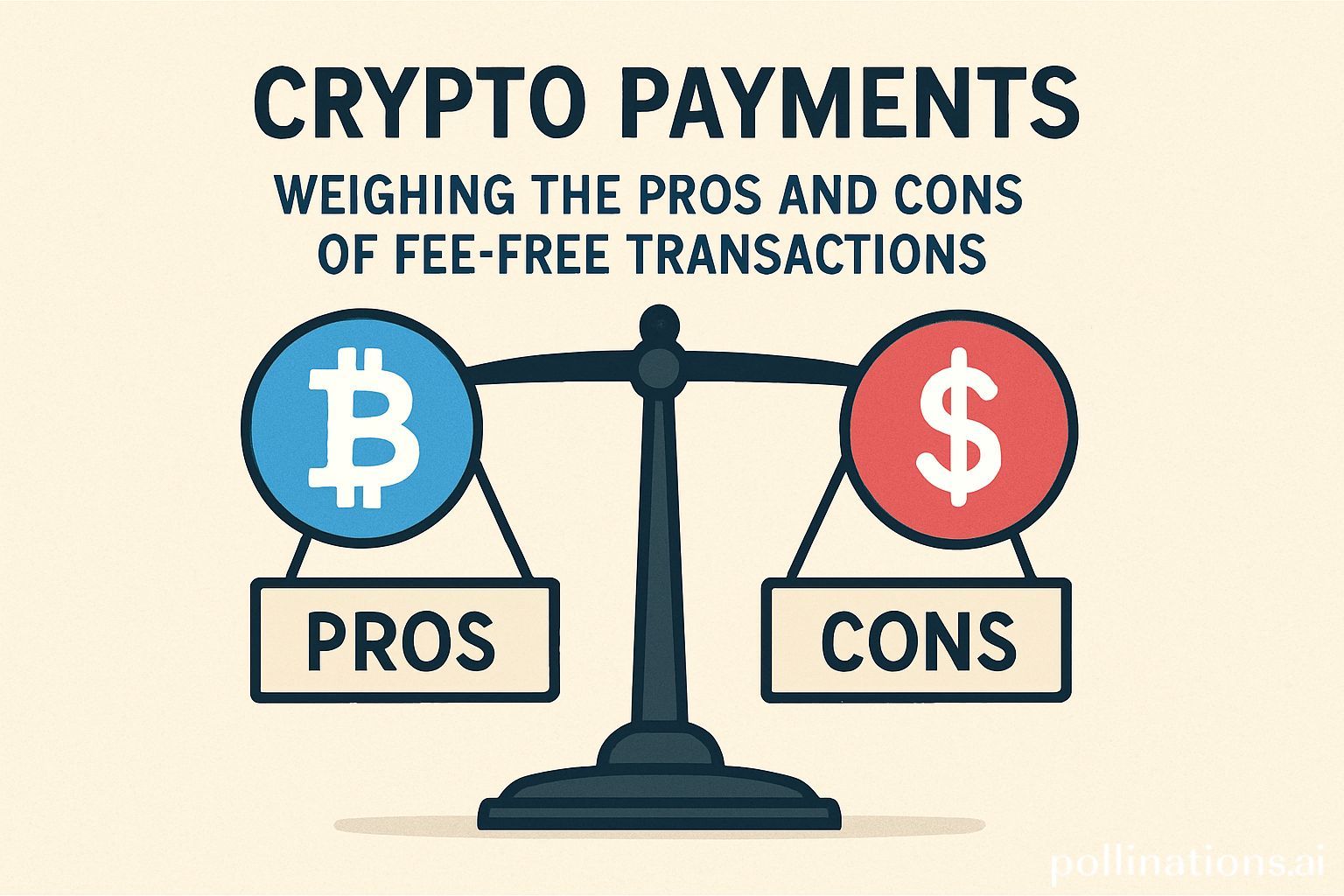
Fee-Free Crypto Payments: Dream Come True or Too Good to Be True?
If you’re knee-deep in crypto like me, you’ve probably daydreamed about fee-free transactions-buying, sending, receiving crypto without those pesky extra costs trimming your gains. Crypto payments are everywhere nowadays, but are fee-free transactions the future or just a shiny bait? We’re unpacking the pros and cons, diving deep into the market mechanics, real data, and expert insights, so you get the full scoop while avoiding rookie mistakes. Ready to weigh the realities of fee-free crypto payments? Let’s get into it.
Key Takeaways
- Fee-free crypto transactions offer speed and cost advantages but face adoption and security trade-offs.
- Cryptos like Nano and Stellar provide near-zero fees leveraging unique consensus models like DAG and SCP.
- Fee markets on Bitcoin and Ethereum fluctuate heavily - periods of near-zero fees happen but often coincide with low network demand.
- Traders must watch liquidity cascades, dominance cycles, and ADX volatility to avoid blow-ups during fee surges or market whiplash.
- Expert eyes warn that fee-free environments can attract abuse and limit miner incentives, potentially reducing security over time.
Subscribe to our Social Media for Exclusive Crypto News and Insights 24/7!
? Why Fee-Free Crypto Payments Are More Than Just a Nice Idea
Imagine trying to pay your coffee with Bitcoin only to lose 50 cents or more in transaction fees-talk about a buzzkill. That’s why fee-free crypto payments have an almost magical appeal. Cryptos like Nano (XNO) and Stellar (XLM) have built their whole ethos on eliminating or minimizing fees, using novel tech like Directed Acyclic Graphs (DAG) and Stellar Consensus Protocols to bypass traditional miners and validators who typically charge fees for including your transaction on the blockchain[2][3].
This means transactions can bounce across the network faster and cheaper than major players like Bitcoin or Ethereum, whose fee markets spike during congestion. In fact, Bitcoin fees have collapsed recently, with what’s called "free blocks" - blocks where users pay about 1 satoshi per byte or less - becoming increasingly common due to lower mempool competition[4]. But here’s the thing: these low-fee or fee-free windows are often cyclical and can vanish quickly when demand surges, so it ain’t a guarantee.
Let me put it like this: Back in 2022, I held ADA (Cardano) through a brutal 60% dump, painful as hell. But the lesson? Fee environments change market dynamics drastically - you gotta know how to time your moves or you get squeezed. The same goes for crypto payments; fee-free is a great selling point, but the devil’s in the details.
? Fee-Free Isn’t Free in the Miner’s Eyes

Here’s the catch with fee-free crypto: miners and validators still gotta get paid somehow. Bitcoin miners earn rewards from block subsidies plus transaction fees. When fees evaporate, which happens during low network usage, this reduces miners’ income and could threaten network security long term if it discourages miners from protecting the blockchain[4].
Think of miners like the security guards of a club-they need tips to keep showing up. No tips? They might slack off or leave, opening the door for troublemakers.
In fact, Bank of America’s research (2025) points out that fee collapses have occurred in cycles, especially after the 2024 Bitcoin halving, putting an interesting spotlight on miner incentive mechanisms[1]. So while fee-free sounds amazing to users, it’s a balancing act to sustain network security.
? Which Cryptos Are Killing It with Low or Zero Fees?
Here’s a quick rundown of some of the cheapest ways to move crypto around, from solid industry sources:
| Crypto | Average Fee (USD) | Key Features | Best Use Case |
|---|---|---|---|
| Nano (XNO) | $0 | DAG-based, no miners, instant settlements | Micropayments, frequent transfers |
| Stellar (XLM) | ~$0.0000041 | SCP consensus, ultra-low fees, fast | Cross-border payments, remittances |
| Monero (XMR) | $0.00014 | Privacy-focused, reasonable fees | Anonymous transactions |
| Ripple (XRP) | $0.0011 | RPCA consensus, cheap & global payment | Small international transfers |
| Bitcoin (BTC) | $0.62 (avg. 2025)* | Traditional PoW, fee market fluctuates | Store of value, large transfers |
*Note: Bitcoin’s fees vary widely with congestion, sometimes dipping near zero during calm periods[2][3][4][9].
If you’re eyeing fee-free crypto payments, Nano and Stellar lead the pack, but adoption matters. Nano’s lightning-fast, zero-fee model is sexy but still niche compared with Stellar’s more extensive ecosystem and partnerships.
? Real Market Mechanics Behind Those Sweet Fee-Free Deals
You’ve seen this before, right? BTC teasing breakout then faking out - fee patterns move the same way. Analyzing dominance cycles (which coins own how much market share), ADX momentum (a volatility index traders swear by), and liquidation cascades (mass forced selling events) explain a lot about when fees spike or drop.
For example, when ETH just “swanned” down to support last June 2025, we saw a mini surge in gas fees as DeFi activity ticked up. But when a prominent exchange tweaked its fee structure around August, liquidity cascaded, flattening volatility temporarily - this was a textbook liquidation event, wiping out weak longs fast[6].
A trader I spoke to said it looked eerily like the 2021 blow-off top, where fee spikes turned investor sentiment on a dime, reminding us that these fee-free utopias aren’t immune to market drama.
? The Real Pros and Cons of Fee-Free Crypto Payments
Pros
- Cost savings: Zero or near-zero fees are a no-brainer for day-to-day transfers, micropayments, and remittances.
- Speed: Systems like Stellar and Nano process transactions in seconds-way faster than Bitcoin confirmations.
- Accessibility: Low fees broaden financial inclusion, especially for users in emerging markets.
- Transparency: Cleaner fee structures mean you know exactly what you’re paying.
Cons
- Security risks: Without robust miner/validator incentives, network security can weaken, increasing attack risk.
- Limited adoption: Fee-free cryptos often lack widespread acceptance in wallets, exchanges or merchants compared to giants like BTC/ETH.
- Network load: Higher activity without fees can lead to congestion, ironically causing delays.
- Vulnerabilities: Fee-free or low-fee models can be exploited by spam or Sybil attacks.
If you think fee-free means “easy street,” think again. It’s like free buffet nights-great until the kitchen runs out or the quality dips.
? What’s Next? Fee-Free Transactions: Trend or Gimmick?
2024 and 2025 saw a roller coaster for crypto payments. Bitcoin’s halving crushed rewards, pushing miner revenue reliance on fees, yet Bitcoin fees hit multi-year lows recently, synced with cooler DeFi and NFT action[4]. Institutional flows keep increasing, with $1.2 trillion of fiat-to-BTC movement alone, showing crypto payments are legit-but mostly not fee-free[5].
The question is whether networks can scale fee-free models without sacrificing security or liquidity. Layer 2 solutions like Lightning Network aim to reduce Bitcoin fees but haven’t cracked mass adoption yet. Meanwhile, zero-fee blockchains are exploring Proof of Stake tweaks, sharding, and niche use cases to navigate these trade-offs.
Honestly, it’s a wild west right now. One trader joked: “The whales ain’t sleeping, fam. They’re rotating between fee-free and fee-bull runs like pros.” So stay tuned, keep your eyes peeled on ADX trends, dominance shifts, and onchain fee analytics.
Because if you’re not paying fees, you really gotta ask: What’s the catch? For now, fee-free crypto payments offer a tantalizing glimpse of a frictionless future, but it’s a tightrope walk balancing user benefits and ecosystem health.
Crypto Payments FAQ: Weighing the Pros and Cons of Fee-Free Transactions (Must-Know Answers)
Q1: What exactly are fee-free crypto payments?
A1: Fee-free crypto payments are transactions conducted without paying the usual blockchain network fees, often enabled by alternative consensus models like DAG or special protocols. They promise cheaper and faster moves but may come with trade-offs in security or adoption.
Q2: Why do some cryptocurrencies have zero or near-zero transaction fees?
A2: Cryptos like Nano or Stellar use unique tech like the block-lattice or Stellar Consensus Protocol to remove miners or reduce validation costs, allowing almost free transactions. This design aims at making micro and cross-border payments affordable.
Q3: How do fee-free transactions impact blockchain security?
A3: Miners and validators rely on transaction fees for rewards; no fees can reduce their incentive to maintain and secure the network, potentially increasing vulnerability to attacks.
Q4: Are fee-free cryptos widely accepted for payments?
A4: Not yet. While fee-free cryptos are great in theory, adoption is limited compared to major players like Bitcoin and Ethereum, which dominate trading volume and merchant acceptance.
Q5: How do market mechanics like ADX or dominance cycles affect transaction fees?
A5: These factors reflect volatility and market control shifts that influence network congestion and fee demand. High volatility often means rising fees; calmer periods see fee dips, sometimes near zero.
Q6: Can fee-free crypto payments replace traditional payment methods?
A6: They have potential, especially for small or cross-border payments, but hurdles around scalability, adoption, and security still need clearing before mainstream replacement.
fee-free crypto transactions
crypto payment fees
low fee crypto payments
- https://nftevening.com/best-zero-fee-crypto-exchanges/
- https://cryptomus.com/blog/top-10-crypto-with-lowest-transaction-fees
- https://b2binpay.com/en/news/top-12-cheapest-crypto-to-transfer-and-save-on-transaction-fees
- https://www.galaxy.com/insights/research/bitcoin-onchain-fees-utxo
- https://www.chainalysis.com/blog/2025-global-crypto-adoption-index/
- https://www.blockpit.io/en-us/blog/is-now-a-good-time-to-invest-in-crypto
- https://ventureburn.com/crypto-exchange-with-lowest-fees/
- https://koinly.io/blog/crypto-exchange-with-lowest-fees/
- https://99bitcoins.com/cryptocurrency/bitcoin/fees/






