
How Institutional Investors Are Finally Growing Up: Why Diversification Is Eating Speculation’s Lunch
? The Shift Nobody Expected-Until It Made Perfect Sense
You know that moment when you realize you’ve been doing something wrong for years, and suddenly everything clicks? That’s basically what’s happening in institutional crypto right now. For the longest time, crypto was the wild west-"get rich quick" schemes, moonshot bets on whatever token was trending on Twitter, and speculation masquerading as analysis. But something fundamental shifted in 2024 and into 2025, and honestly, it’s kind of beautiful to watch.
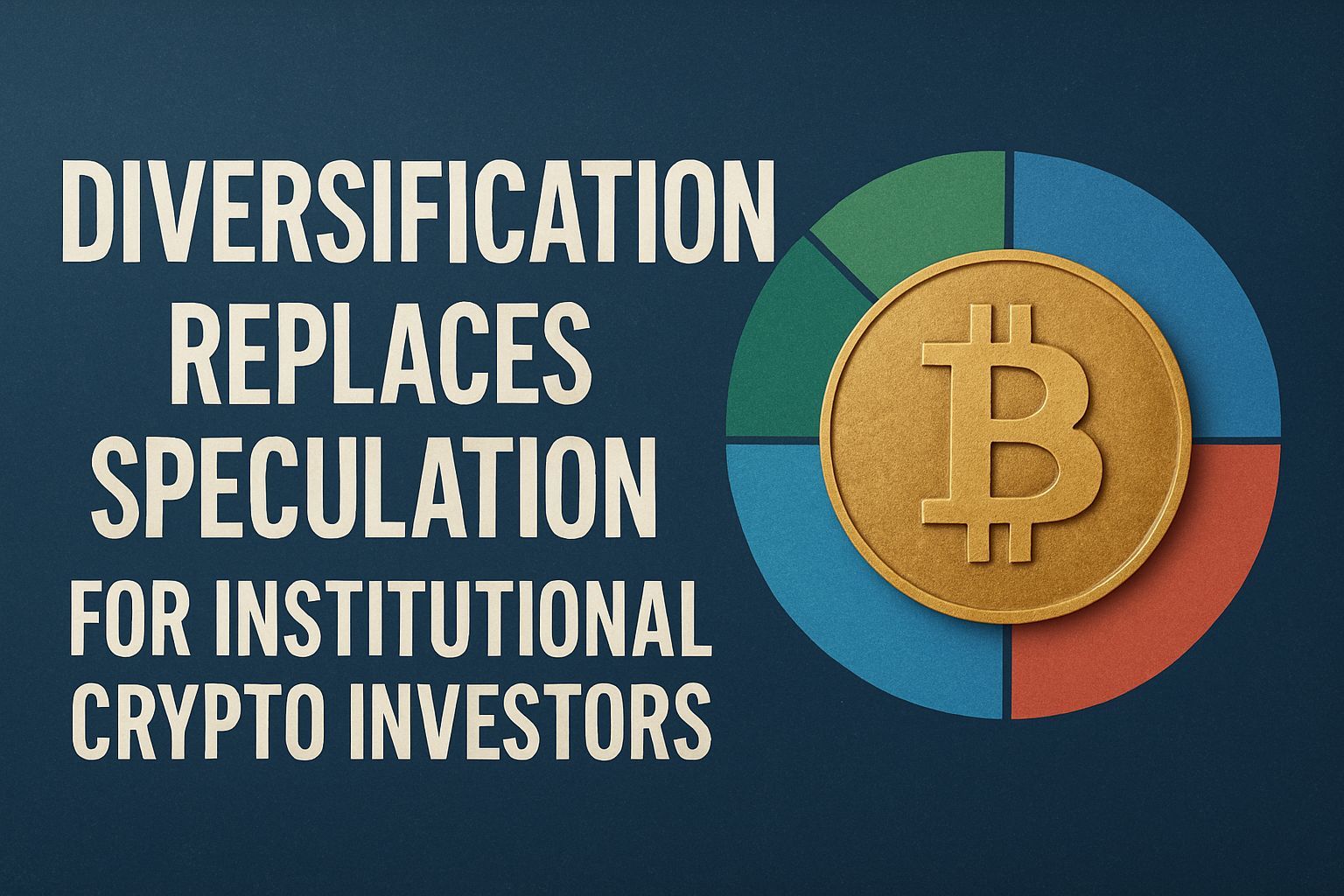
Portfolio diversification has officially replaced speculation as the core investment thesis for institutional crypto investors[2]. Let that sink in for a second. For the first time ever, 57% of institutional respondents rated portfolio diversification as their primary reason for holding digital assets-beating out short-term returns (53%) and the "crypto as insurance" narrative (45%)[2]. That’s not just a trend shift; that’s a fundamental mindset realignment happening across hedge funds, private equity, family offices, and pension funds worldwide.
Subscribe to our Social Media for Exclusive Crypto News and Insights 24/7!
And here’s the kicker: 59% of institutional investors plan to allocate over 5% of their assets under management (AUM) to cryptocurrencies in 2025, with many pushing beyond that threshold[4]. We’re not talking about millions anymore. We’re talking about trillions being redeployed into digital assets. But unlike the old guard of retail speculators throwing money at the next Dogecoin variant, these institutions are thinking like-well, institutions. They’re building frameworks. They’re hedging risk. They’re treating crypto like grown-ups treat investments.
Key Takeaways
- Institutional crypto allocation is shifting from speculation-driven trades to diversified, multi-asset portfolio strategies
- 86% of institutional investors already have or plan to allocate to digital assets, signaling mainstream acceptance[3]
- Bitcoin and Ethereum now anchor portfolios as "core holdings," with altcoins serving as satellite diversifiers
- Actively managed mandates are replacing single-token exposure, adapting to policy and event-driven markets
- Real-world asset tokenization and DeFi yield strategies are expanding the investable universe beyond pure speculation
? The Numbers Don’t Lie: Institutional Money Is Voting With Its Feet
Let me paint you a picture. Back in 2022, when the crypto market was imploding-FTX was collapsing, Terra had already nuked itself, and every major exchange looked like it might go under-the smart money was supposed to leave. Instead, they doubled down. Why? Because they saw something retail traders couldn’t: an opportunity to build real infrastructure and real portfolios instead of gambling on hype cycles.
Fast forward to now. Professional investors hold $27.4 billion in U.S. Bitcoin ETFs alone[1]. Alone. That’s not counting Ethereum ETFs, spot crypto holdings, or any of the derivative positions we’ll get into. That’s just the boring, "I’m putting this in my 401(k)" Bitcoin exposure. And here’s the wild part: 80% of institutions are interested in crypto ETFs beyond Bitcoin and Ethereum[2]. They’re not satisfied with just the blue chips. They want exposure to the entire ecosystem.
This matters because it signals a crucial transition. When institutions start asking for more diversification, not less, you know the market’s grown up. They’re not chasing alpha through concentration risk anymore. They’re chasing steady returns through rational allocation.
?️ The Architecture: How Institutional Portfolios Actually Work Now

Okay, so institutions aren’t just throwing darts anymore. They’ve built an actual framework-multiple frameworks, actually[1]. Let me break down what’s gaining serious traction in 2025:
The Classic Institutional Three-Tier Model

Core Holdings (60-70% allocation)
Bitcoin and Ethereum sit here. Not because they’re the sexiest tokens-they’re not. But because they’re the most liquid, most widely adopted, and least likely to get you fired in a board meeting. Bitcoin typically claims around 40% of the core allocation, while Ethereum takes about 20%. Think of them as the "defensive" positions. They anchor the portfolio. They’re the reason you can sleep at night when the market goes sideways.
A trader I spoke with-someone managing institutional allocations at a mid-sized crypto fund-put it this way: "BTC and ETH are table stakes now. If you’re not holding them, you’re not serious. They’re the foundation. Everything else is built on top." And he’s right. These assets have survived every market cycle, every regulatory attack, every "Bitcoin is dead" headline. They’ve earned their stripes.
Satellite Diversifiers (20-30% allocation)
This is where it gets interesting. We’re talking Layer-2 protocols, DeFi tokens, large-cap altcoins, and emerging narratives like real-world asset (RWA) tokenization and interoperability plays[1]. The idea here is that while your core holdings keep you stable, your satellite positions give you exposure to the next evolution of finance without blowing up your entire portfolio.
Imagine SOL crashed 30% tomorrow. If you’re properly diversified, that’s maybe a 3% portfolio hit, not a 30% catastrophe. That’s the whole point. You’re not betting on any single narrative. You’re hedging across narratives because, honestly, nobody knows which one wins.
Tactical Allocation (5-10% flexibility)
This is the opportunistic bucket. Emerging tokens, special situations, high-conviction trades that could compound faster. But here’s the key: it’s capped. It’s not the bulk of your portfolio. It’s the "what if I’m right about this obscure Layer-2" position, not your entire net worth.
? Why This Shift Matters More Than You Think
Let me be real with you. Back in 2021, I knew people-smart people, actually-who put their entire savings into one altcoin. One. It was "the next Ethereum," according to whatever influencer they were following. You know what happened? It went to zero. Not 50% down. Zero. Completely rug-pulled. And it crushed them financially and psychologically.
That’s not an outlier story. That’s the norm for speculation-driven investing. The reason institutions are moving away from this isn’t because they’re boring. It’s because they’re empirically right. Diversification works. It always has. It always will.
Here’s what changed: the infrastructure caught up with the narrative. Five years ago, if you wanted to build a truly diversified crypto portfolio as an institution, it was a nightmare. Limited liquidity outside of BTC and ETH. Regulatory gray areas. Custody solutions that were sketchy at best. Now? You’ve got institutional-grade infrastructure, clear regulatory pathways (at least in some jurisdictions), and enough market depth to deploy serious capital without moving markets.
The proposed Retirement Investment Choice Act is particularly huge here-it would formally permit crypto in 401(k) plans[3]. That’s not just regulatory; that’s a permission slip for pension funds and retirement systems to allocate. When that passes (and it will, eventually), you’re talking about hundreds of billions in new institutional capital flowing into crypto. But it’s not going to flow into random meme coins. It’s flowing into diversified, boring, sensible portfolios.
? The Actively Managed Revolution
Here’s something that surprised me: single-token exposure is basically dead in institutional crypto now[2]. The new dominant strategy? Actively managed mandates. Discretionary. Flexible. Adaptive to changing market conditions.
Why? Because the market’s not driven by hype anymore-not entirely, anyway. It’s driven by policy. By regulation. By macro conditions. By geopolitics. By actual adoption metrics. An actively managed mandate lets institutions react to these shifts without being locked into a static allocation.
Think about what happened in Q1 2025. ETH rallied hard because of ETF inflows and treasury demand. If you were passively holding a BTC-heavy portfolio, you missed alpha. If you were actively managing, you could rotate into ETH when the conditions warranted. That’s the difference between returns that barely beat inflation and returns that compound seriously over time.
? The Expanding Universe: Why There’s So Much More to Own Now
You know what’s really wild? The investable crypto universe has exploded beyond what existed even two years ago. We’re not just talking about Layer-1 blockchains and DeFi anymore. We’re talking about:
Real-World Asset Tokenization (RWAs)
Bonds, real estate, commodities-all being tokenized onto blockchain. This is huge for institutions because it’s familiar terrain. They already know how to think about bonds and real estate. Now they can own them on-chain, with better efficiency, fractional ownership, and 24/7 markets. This is bringing "boring" finance onto blockchain rails, which is actually way more important than people realize[1].
Yield-Bearing DeFi
Staking, lending, yield farming-but institutional-grade. We’re not talking about risking your whole stack on some yield farm with 500% APY that blows up in three weeks. We’re talking about 3-5% yields from established protocols with institutional audits. For a fund managing billions, a "boring" 3% beat in a low-yield environment is huge.
Infrastructure and Fintech
This is the meta-play. Rather than just holding tokens, some institutions are buying into the companies building the infrastructure. We’re talking Coinbase, Circle, Block, Robinhood-the picks and shovels of the crypto industry[3]. This is particularly smart because it gives you crypto exposure without the volatility of pure token holdings.
? Market Mechanics: Why Diversification Actually Protects You
Let me walk you through how this works in practice, because understanding the mechanics changes everything.
Dominance Cycles and Rotation Risk
Bitcoin dominance (BTC’s percentage of total crypto market cap) cycles between roughly 35% and 65%. When BTC dominance is high, altcoins get crushed. When it’s low, they explode. This is mechanical. It’s not about fundamentals; it’s about capital allocation flows.
If you’re 100% BTC and dominance cycles high, you’re fine. If dominance cycles low, you’re missing the altseason rally. A diversified portfolio-heavy in BTC but with real satellite exposure-lets you capture both scenarios without getting liquidated in either.
Liquidation Cascades and Correlation Breakdown
In extreme bear markets, crypto assets become highly correlated. Everything drops together. That’s when diversification seems worthless. But here’s the thing: it’s not. Because not everything recovers at the same pace. Bitcoin bounces back faster. Layer-2s follow. DeFi tokens lag. RWAs barely move because they’re more stable.
Back in the 2022 crash, I watched a friend’s portfolio get absolutely demolished because he had 80% in altcoins. But the institutions that held 60% BTC, 20% ETH, 15% Layer-2 tokens, and 5% in new narratives? They recovered first and strongest. That’s not luck. That’s math.
Exchange Counterparty Risk
Here’s something most retail traders don’t think about: where you hold your crypto matters. Institutions spread holdings across multiple venues-CEX (centralized exchanges) and DEX (decentralized exchanges)-specifically to mitigate counterparty risk[1]. If one exchange goes down (and they will, eventually), you’re not ruined. You’re annoyed.
? What This Means for Your Portfolio
Okay, let’s get practical. If you’re running your own portfolio-whether you’ve got $10k or $10M-how do you think about this?
First: Stop thinking about "which token will moon?" Start thinking about "what allocation gives me the best risk-adjusted returns?"
Second: Build your core. Bitcoin and Ethereum. Not because they’re exciting, but because they’re reliable. Think 50-70% of your portfolio depending on your risk tolerance.
Third: Diversify thoughtfully. Layer-2s, DeFi, RWAs, infrastructure plays. But don’t spray your money everywhere. Pick 3-5 narratives you actually believe in and allocate accordingly.
Fourth: Consider actively managed exposure if you’ve got the bandwidth. The market’s too event-driven to be purely passive right now. But if you can’t manage it, then get passive exposure through ETFs or index funds[2].
Fifth: Hedge your hedges. Use stablecoins not just as dry powder, but as actual portfolio allocation. 5-10% stables gives you the optionality to deploy in crashes. Boring? Sure. But that’s the point.
? What’s Next: The 2025-2026 Outlook
Here’s my honest take: we’re at an inflection point. The infrastructure’s there. The regulatory clarity is improving. The capital flows are massive. The question isn’t whether institutional adoption continues-it does. The question is how fast and in what form.
I’d watch three things closely:
1. The Retirement Act Pass - If crypto gets formally approved for 401(k)s, we’re looking at a different market entirely. Trillions of new capital. But it’s gonna be boring capital. Diversified, low-conviction, index-fund capital. Which actually stabilizes the market in a weird way.
2. RWA Tokenization Adoption - When you can actually buy tokenized Treasury bonds on Ethereum and get 5% yield with institutional custody, the entire fixed-income world starts paying attention. This is coming faster than people think.
3. Policy Clarity in Major Markets - If the EU, US, and Singapore all nail down clear regulatory frameworks in 2025, that’s a game-changer. Institutions need certainty more than they need returns.
Frequently Asked Questions About Institutional Diversification in Crypto
Q1: What exactly is meant by "diversification replaces speculation" in institutional crypto?
A1: Instead of betting heavily on individual tokens hoping for massive gains, institutional investors now prioritize spreading risk across multiple asset types-Bitcoin, Ethereum, altcoins, DeFi protocols, and real-world assets. This approach prioritizes steady, risk-adjusted returns over home-run plays. The shift reflects mature portfolio management philosophy applied to digital assets.
Q2: Why are Bitcoin and Ethereum considered "core holdings" in institutional portfolios?
A2: BTC and ETH dominate because of their liquidity, regulatory clarity, and proven track record through multiple market cycles. They’re the largest and most widely adopted digital assets, making them foundational for reducing portfolio volatility. Institutions treat them similarly to how traditional investors treat large-cap stocks-defensive, reliable, and hard to justify excluding from any portfolio.
Q3: How do institutions manage risk when investing in volatile altcoins?
A3: Institutions cap altcoin exposure at 20-30% maximum and actively manage these positions to adapt to market conditions. They also use multiple trading venues to mitigate exchange risk and employ hedging strategies through derivatives. This approach limits downside while maintaining upside participation in emerging narratives.
Q4: What role do ETFs play in institutional crypto allocation strategies?
A4: Over 80% of institutional investors want crypto ETF exposure beyond Bitcoin and Ethereum, with 70% willing to allocate more if ETFs offered staking rewards. ETFs simplify compliance, provide custody security, and allow institutions to gain diversified exposure without directly managing tokens. They’re essentially the on-ramp that traditional finance needs.
Q5: Are real-world asset tokenization and DeFi yield part of institutional portfolios now?
A5: Yes. Institutions increasingly allocate to RWA tokenization (bonds, real estate, commodities on-chain) and institutional-grade DeFi yield (3-5% from audited protocols). These expand the investable universe beyond pure speculation, offering familiar financial instruments with blockchain efficiency. This is why the "boring" corner of crypto is attracting serious capital.
Q6: How does actively managed crypto exposure differ from passive index investing in this space?
A6: Actively managed mandates allow institutions to rotate between assets based on policy shifts, macro conditions, and market catalysts. Passive index investing locks you into a static allocation. Given crypto’s event-driven nature and regulatory evolution, active management captures opportunities that passive strategies miss-but requires more sophistication and ongoing research.
Related Resources
Institutional Crypto Diversification
Bitcoin Ethereum Portfolio Allocation
Sources Referenced
- https://www.xbto.com/resources/building-a-diversified-crypto-portfolio-best-practices-for-institutions-in-2025
- https://ffnews.com/newsarticle/cryptocurrency/diversification-replaces-speculation-as-core-investment-thesis-for-institutional-crypto-investors/
- https://8figures.com/blog/crypto/crypto-enters-its-institutional-era-what-it-means-for-long-term-investors
- https://www.ey.com/content/dam/ey-unified-site/ey-com/en-us/insights/financial-services/documents/ey-growing-enthusiasm-propels-digital-assets-into-the-mainstream.pdf
- https://101blockchains.com/institutional-adoption-of-bitcoin/






