
Crypto Training Programs Are Stepping Up-Here’s What You Need to Know Right Now
The Real Talk on Getting Smart About Cryptocurrency
Look, if you’ve been paying attention to the crypto space lately, you know things are moving fast. Really fast. And the stakes? They’re getting higher every single day. That’s why educational workshops focused on crypto safety and competency aren’t just nice-to-haves anymore-they’re becoming essential.[6] In 2025 alone, global crypto scams hit a record $17 billion, powered by AI-generated personas and increasingly sophisticated laundering techniques.[6] Yeah, you read that right. So let’s talk about what’s actually happening in the world of crypto education and training programs designed to help you and professionals navigate this space safely.
Key Takeaways
Subscribe to our Social Media for Exclusive Crypto News and Insights 24/7!
- Crime is outpacing training: Global crypto scams reached $17 billion in 2025, proving that traditional training schedules can’t keep up with evolving threats.[6]
- Specialized certifications are booming: Law enforcement, prosecutors, financial investigators, and researchers now have access to hands-on blockchain forensics training.[1]
- Multiple learning pathways exist: From free community college workshops to intensive professional certifications, options range widely in scope and accessibility.[2][3][6][7]
- Practical, role-based learning wins: Programs emphasizing real-world scenario exercises and hands-on tools beat theoretical-only approaches.[1][6]
The Training Landscape is Expanding-But It’s Fragmented
Here’s the thing about crypto education in 2026: it’s everywhere, but it’s not all created equal. You’ve got everything from free webinars at community colleges to intensive law enforcement workshops to professional blockchain certifications. The quality varies wildly depending on who’s running it and what you actually need to learn.
On the law enforcement side, institutions like the Academy of Criminal Justice Sciences (ACJS) are running specialized workshops focused on cryptocurrency investigation and blockchain forensics.[1] These programs aren’t messing around. They’re designed specifically for patrol supervisors, detectives, prosecutors, fusion center analysts, and federal agents who need to actually trace transactions and identify wallet addresses in real investigations.[1] The March 2026 ACJS workshop, for instance, covers detection of money laundering through blockchain analytics, regulatory compliance, AML/KYC protocols, and hands-on exercises using actual forensic tools.[1] Participants learn to identify source and destination wallet addresses, transaction IDs, timestamps, and amounts transferred-the kind of practical skills that matter when you’re building a case.[1]
But here’s where it gets interesting: the barrier to entry for everyday people interested in crypto literacy is way lower. Lincoln Land Community College is offering free three-part virtual workshops in partnership with Fidelity and J.P. Morgan, covering everything from “Bitcoin and Digital Assets - Understanding the Digital Ecosystem” to implications of emerging technologies.[7] That’s right-free. On Zoom. No gatekeeping.
Where the Real Learning Happens

If you’re serious about building expertise, online platforms are stepping up. Coursera offers cryptocurrency specializations through the University of Pennsylvania that cover FinTech, blockchain technology, cryptography, fraud detection, and digital assets over 3-6 months.[2] You can audit courses for free, but if you want the certificate and full access, you’ll need to invest. The curriculum covers practical applications of blockchain, trading strategies, market analysis, and regulatory landscape-basically, everything you’d need to understand how crypto actually works in the real world.[2]
On the certification side, EC-Council’s Certified Blockchain Professional program is curated by experts and designed for developers, business leaders, and fintech professionals.[3] It covers development, implementation, and strategy across multiple industries-not just Bitcoin and cryptocurrency, but real-world blockchain applications.[3] The recommended learning path is about 3 months if you commit 10 hours per week, but you can customize it based on your background.[3]
Now, here’s where things get really interesting for people who need to stay current: Chainalysis Academy is changing the game with what they call an “always-on learning experience” that stays current as crypto evolves.[6] Instead of traditional one-off courses, they’re building continuous learning paths included with their software subscriptions-no per-user fees, role-based access.[6] More than 41,000 professionals across 1,500+ institutions and government agencies have earned Chainalysis certifications, and they’re basically saying: “We trained the people behind the world’s most consequential investigations and recoveries.”[6] That’s not hype; that’s track record.
Why Hands-On Training Actually Matters

Here’s what separates the good programs from the mediocre ones: they actually let you do the thing. The ACJS workshop doesn’t just talk about blockchain forensics; attendees engage in scenario-based exercises using document triage worksheets and crypto evidence collection guides, preparing them for immediate field deployment.[1] You’re learning sextortion cases, romance scams, pig butchering schemes, human trafficking-real scenarios that investigators actually face.[1] That’s not textbook theory; that’s preparation for the actual job.
Similarly, the Blockchain Intelligence & Practical Application workshop happening in Paris on February 17, 2026, emphasizes practical and effective training-the name says it all.[8] These programs understand that crypto crime (and legitimate crypto use) requires more than knowing what a blockchain is.
The Cryptography Angle: Post-Quantum Matters

There’s also a deeper layer worth considering. If you’re thinking about long-term crypto security and safety, programs like the Workshop on Evolving Cryptographic Paradigms at MANIT in India (which ran in January 2026) address post-quantum cryptography-basically, how current encryption schemes like RSA and ECC are becoming vulnerable to quantum attacks.[5] That might sound like sci-fi, but it’s the future of secure digital communication, and understanding these paradigms is increasingly relevant to crypto professionals and researchers.[5]
The Bottom Line
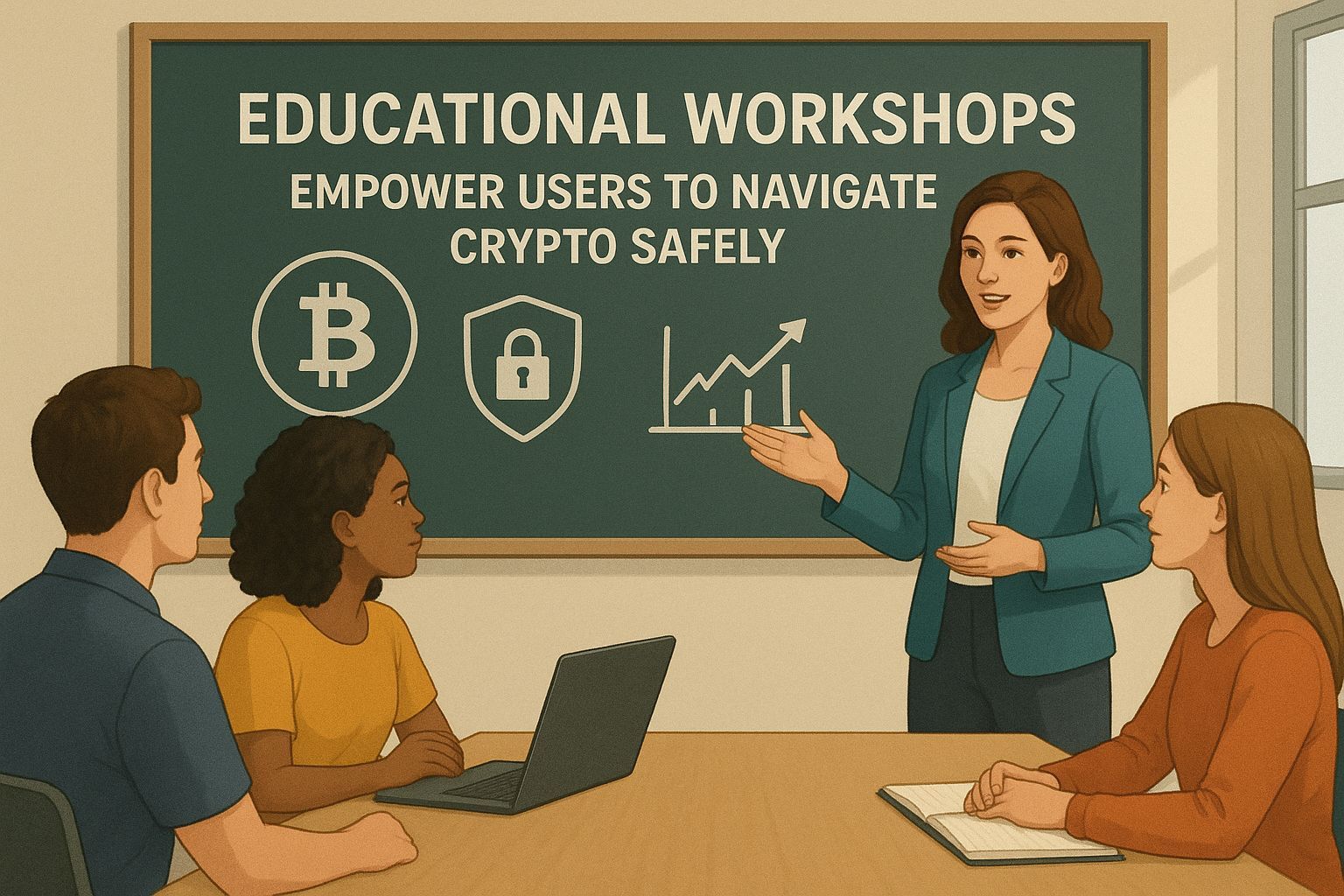
Educational workshops empowering users to navigate crypto safely aren’t a luxury-they’re becoming standard operating procedure for anyone serious about this space. Whether you’re law enforcement trying to solve crypto crimes, a financial professional understanding regulatory compliance, or an individual investor wanting to protect yourself from scams, there’s a program designed for your skill level and needs.
The market for quality crypto education is booming because it has to be. Crime’s moving faster than ever, regulations are tightening, and the consequences of getting it wrong are higher than they’ve ever been. The good news? Access is democratizing. You don’t need to be federal agent to learn blockchain forensics principles anymore. You don’t need deep pockets to understand how crypto actually works.
The better question isn’t whether you should get trained. It’s which program fits your timeline, budget, and goals. Because honestly, in a space where scams hit $17 billion in a single year, ignorance isn’t bliss-it’s expensive.
- https://members.acjs.org/event-calendar/details/2026-acjs-cybersecurity-workshop-fundamental-cryptocurrency-investigation-and-blockchain-forensics-1433116
- https://www.coursera.org/courses?query=cryptocurrency
- https://www.eccouncil.org/train-certify/blockchain/
- https://www.cchcpelink.com/live-webinar/digital-assets-and-cryptocurrency/31957/
- https://sites.google.com/view/crypto-2026/home
- https://www.chainalysis.com/blog/new-chainalysis-academy-2026/
- https://www.llcc.edu/news/llcc-offering-free-three-part-series-cryptocurrency
- https://blockchaintelligence.com/projects-bipa-practical-and-effective-blockchain-intelligence-training/






