Title
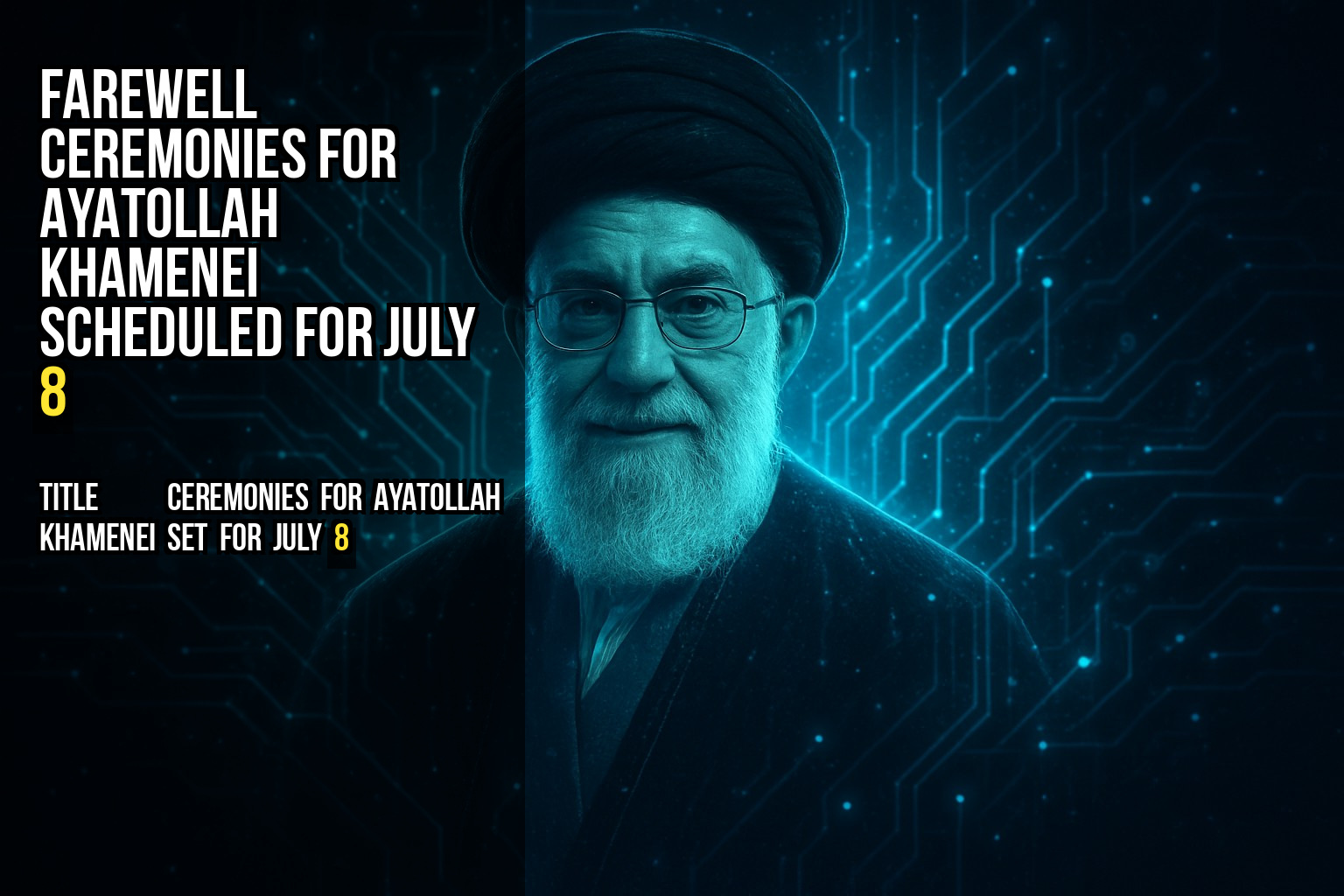
Farewell Ceremonies for Ayatollah Khamenei Set for July 8
Farewell ceremonies for late Supreme Leader Ayatollah Ali Khamenei are scheduled for July 8, 2026, as part of a six‑day, multi‑city procession spanning Tehran, Qom, Iraq, and Mashhad.[1][2][3] The planned route and timing underscore the scale of state‑organized mourning and regional coordination, particularly around the planned transfer of his body to Iraq for processions in Najaf and Karbala later that day.[2][3][8]
Overview
- Iran’s funeral headquarters has announced a six‑day schedule beginning July 4 in Tehran, with farewell and main funeral ceremonies in Tehran and Qom before the July 8 processions in Iraq.[1][3][8]
- The Tehran leg features a two‑day farewell at the Imam Khomeini Mosalla on July 4-5, followed by the main July 6 procession in the capital and a July 7 ceremony in Qom.[1][3][8]
- On July 8, Khamenei’s body is set to be transferred to Iraq, where Iraqi authorities have been asked to host processions in Najaf and Karbala, though exact times and locations remain pending Iraqi confirmation.[2][3][8]
- The final burial is scheduled for July 9 in Mashhad at the Imam Reza Shrine, coinciding with the night of Imam Sajjad’s martyrdom, tying the rites to a major Shia commemorative date.[1][3][4]
- Tehran Mayor Alireza Zakani has released a proposed route through Damavand, Enghelab, and Azadi streets, but the final section is still under evaluation, indicating last‑minute logistical and security planning.[2][7]
Subscribe to our Social Media for Exclusive Crypto News and Insights 24/7!
Farewell Ceremonies on July 8
The July 8 schedule represents the cross‑border phase of the mourning, with Iran coordinating the transfer of Khamenei’s body to Iraq at the request of tribes, scholars, and political and religious figures in Baghdad.[2][3][8] Iraqi authorities have not yet issued detailed public timetables, leaving the specific sites and security arrangements for the Najaf and Karbala processions still open.[3][7]
Iranian state media describe the July 8 events as both a farewell and a procession, emphasizing participation from Iraqi elites and religious leaders.[2][3] This aligns with traditional practice of rotating major funerary rites for senior figures between key Shia centers in Iran and Iraq, reinforcing clerical networks and regional influence.[3][8]
Multi‑City Procession Plan
The overall plan spans five cities over six days, starting with two‑day farewells in Tehran on July 4-5, followed by the main July 6 procession in the capital and a July 7 ceremony in Qom.[1][3][8] These domestic stages allow large‑scale public participation and security marshaling before the international leg in Iraq.[2][3]
The July 8 procession in Iraq is framed as a response to “repeated requests” from Iraqi figures, underscoring the ritual and political weight of hosting the funeral of Iran’s Supreme Leader on Iraqi soil.[2][3] The planned route in Tehran-through Damavand, Enghelab, and Azadi streets toward the Lashgari Expressway-reflects the anticipated scale of crowds and the need to manage traffic and security in central Tehran.[2][7]
Final Burial in Mashhad
The July 9 burial in Mashhad, at the Imam Reza Shrine, positions Khamenei’s resting place within one of Shia Islam’s most venerated sites.[1][3][4] Authorities have linked the timing to the night of Imam Sajjad’s martyrdom, a date with heightened religious significance that is likely to draw large pilgrimages and additional security deployments.[1][3]
Mashhad’s role as Khamenei’s hometown and a major pilgrimage center amplifies the symbolic and political value of the burial location.[3][4] The convergence of commemorative and funerary rituals in the shrine complex may also influence movement patterns and security posture across the city.[1][3]
Logistical and Security Implications
Tehran’s municipal authorities continue to evaluate the final sections of the July 6 procession route, suggesting that traffic management, crowd control, and security assessments remain in flux.[2][7] The combination of multiday domestic events and a cross‑border transfer on July 8 increases the complexity of coordinating police, intelligence, and ceremonial units.[2][3]
Iraq’s decision‑making on exact venues and security protocols in Najaf and Karbala will also shape the practical execution of the July 8 farewell.[3][7] Any delays or changes in Iraqi coordination could compress or alter the timeline of processions on that day.[2][3]
Regional and Political Context
The decision to include Iraq in the funeral schedule signals ongoing efforts to reinforce clerical and political ties between Tehran and key Iraqi religious and tribal centers.[2][3] The presence of Iraqi figures in the procession and the logistical support needed for the July 8 transfer may further test or solidify bilateral coordination in an environment of elevated regional tensions.[1][3]
At the same time, the timing of the ceremonies-following Khamenei’s death in U.S.‑Israeli strikes on February 28-frames the July 8 events within a broader narrative of martyrdom and resistance in state‑run narratives.[2][3] This framing is likely to influence public messaging and security‑related decisions around the processions in Tehran, Qom, Iraq, and Mashhad.[1][3]
Remaining Uncertainties
Despite the detailed schedule published by Iran’s commemoration headquarters, at least two key uncertainties remain: the final confirmation and publicization of Iraqi procession times and venues in Najaf and Karbala, and the exact route and security configuration for the later stages of the July 6 Tehran procession.[2][3][7] Iraqi authorities have not yet issued matching announcements, leaving the July 8 rites partially contingent on Baghdad’s operational decisions.[3][7]
Separately, the intersection of large‑scale mourning events with potential security sensitivities in multiple cities raises the risk of last‑minute route changes, crowd dispersals, or restricted access for segments of the public.[2][3] These factors could affect the perceived scale and public experience of the farewell ceremonies on July 8, even as the official schedule remains in place.[2][7]
Numbered source list
[1] https://www.nampa.org/text/22949003[2] https://en.964media.com/48456/
[3] https://www.presstv.ir/Detail/2026/06/22/770892/Iran-six-day-funeral-martyred-Leader-Tehran,-Qom,-Iraq,-Mashhad
[4] https://www.youtube.com/watch?v=8wnATlfqwJc
[5] https://www.facebook.com/WISHNews8/posts/irans-state-run-news-agency-said-saturday-funeral-processions-for-its-former-sup/1428738395966679/
[6] https://www.jpost.com/middle-east/iran-news/article-888752
[7] https://www.kurdistan24.net/en/story/920564/iran-announces-funeral-procession-for-ayatollah-khamenei-confirms-burial-plans-in-iraq
[8] https://www.taghribnews.com/en/news/727161/funeral-ceremonies-for-late-leader-ayatollah-khamenei-announced