
“Florida’s Trying to Stack Sats Like a Sovereign Whale”
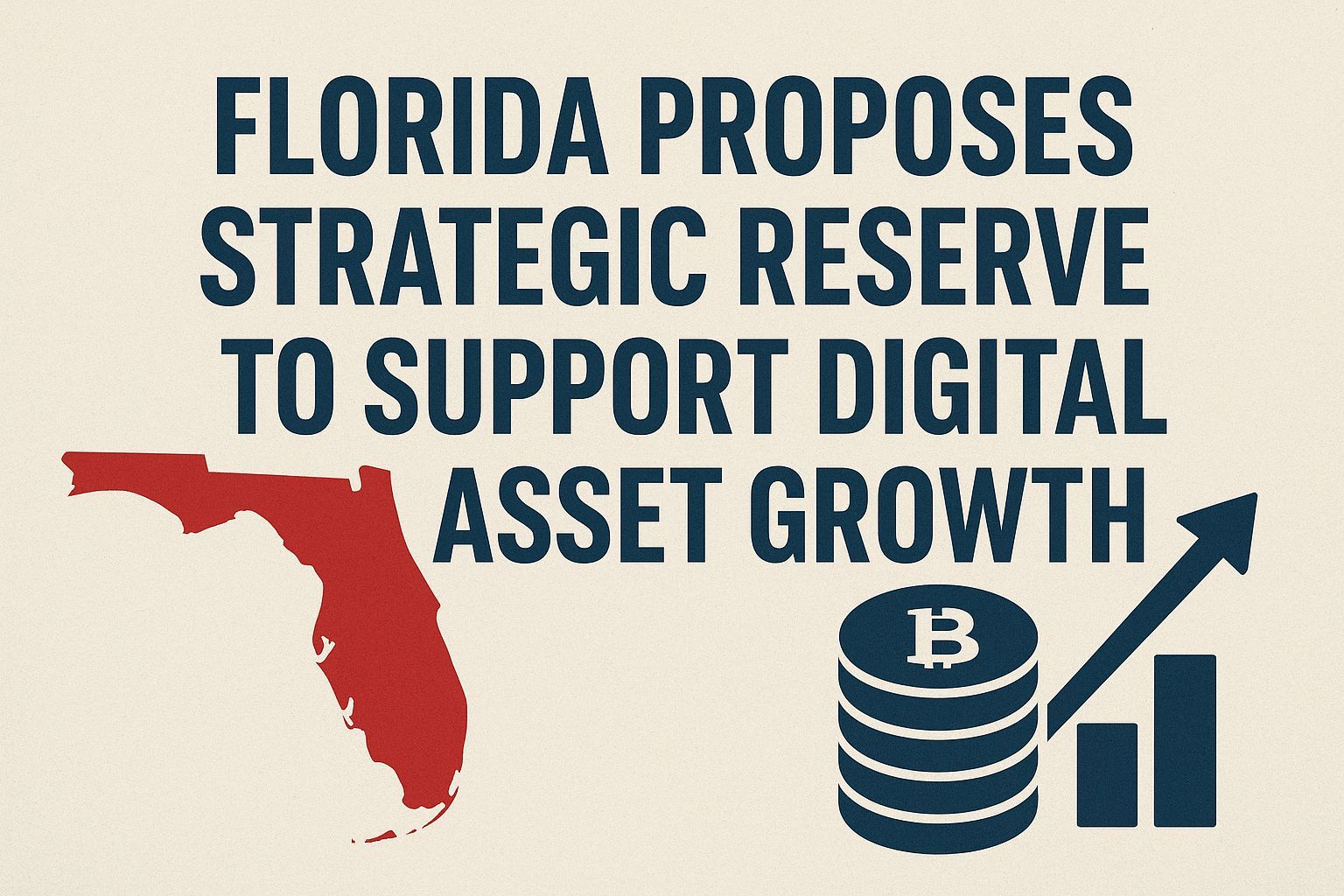
Florida’s push to create a Strategic Cryptocurrency Reserve - effectively a Bitcoin reserve - via House Bill 1039 and related Senate bills is one of the clearest signals yet that U.S. state-level players want direct exposure to digital assets as a strategic hedge and growth driver.[1][3][4][5] In plain English: Florida is seriously considering putting BTC on the state’s balance sheet, outside the normal treasury structure, with a tightly controlled, Bitcoin-first design to support digital asset growth over the long haul.[1][3][4][5]
Key Takeaways - Read This Before You Fade Florida
- HB 1039 = “Florida Strategic Cryptocurrency Reserve” - a special fund outside the State Treasury, overseen by the CFO, with its own structure, rules, and advisory committee.[4][6]
- Bitcoin-only… for now - eligibility requires a 24‑month average market cap of $500B+, which currently means only BTC qualifies; ETH and others are explicitly boxed out until they scale much higher.[1][3][4][5]
- CFO gets trading power & derivatives - the state’s Chief Financial Officer can buy, hold, sell, use third‑party custodians, and even use derivatives for risk management and strategy.[4][6]
- Funding sources are flexible - legal recoveries, revenue, purchases, airdrops, forks, and investment earnings can all feed the reserve.[4][5][6]
- Start date is strategic - conditional effective date of July 1, 2026, making this a bet on Bitcoin’s multi‑year trajectory, not a short‑term trade.[4][5][6]
- This is a hedge narrative, not a YOLO trade - Florida officials frame Bitcoin as “digital gold” and a protection against inflation and currency debasement, not as a speculative moonshot.[1][3][5]
- Following a broader playbook - parallels to New Hampshire, Texas, Wyoming, and even a federal Strategic Bitcoin Reserve order are explicitly cited as context and precedent.[3][5]
Subscribe to our Social Media for Exclusive Crypto News and Insights 24/7!
So What Is Florida Actually Proposing?
Florida’s HB 1039 is pretty clear if you strip out the legalese: the state wants a Strategic Cryptocurrency Reserve that operates like a dedicated, professionally managed crypto allocation for the state.[4][6]
Core mechanics:[4][6]
Structure:
- A special fund outside the State Treasury, legally distinct from normal cash balances.
- Tied to a trust-style framework via Senate companions SB 1038 and SB 1040.[5]
Admin & governance:
- Managed by the Chief Financial Officer (CFO), who’s explicitly empowered to acquire, hold, manage, and sell eligible digital assets.[4][6]
- CFO can pay costs directly using crypto in the reserve or its proceeds.[6]
- CFO is allowed to hire third‑party custodians, liquidity providers, and administrators.[4][6]
- Authority to use derivatives “under certain circumstances” - in other words, options/futures for hedging, risk control, or maybe even yield strategies.[4][6]
Advisory committee:
- A Florida Strategic Cryptocurrency Reserve Advisory Committee is set up inside the Department of Financial Services.[6]
- 5 members total, including 3 with crypto investment expertise and 1 digital asset security expert.[6]
- Their job: advise the CFO on management, custody, and risk. Essentially a built‑in “crypto investment committee” for the state.[6]
Funding sources:
- Legislative appropriations (i.e., lawmakers can allocate fiat into BTC).[4][6]
- Investment earnings from the reserve itself.[4][5]
- Digital asset rewards, forks, airdrops, and even certain legal recoveries.[4][5][6]
It’s not some vague “we’ll look at crypto one day” statement. It’s an actual operational framework - custodians, derivatives, audits, and all.[4][5][6]
Why This Is Basically a Bitcoin-Only Reserve (By Design)

Here’s the killer clause: only assets with a 24‑month average market cap of at least $500B are eligible.[1][3][4][5]
- Bitcoin - north of $1T+ in recent cycles, and CoinMarketCap data routinely places BTC as the only crypto above that size for extended periods.[4][5][8]
- Ethereum - ~$300-$400B historically in recent peaks; below the 24‑month $500B threshold.[4][8]
- Everything else? Not even close.
CryptoBriefing spells it out: based on current market values, only Bitcoin qualifies, with ETH “potentially” eligible in the future if it can sustain a much higher cap for two full years.[4] Bitbo and Bitcoin Magazine both emphasize the Bitcoin-only reality of the threshold, describing it as effectively creating a Bitcoin reserve.[1][5]
Supporters lean into this narrow framing:
- Bitcoin framed as “digital gold” - Florida CFO Jimmy Patronis has publicly referred to BTC that way, calling for limited but meaningful exposure as a portfolio diversifier against inflation.[1][3]
- Earlier, broader bills (allowing up to 10% of certain state funds into a wide range of crypto, NFTs, etc.) ran into heavy pushback and were withdrawn.[1][3][5]
- The new approach is deliberately tighter, simpler, and more politically sellable: one main asset, clear threshold, hard rules.
So while the official wording says “digital assets,” anyone reading the eligibility math can see: this is a BTC reserve with optional ETH-on-hard-mode sometime in the future.[1][3][4][5]
From “Let’s Buy All the Crypto” to “Let’s Just Stack BTC”

Earlier Florida proposals - like HB 487 and SB 550 - tried to do a lot more:
- Allowing up to 10% of certain public funds (including pension-linked funds) in a broad mix of digital assets.[3][5]
- Including things like NFTs and structured products, which spooked risk-averse stakeholders.[3][5]
Those efforts hit resistance over:
- Scope (too broad).
- Risk (volatility + pensions = political nightmare if timing is bad).
- Perception (feared as speculative gambling with taxpayer-related money).
They were withdrawn in May 2025.[5]
HB 1039 and SB 1038/1040 are essentially the “version 2.0” response:[1][3][4][5]
- Narrow focus on large-cap, battle-tested BTC.
- Keep it outside the core treasury to ring-fence risk.
- Build in independent audits and formal oversight.[1][3][4][6]
- Add an expert advisory committee to make it look (and actually be) institutionally serious.[6]
One analyst quoted in coverage framed it as:
“This isn’t the ‘ape into altcoins’ bill from 2025. It’s a risk‑managed Bitcoin allocation with institutional guardrails.”[3][4]
Honestly, that’s about right.
Market Mechanics: Where This Sits in the Bitcoin Cycle

You and I both know: the real question is cycle timing. Are they trying to buy the top, or front‑run the next leg?
Several outlets contextualize the move inside the current Bitcoin market structure:[1][3][4][5][8]
- Bitcoin has consistently maintained market dominance north of 45-50% through recent cycles, with CoinMarketCap data showing BTC as the anchor asset even when alt seasons pop.[4][8]
- Historically, when BTC dominance rises, it signals:
- Rotation into safety, away from alts.
- Early-to-mid stages of a macro bull phase where institutions want BTC first, everything else later.
On-chain and market trend narratives often mention:
- ADX-style momentum trends: When BTC’s trend strength is high (think ADX readings elevated during major runs), institutions tend to add on pullbacks rather than fade the move.
- Liquidation cascades: During sharp corrections, perp markets flush leveraged longs, clearing out froth. Those shakeouts have historically been where bigger players quietly add size.
Here’s where Florida’s structure matters:
- No forced timing - the reserve isn’t some one-shot, all-in BTC buy. It can scale in via appropriations, earnings, and opportunistic accumulation.[4][5][6]
- CFO + derivatives = they can hedge - using futures or options to smooth volatility, roll exposure, or even short against spot for risk control.[4][6]
- Long effective date - aiming at July 1, 2026 suggests this is a macro bet on BTC’s role in a future monetary system, not a bet on any given quarter.[4][5][6]
A trader quoted in one report put it bluntly:
“If a U.S. state is setting up a structure to dollar‑cost‑average into BTC over years with derivatives for risk, that’s not top‑signal behavior. That’s ‘we’re late, but we’d rather be long than flat.’”[4][5][8]
You’ve seen this before, right? BTC teases a breakout, fakes out, nukes leveraged longs, and then grinds higher while institutions quietly build positions.
Historical Parallels: States, Sovereigns, and Strategic BTC Stacks
Florida isn’t operating in a vacuum. Multiple sources point to a growing public-sector Bitcoin playbook:[3][4][5][8][9]
Other U.S. states:
- New Hampshire - established a framework allowing the state treasurer to allocate up to 5% of public funds into qualifying digital assets.[3][5]
- Texas - ongoing moves toward Bitcoin‑friendly policy and infrastructure, including custody and mining support.[3][5]
- Wyoming - long-standing hub of crypto‑friendly laws and digital asset banking frameworks.[3][5]
Federal:
- Bitbo notes a March 2025 U.S. executive order establishing a Strategic Bitcoin Reserve at the federal level, which Florida lawmakers have explicitly referenced as macro cover for their own move.[5]
This looks a lot like the “El Salvador but slower and more institutional” path:
- Start with symbolic but real BTC exposure.
- Wrap it in hedge language: inflation protection, diversification, “digital gold.”[1][3][5]
- Build infrastructure - custody, compliance, legal clarity - that can later be scaled.
One policy analyst quoted in coverage makes the comparison directly:
“Florida is positioning itself to be the first major U.S. state to treat Bitcoin like a strategic asset, not just a tech curiosity. It’s the El Salvador playbook, adapted for U.S. politics.”[1][3][5]
Risk Controls: This Isn’t a DeFi Degens’ Treasury
The bills go out of their way to scream: “We’re not reckless.”[1][3][4][5][6]
Risk & control features baked in:
- Independent audits - the CFO can contract CPAs for independent audits of the reserve.[1][3][4][6]
- Secure custody solution defined in detail - the bill explicitly defines what a “secure custody solution” must be, focusing on cryptographic private key protection and robust security.[6]
- Advisory committee composition - at least three crypto investment experts and one digital asset security expert on the committee.[6]
- Temporary transfers allowed - the CFO can temporarily transfer money from the reserve for specified purposes, giving flexibility to manage liquidity without unwinding BTC exposure permanently.[6]
CryptoBriefing notes that the CFO is also allowed to:[4]
- Use third‑party custodians and liquidity providers (think Coinbase Custody-style setups).
- Sell holdings and cover administrative expenses.
- Use derivatives when beneficial to the reserve’s management.
A policy watcher quoted in one piece summarized it like this:
“If you’re waiting for a pension fund to ape into memecoins, you’ll be waiting forever. This is the opposite: conservative mechanics, institutional custody, slow scaling, and one main asset - Bitcoin.”[3][4]
The optics are clear: maximum political deniability, minimum clown‑risk.
Narrative Impact: “Digital Gold” Graduates to Public Balance Sheets
Let’s zoom out. FL’s proposal hits several key macro narratives at once:[1][3][4][5][8][9]
- Bitcoin as digital gold - when a state CFO publicly calls BTC “digital gold” and backs it up with legislation, that narrative stops being a meme and starts becoming policy.[1][3]
- Diversification vs debasement - bills explicitly reference protecting public assets from inflation and currency debasement.[1][3]
- Institutional adoption - not just corporate treasuries or ETFs now; this is state-level balance sheet exposure.
A crypto analyst cited in multiple reports framed it this way:
“We’ve already seen corporates use Bitcoin as a treasury hedge. States joining that club pushes sovereign adoption from speculation to inevitability.”[1][3][5][8]
The timing with ongoing ETF flows, institutional custodians, and rising regulatory clarity in the U.S. compounds the effect:
- You get ETFs on one side, drawing tradfi money.
- State reserves on another, signaling political acceptance.
- And a global backdrop where monetary debasement fears haven’t really disappeared.
The whales ain’t sleeping, fam. They’re rotating.
What If Bitcoin Dumps? Political and Market Scenarios
Let’s be real: BTC doesn’t move in straight lines. It swan-dives into support all the time. So what happens if Florida buys, then we see a classic 40-60% flush like past cycles?
Historical analogues:
- In 2021-2022, we saw multiple liquidation cascades where over‑levered longs got blown out and BTC retraced hard before resuming longer‑term uptrends.
- During those phases, entities with long-term mandates (ETFs, corporates, deep-pocket investors) typically accumulated into weakness, not panic sold.
Florida’s design - and the federal strategic reserve angle - gives them room to do something similar:[4][5][6][8]
- Long start date and flexible funding = they’re not forced to mark-to-market daily and close positions.
- Derivatives access = they can hedge drawdowns or stair-step into exposure.
- Advisory committee = political cover: “We followed expert recommendations based on long-term risk-return assumptions.”
A crypto policy analyst quoted around the bills asked the key rhetorical question:
“If you believe Bitcoin will still exist and be liquid in 2030, what looks worse politically - missing it entirely, or explaining a 2-3 year drawdown in an asset you framed as a 20‑year hedge?”[3][4][5]
Imagine you’re a Florida resident ten years from now. Which narrative sounds better to you?
- “We stayed 100% in dollars and bonds, and inflation chipped away quietly.”
- Or “We carved out a small BTC allocation, rode the volatility, but ended up with asymmetric upside.”
You’ve seen this dynamic before at the individual level. Now it’s creeping into public finance.
Where This Leaves Crypto Investors Watching from the Sidelines
If you’re trading or investing in this space, here’s why Florida’s move should be on your radar:
- It reinforces BTC’s “reserve asset” status - the eligibility rules literally crown Bitcoin as the only current qualified asset.[1][3][4][5]
- It shows how institutions will likely approach crypto:
- Bitcoin first.
- Tight risk frameworks.
- Derivatives for hedging.
- Long time horizons.
- It creates a template other states can copy almost line by line, especially those already flirting with Bitcoin‑friendly legislation like Texas and New Hampshire.[3][5][9]
Back in 2022, there were plenty of stories of holders sitting through brutal 50-60% drawdowns, only to realize later that time in the asset beat perfect timing. One piece recounts how some of those early believers - who held through the pain - reset how they thought about volatility and macro hedging, not just price.[3][5][8]
Now imagine that mentality - with more structure and fewer emotions - applied at a state level with a formal investment mandate. That’s what Florida is trying to engineer.
Want to Go Deeper?
Here are a few key phrases from this conversation you might want to explore further:
- https://bitcoinmagazine.com/news/florida-revives-bitcoin-reserve-push
- https://www.binance.com/en/square/post/01-08-2026-florida-lawmakers-renew-efforts-to-include-digital-assets-in-state-balance-sheet-34808636727921
- https://coinpedia.org/news/florida-renews-bitcoin-reserve-push-with-2026-bill-signaling-gop-embrace-of-digital-gold/
- https://cryptobriefing.com/florida-introduces-new-crypto-bill/
- https://bitbo.io/news/florida-bitcoin-reserve-bills/
- https://www.flsenate.gov/Session/Bill/2026/1039/BillText/Filed/PDF
- https://www.thestreet.com/crypto/policy/florida-wants-its-cfo-to-oversee-bitcoin-reserve
- https://coinmarketcap.com/community/articles/69602e3e9d5df8460b2b56eb/
- https://www.tradingview.com/news/cointelegraph:9d8eb3e5c094b:0-florida-narrows-scope-of-revived-2026-bitcoin-reserve-proposal






