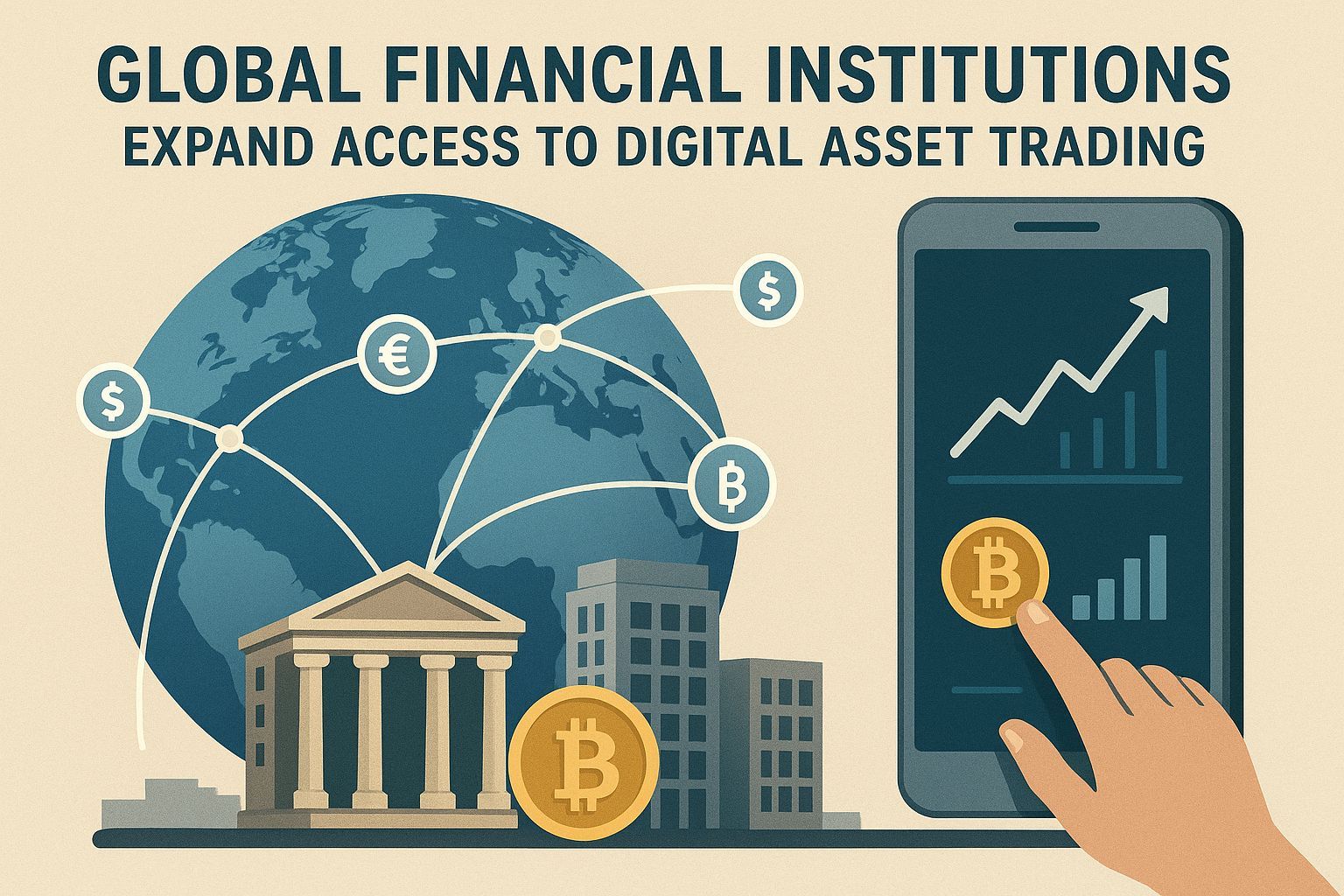
The Great Wall Crumbles: How Banks and Regulators Are Finally Opening the Crypto Floodgates
When Traditional Finance Said “Yes” to Digital Assets
Here’s the thing-for years, traditional finance treated crypto like that cousin nobody wanted at Thanksgiving. Banks wouldn’t touch it. Regulators threw up walls. But something shifted dramatically in 2025, and what’s unfolding in 2026 is nothing short of a fundamental reshaping of who gets access to digital assets and how.[1][3][4]
We’re watching a historic regulatory pivot. The banking regulators-the Federal Reserve Board, the Office of the Comptroller of the Currency, and the FDIC-have formally rescinded guidance that had basically told banks to stay away from crypto firms and custody services.[4] That’s not a small thing. That’s the green light the entire financial establishment was waiting for.
Key Takeaways: The New Crypto Playbook
- Banks can now custody crypto without fear of losing their federal backing[4]
- The U.S. is building competitive crypto frameworks to position itself as the “crypto capital of the world”[3]
- Market abuse safeguards are finally coming with new regulatory architectures in the UK and U.S.[1][2]
- Stablecoins are getting legitimacy through frameworks like GENIUS Act regulations expected in 2026[6]
- Jurisdictional clarity is reducing the regulatory ambiguity that strangled the space for years[4]
Banks Went From “Hell No” to “Let’s Go”

Think about it. The OCC alone has granted fintech firms national trust bank charters, which basically means they can now interact with digital assets and distributed ledger technology under comprehensive federal regulation.[3] That’s a massive unlock. Banks and their affiliates can now engage in digital asset activities without the existential dread of regulatory backlash.
Subscribe to our Social Media for Exclusive Crypto News and Insights 24/7!
The shift wasn’t random. President Trump convened a Working Group on Digital Assets that issued recommendations specifically designed to strengthen U.S. leadership in digital financial technology.[3] When you’ve got the executive branch actively pushing pro-crypto policy, the financial institutions take notice. Suddenly, crypto isn’t a regulatory liability-it’s a competitive advantage.
The Regulatory Framework Is Actually Getting Coherent

Remember the old days when you’d watch regulators talk past each other like they were from different planets? The SEC would say one thing, the CFTC another, and nobody knew which rules applied to what.
Not anymore. The SEC and CFTC have launched a “Harmonization Initiative” to eliminate duplicative and conflicting regulatory requirements and provide clear guidance on jurisdictional boundaries.[4] They’re literally building a taxonomy for digital assets to reduce regulatory ambiguity. That might sound boring, but for institutions trying to figure out if they can offer crypto products, it’s a lifeline.
The SEC has shifted its entire posture away from enforcement toward providing clearer guidance for digital asset issuers-a trend expected to continue throughout 2026.[6] The agency terminated most enforcement actions pending against crypto firms, including that landmark case where it alleged Coinbase was selling unregistered securities.[4] That alone opens the door for mainstream financial institutions to enter the space without legal fear.
How the U.S. Is Building Its Regulatory Moat

The Digital Commodity Intermediaries Act (DCIA) cleared the Senate Agriculture Committee on a party-line vote in late January, and here’s why it matters for institutional access.[2] The bill would define “digital commodities” under the Commodity Exchange Act and give the CFTC exclusive regulatory jurisdiction over cash and spot transactions in digital assets when they occur through CFTC-registered intermediaries.
Here’s the clever part: it doesn’t try to turn regulators into bank-style prudential regulators of issuers. Instead, it pulls centralized trading and intermediation into a federal perimeter.[2] That distinction matters because it means institutions can trade crypto without regulators micromanaging the underlying protocol or issuer.
The DCIA also addresses stablecoins explicitly. The CFTC would oversee transactions in permitted stablecoins when conducted through registered entities, but the statute bars the CFTC from regulating the operations of stablecoin issuers themselves.[2] That separation of concerns is huge-it lets traditional finance integrate stablecoins without regulatory overreach strangling innovation.
What Institutional Traders Actually Get Under These Rules

Imagine you’re a major hedge fund or asset manager. Under the DCIA framework, digital asset intermediaries would be required to segregate customer assets, use qualified digital asset custodians, and generally be prohibited from trading against their own customers.[2] That’s the kind of institutional-grade protection that was missing before.
Brokers and dealers would face similarly robust frameworks-CFTC registration, capital requirements, risk-management standards, recordkeeping, and business-conduct rules.[2] Customers could opt into staking or blockchain-based services, but access to basic trading couldn’t be conditioned on that participation. Translation: you get to trade without being forced into yield schemes.
Individuals working at these firms would also face CFTC registration requirements.[2] That raises the bar on professionalism across the entire ecosystem. When your broker’s employees are registered and monitored, you get better outcomes.
The UK Is Building Its Own Crypto Citadel
While the U.S. is moving fast, the UK published the Financial Services and Markets Act 2000 (Cryptoassets) Regulations 2026 on February 4th.[1] This establishes a comprehensive regulatory regime for cryptoasset activities that’s genuinely sophisticated.
The regulations define three main categories of cryptoassets-qualifying cryptoassets, qualifying stablecoins, and specified investment cryptoassets-and specify which activities require Financial Conduct Authority authorization.[1] Issuing stablecoins, safeguarding cryptoassets, operating trading platforms, dealing as principal or agent-all now regulated activities requiring explicit FCA approval.
But here’s what makes it institutional-grade: the UK is building a full market abuse framework. Inside information, market manipulation, insider dealing-these protections, which existed in traditional markets for decades, are now coming to crypto.[1] That’s the kind of guardrail that makes institutional money feel comfortable parking capital.
The regulations also introduce criminal penalties for making public offers of qualifying cryptoassets without falling within an exception.[1] That’s serious. It signals that crypto isn’t a regulatory free-for-all anymore; it’s a structured market with real consequences for violations.
The Global Compliance Tightening (And What It Means for Access)
Here’s the paradox: while major jurisdictions are opening doors to digital assets, they’re also tightening compliance. The Financial Action Task Force reports that 85 of 117 jurisdictions have passed or are in the process of passing legislation implementing the Travel Rule for virtual assets, up from 65 in 2024.[5] More jurisdictions are working on it.
That sounds restrictive, but from an institutional perspective, it’s actually enabling. When the compliance playbook is globally standardized, it’s easier for large financial institutions to operate across borders. Uncertainty killed institutional adoption; clarity enables it.
Regulators are also increasingly expecting proof-of-reserves from virtual asset service providers and exchanges.[5] The Basel Committee on Banking Supervision has approved frameworks for banks to disclose virtual asset exposure starting in 2026.[5] These aren’t roadblocks-they’re the infrastructure that lets banks integrate crypto into their operations responsibly.
Tokenization: The Next Frontier
You’ve probably heard the term “asset tokenization” thrown around, but here’s why it matters: regulatory clarity on digital assets is accelerating tokenization across equities, bonds, real-world assets, and more.[7] Fintechs and traditional financial institutions are developing new products-tokenized deposits, securities, prime brokerage arrangements, and complex derivatives tied to digital assets.[3]
Imagine being able to trade tokenized fractional ownership of real estate or commodities on a 24/7 basis with settlement in minutes instead of days. That’s not science fiction-it’s the ecosystem that these regulatory frameworks are enabling. The CFTC has even indicated it will facilitate 24/7 trading for both digital assets and traditional equities.[3]
The Real Story: Regulatory Competition Is Your Advantage
The wildest part? Jurisdictions are competing to attract crypto innovation. The U.S. working group wants to make America the “crypto capital of the world.”[3] The UK is building comprehensive frameworks to establish London as a global hub. Singapore, Switzerland, and others are doing the same.
That competition benefits you. When regulators compete, they become more accommodating because losing talent and capital to rival jurisdictions is politically costly. Financial institutions can now shop for regulatory regimes, and that shopping pressure keeps everyone moving forward.
What Happens Next
Regulations for stablecoins under the GENIUS Act are expected in 2026, which would enable traditional financial institutions to issue such cryptocurrencies.[6] The SEC is executing “Project Crypto,” shifting toward guidance rather than enforcement.[6] The CFTC is likely to continue allowing futures exchanges to list new contract types, including spot purchases and sales of digital assets.[3]
The harmonization between SEC and CFTC continues throughout 2026, with agency leaders working to outline a clear taxonomy for digital assets.[4] That roadmap reduces ambiguity and accelerates institutional entry.
The Bottom Line
We’re not in an era where financial institutions are dipping their toes into crypto. We’re in an era where they’re diving in-custody services, trading platforms, stablecoin issuance, tokenized assets, the full stack. The regulatory walls haven’t disappeared; they’ve been redesigned as professional safeguards that actually facilitate institutional participation.
For investors and traders, that means deeper liquidity, better market structure, and access to products that were impossible two years ago. The floodgates aren’t just opening-they’re being built bigger by the day.
- https://www.regulationtomorrow.com/eu/financial-services-and-markets-act-2000-cryptoassets-regulations-2026-published/
- https://www.consumerfinancialserviceslawmonitor.com/2026/02/digital-commodity-intermediaries-act-clears-senate-ag-committee/
- https://www.clearygottlieb.com/news-and-insights/publication-listing/2026-digital-assets-regulatory-update-a-landmark-2025-but-more-developments-on-the-horizon
- https://www.conference-board.org/research/ced-policy-backgrounders/the-outlook-for-digital-assets-in-2026
- https://sumsub.com/blog/global-crypto-regulations/
- https://www.skadden.com/-/media/files/publications/2026/2026-insights/with_supportive_new_regulations_digital_assets_are_likely_to_proliferate_in_2026.pdf?rev=f86f5ff276d04422b75f6348b4a0057e
- https://www.weforum.org/stories/2026/01/digital-economy-inflection-point-what-to-expect-for-digital-assets-in-2026/