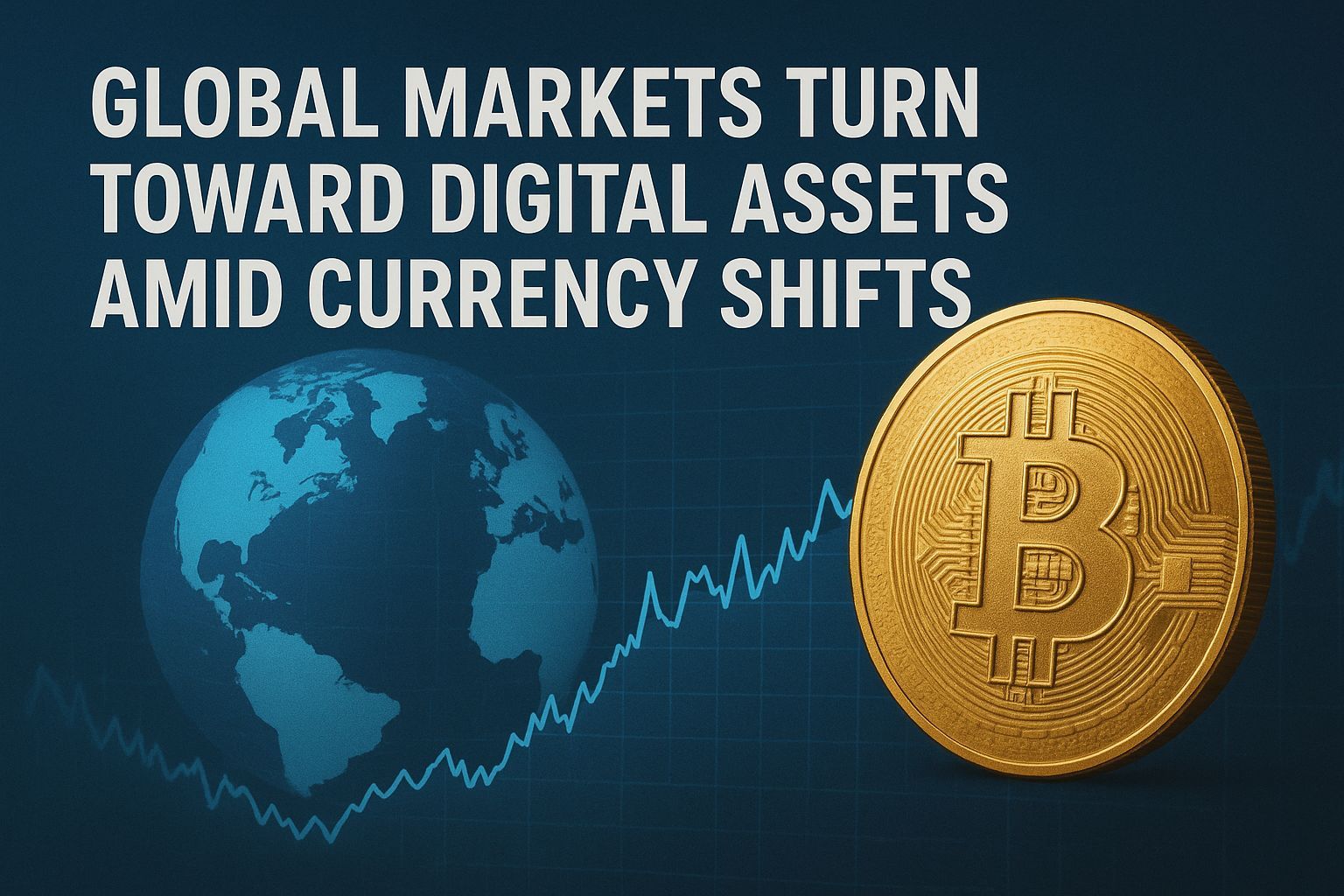
The Digital Asset Revolution Is Here-And It’s Not What You Expected
Traditional Finance Just Admitted It Can’t Ignore Blockchain Anymore
Look, we’re at a genuine inflection point. The global financial system isn’t gradually tiptoeing into blockchain anymore-it’s sprinting. What started as a fringe experiment a decade ago has morphed into something altogether different: major institutions are now building the infrastructure that’ll underpin tomorrow’s financial markets[1]. And honestly? That shift changes everything.
The narrative you’ve probably been hearing-"crypto versus traditional finance"-is officially dead. What’s emerging instead is a full-blown convergence where Wall Street’s heavyweights and Silicon Valley’s blockchain natives are literally building the same settlement networks, just from different sides of the equation[1].
Subscribe to our Social Media for Exclusive Crypto News and Insights 24/7!
Key Takeaways: Why This Moment Matters
- Regulatory clarity is fueling real adoption, not just hype. Traditional financial institutions aren’t experimenting anymore-they’re shipping products[1][4].
- Asset tokenization isn’t theoretical. BlackRock’s Larry Fink and Rob Goldstein see it expanding investable assets "beyond listed stocks and bonds that dominate markets today"[1].
- Stablecoins are becoming infrastructure. They’ve evolved from speculative tools into the backbone of real cross-border payments and treasury operations[4].
- Institutional capital is flooding in vertically. Venture checks are getting bigger, and M&A activity is reshaping the entire ecosystem[4].
When TradFi Met DeFi: The Merger Nobody Expected
Here’s what’s wild: JP Morgan-JP Morgan-just issued their USD deposit token, JPM Coin, on a public blockchain[1]. Citi integrated token services with 24/7 clearing for real-time cross-border payments[1]. These aren’t side projects. These are core product launches from institutions that literally invented modern finance.
You’ve seen this before, right? A legacy player enters a space everyone thought they’d ignore, and suddenly the entire game shifts. That’s where we’re at.
The convergence is creating a full-stack revolution. Traditional financial institutions are building "crypto banks" that mirror integrated services of actual fintech players[4]. Consolidation is accelerating because fragmented infrastructure doesn’t cut it anymore. The winners will be players who can bridge both worlds seamlessly.
Asset Tokenization: From Niche Experiment to Market Structure

Honestly, the momentum shift here caught even seasoned observers off guard.
Tokenization experimentation’s been bubbling for over a decade, but 2026 is the year it stops being a proof-of-concept and starts reshaping how capital markets function[1]. We’re talking about expanding the universe of investable assets-funds, private markets, T-bills, real estate proxies-all settling on the same rails[4].
Think about what that means:
- Liquidity improves dramatically when you can trade 24/7 on borderless networks
- Access democratizes when fractional ownership of institutional-grade assets becomes standard
- Settlement cycles collapse from days to minutes
This isn’t speculation. BlackRock and Citi aren’t deploying billions into tokenization because it feels trendy. They’re doing it because they see the structural inevitability[1].
The Stablecoin Story Got Competitive (Finally)
For years, Tether and Circle basically owned the stablecoin space. But something shifted in 2026.
Yield is reshaping the entire stablecoin stack[2]. New issuers are gaining ground because they’re offering what the incumbents weren’t: productive yield, better compliance frameworks, and genuine utility for payments rather than speculation[2][4].
Banks and fintechs are now launching tokenized versions of local currencies for remittances and B2B settlement[4]. The implication? Stablecoins aren’t becoming "the internet’s dollar"-they’re becoming the internet’s rails for every currency[4].
Tether’s playing it smart too. They’re planning federal compliance with a new stablecoin while gradually bringing USDT in line[4]. It’s defensive positioning, sure, but it signals where regulation’s headed: clearer, more institutional, less volatile.
Institutional Adoption Just Hit Critical Mass
What separates this cycle from 2017 and 2021? Institutional players aren’t treating crypto as a trading opportunity anymore-they’re treating it as infrastructure[2].
Larger venture capital checks. Bank-led custody and settlement. Crossover products that blend traditional and digital assets. This isn’t speculation flowing in; it’s structural capital allocation[4].
The data’s telling: In 2025, stablecoin adoption was catalyzed more by utility than speculation for the first time[2]. That’s the inflection point nobody talks about. When boring beats exciting, you know real adoption’s happening.
ETFs are purchasing more than 100% of new Bitcoin, Ethereum, and Solana supply as institutions accelerate[3]. Translation? Demand from legitimate institutions is already outpacing supply growth. That’s a structural tailwind most people still don’t fully grasp.
The Macro Backdrop: Liquidity Conditions Are Shifting
Here’s where the macro gets interesting. The Federal Reserve’s cutting path is steepening beyond what markets expected[2]. Economic activity is set to accelerate in 2026 as global macro conditions shift into "the most supportive configuration since 2022"[2].
That environment historically favors risk assets. Cryptocurrencies increasingly show correlation with traditional markets during risk-off periods, but they’re retaining their function as hedges against currency debasement in jurisdictions facing financial instability[5].
Bitcoin’s correlation with stocks is expected to fall in 2026[3]. If that plays out, it means digital assets are finally developing independent price drivers beyond macro sentiment.
Real-World Applications Just Got Practical
Remember when blockchain was all theoretical? Polymarket entering the U.S. market signals how on-chain applications can capture real-world utility at scale[2]. Prediction markets, onchain vaults ("ETFs 2.0"), and consumer-grade tokenization aren’t experiments anymore-they’re shipping products with actual adoption curves.
Ethereum’s Layer 1 is scaling exponentially while Bitcoin’s taking its first steps toward quantum resistance[2]. The infrastructure’s getting serious. These aren’t nice-to-haves; they’re must-haves for institutional-grade deployment.
The Realistic Price Outlook for 2026
Look, price predictions are inherently speculative, but the structural setup deserves attention[5]:
Bitcoin scenarios:
- Bear case: ~$65,000
- Base case: ~$95,000
- Bull case: ~$150,000[5]
Bitcoin could approach $180K if the Fed’s cutting path accelerates and macro liquidity improves significantly[2]. Ethereum’s structural setup entering 2026 is "one of the strongest it has exhibited in any prior cycle"[2], with potential to reach $8K under bullish conditions[2].
But here’s the thing: These aren’t guarantees. Key risks include tighter global monetary conditions, adverse regulatory changes, and reduced demand for risk assets[5]. The digital asset story is compelling, but it’s not immune to macro shocks.
Why This Moment Is Different
You’ve probably heard crypto narratives before. Usually they’re either "blockchain will replace everything" or "this is pure speculation." Both miss the actual story.
What’s happening in 2026 is pragmatic infrastructure building. Not revolution. Not disruption theater. Just boring, institutional players recognizing that blockchain’s the most efficient way to settle certain classes of transactions, and acting accordingly.
The convergence of regulatory clarity, enterprise-grade deployment, and improving interoperability is pushing blockchain from experimental status to foundational financial infrastructure[1]. That shift doesn’t make headlines, but it compounds into structural value over time.
The whales ain’t sleeping, fam. They’re rotating capital into digital assets because the risk-reward calculus has fundamentally shifted. Whether you’re watching tokenized real estate, stablecoin settlement rails, or institutional custody solutions, the direction is unmistakable.
- https://www.weforum.org/stories/2026/01/digital-economy-inflection-point-what-to-expect-for-digital-assets-in-2026/
- https://bitcoinsuisse.com/outlook/2026
- https://bitwiseinvestments.com/crypto-market-insights/the-year-ahead-10-crypto-predictions-for-2026
- https://www.svb.com/industry-insights/fintech/2026-crypto-outlook/
- https://www.youhodler.com/blog/cryptocurrency-price-prediction-2026-top-10-crypto