How Decentralized AI Is Reshaping the Trading Game for Everyone
When the Playing Field Finally Gets Level
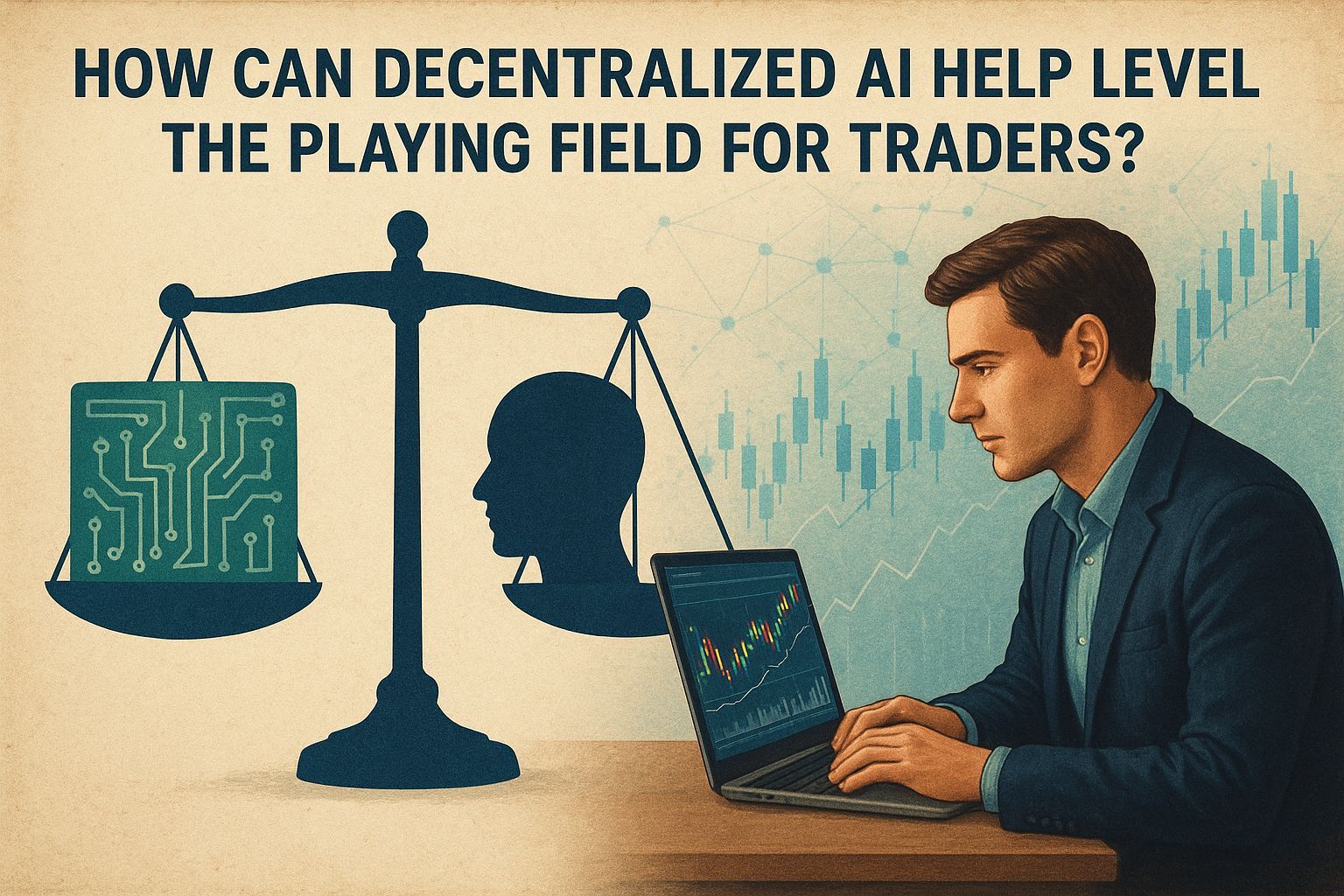
Here’s the thing-for decades, retail traders have been playing checkers while institutions were playing 4D chess. Hedge funds had access to high-frequency trading algorithms and sophisticated AI systems that could parse market data and execute trades in milliseconds. Meanwhile, regular folks were watching price charts on their phones, hoping to catch the next moonshot. But something’s shifting. Decentralized AI is cracking open access to tools that were once locked behind institutional paywalls, and the implications for traders are massive.[1][2]
The convergence of artificial intelligence and blockchain technology isn’t just hype-it’s reshaping how trading actually works. We’re talking about systems that can analyze vast datasets in real-time, adjust strategies on the fly, and execute trades across multiple chains without needing a gatekeeper in the middle. And the best part? They’re becoming accessible to everyday traders.[1][2]
Key Takeaways
- AI agents are already live in crypto, executing trades across decentralized exchanges (DEXs) and analyzing market data at scale-capabilities that were exclusive to institutional traders just years ago[1][2]
- The sector is exploding: AI agent tokens hit $7.7 billion in market cap with $1.7 billion in daily trading volumes, signaling serious institutional and retail interest[2]
- Decentralized infrastructure levels the playing field by removing intermediaries, enabling 24/7 trading without broker restrictions, and democratizing access to sophisticated automation[2][3]
- Projects like Bittensor (TAO) and the ASI alliance are building the foundational layers that’ll power the next wave of retail-accessible AI trading tools[5]
The Old Guard vs. the New Playbook
You’ve seen this movie before, right? Institutions dominate because they have resources. They hire teams of quants, deploy custom algorithms, pay for premium data feeds. A retail trader? They’re basically working with the same public information everyone else has, running on a browser, and refreshing price charts manually.
But here’s where it gets interesting. AI agents in Web3 are flipping that script entirely.[2] These aren’t your grandpa’s trading bots-the kind you’d set up on 3Commas to DCA into Bitcoin. We’re talking about intelligent systems that can:
Subscribe to our Social Media for Exclusive Crypto News and Insights 24/7!
- Monitor token prices across multiple chains simultaneously[2]
- Analyze market data and price charts to inform strategy in real-time[2]
- Execute orders across decentralized exchanges without waiting for market hours or broker approval[3]
- Apply natural language processing to track sentiment across news and social media[2]
- Manage liquidation risk and adjust positions dynamically[2]
The kicker? These tools are increasingly decentralized. You’re not dependent on a centralized platform that could go down, get hacked, or freeze your account. You control the execution. You control the data. You own the strategy.[1]
Why This Actually Matters (Beyond the Hype)

Let’s be real-most crypto trading bots have historically been pretty limited. They were glorified automation scripts. You’d set up a grid bot, maybe a DCA bot, and hope the market cooperated. That was your edge. Now, AI-powered systems apply machine learning and neural networks to parse vast datasets and act more adaptively than static, rule-only bots.[1] They incorporate historical behavior, real-time sentiment from news and social sources, and volatility forecasts-adjusting tactics on the fly.
Think about what that means for a solo trader. You’re no longer just setting buy-and-hold parameters. Your bot learns. It iterates. Platforms using AI to refine DCA logic show backtests with notable improvements, and reinforcement learning helps bots learn from drawdowns and optimize.[1]
The playing field doesn’t just get level-it actually tilts toward decentralized participants because they’re not constrained by traditional market hours or custodial limitations.
The Infrastructure Enabling This Shift

So what’s making this possible? Three things are converging:
1. Decentralized AI Marketplaces
Projects like Bittensor (TAO) are creating a decentralized marketplace for AI where different models compete and collaborate to solve problems.[5] The goal? A foundational layer for global intelligence where machine learning models can be trained and executed without censorship or centralized control.[5] Imagine an open marketplace where your trading strategy-and thousands of others-can run simultaneously, each competing to find the best edge. That’s the endgame.
2. Enterprise-Grade AI Infrastructure
The Artificial Superintelligence Alliance (ASI), born from the merger of Fetch.ai, SingularityNET, and Ocean Protocol, is building infrastructure specifically designed for autonomous agents and automation.[5] This alliance is aiming to create a global market for AI services that could revolutionize automation itself.[5] For traders, that means standardized, auditable AI systems powering their strategies instead of black-box algorithms you have to trust blindly.
3. Real-Time Blockchain Data + AI Analysis
Here’s the beautiful part: blockchain is transparent. Every transaction is on-chain, every liquidity pool is observable, every whale move is visible. Now layer AI agents on top of that. These systems can analyze on-chain patterns, spot arbitrage opportunities across DEXs in real-time, and execute without human intervention.[2][3] They’re not fighting against information asymmetry-they’re working within a system designed for transparency.
What the Market’s Actually Telling Us

The numbers are speaking. AI agent tokens have already surpassed $7.7 billion in market capitalization, with daily trading volumes approaching $1.7 billion.[2] That’s not retail speculators chasing memes-that’s capital flowing into infrastructure. Leading projects like Virtuals Protocol, Fetch.ai, and SingularityNET are pioneering this integration.[2]
But here’s the thing that catches most traders off guard: this isn’t just about trading bots anymore. AI agents are already being used to oversee project treasuries, run DAO-style business models independently, and manage tokenized real-world assets (RWAs) like stocks, treasuries, and even real estate.[3] They’re streamlining asset verification, compliance, and liquidity management without traditional intermediaries-allowing assets to trade on-chain 24/7 without a broker.[3]
That’s the actual revolution. It’s not “my bot beats your bot.” It’s “we’ve removed the need for a broker entirely.”
The Real Edge: Access Without Permission
Here’s what separates this moment from every previous wave of trading tech. Before, you needed:
- A brokerage account (with approval)
- Market hours (usually 9 AM to 4 PM your local time)
- Sufficient capital (most platforms have minimums)
- Permission to use leverage or derivatives
- Trust that your broker wouldn’t freeze your account
With decentralized AI, you need:
- A wallet
- Internet connection
- Capital (even small amounts can work via DCA)
- That’s it.
No gatekeepers. No “we’ve temporarily disabled withdrawals.” No market hours. A bot can be executing strategies at 3 AM on a Sunday because on-chain trading never sleeps. You’re competing on strategy and capital allocation-not on whether you know someone at a hedge fund.[1][2][3]
The Catch (Because There’s Always a Catch)
Let’s not pretend this is risk-free. Decentralized systems are still new. Smart contracts can have bugs. Gas fees can spike. Slippage on smaller trades can eat profits. And honestly? Most bots-even AI-powered ones-still fail.[7] They fail because traders set them and forget them, don’t understand their own strategy, or get liquidated in a flash crash.
The difference is: when a decentralized system fails, it’s your fault, not the platform’s. You own the outcome, which is both empowering and terrifying.
Where This Heads Next
The trajectory is clear. Projects supporting critical infrastructure-autonomous stablecoin payment rails, tokenization platforms, decentralized compute and data networks, privacy and verification systems-will have the most upside potential in the medium to long term.[3] That’s where the actual leverage is. Not in individual trading bots, but in the infrastructure enabling millions of AI agents to operate simultaneously.
For traders specifically: you’re moving from a world where you picked a trading bot off a shelf and hoped it worked, to a world where you can access modular, transparent, AI-powered trading infrastructure and compose it however you want. That’s the leveling of the playing field. Not because everyone becomes a genius trader, but because genius is now a distribution game, not an access game.
The whales ain’t sleeping, but neither is your AI agent. And for once, they’re operating under the same rules.
- https://westafricatradehub.com/crypto/best-ai-crypto-trading-bots/
- https://www.quicknode.com/builders-guide/best/top-10-ai-agents-in-web3
- https://www.youtube.com/watch?v=D1t1CvQ4nbo
- https://www.businessinsider.com/personal-finance/best-crypto-trading-apps
- https://www.binance.com/en/square/post/34061916945010
- https://www.seedtable.com/best-decentralized-application-dapp-startups
- https://www.coinapi.io/blog/best-ai-crypto-trading-bots-for-2026
- https://orai.io/guide/a-beginners-guide-to-investing-in-decentralized-ai-projects