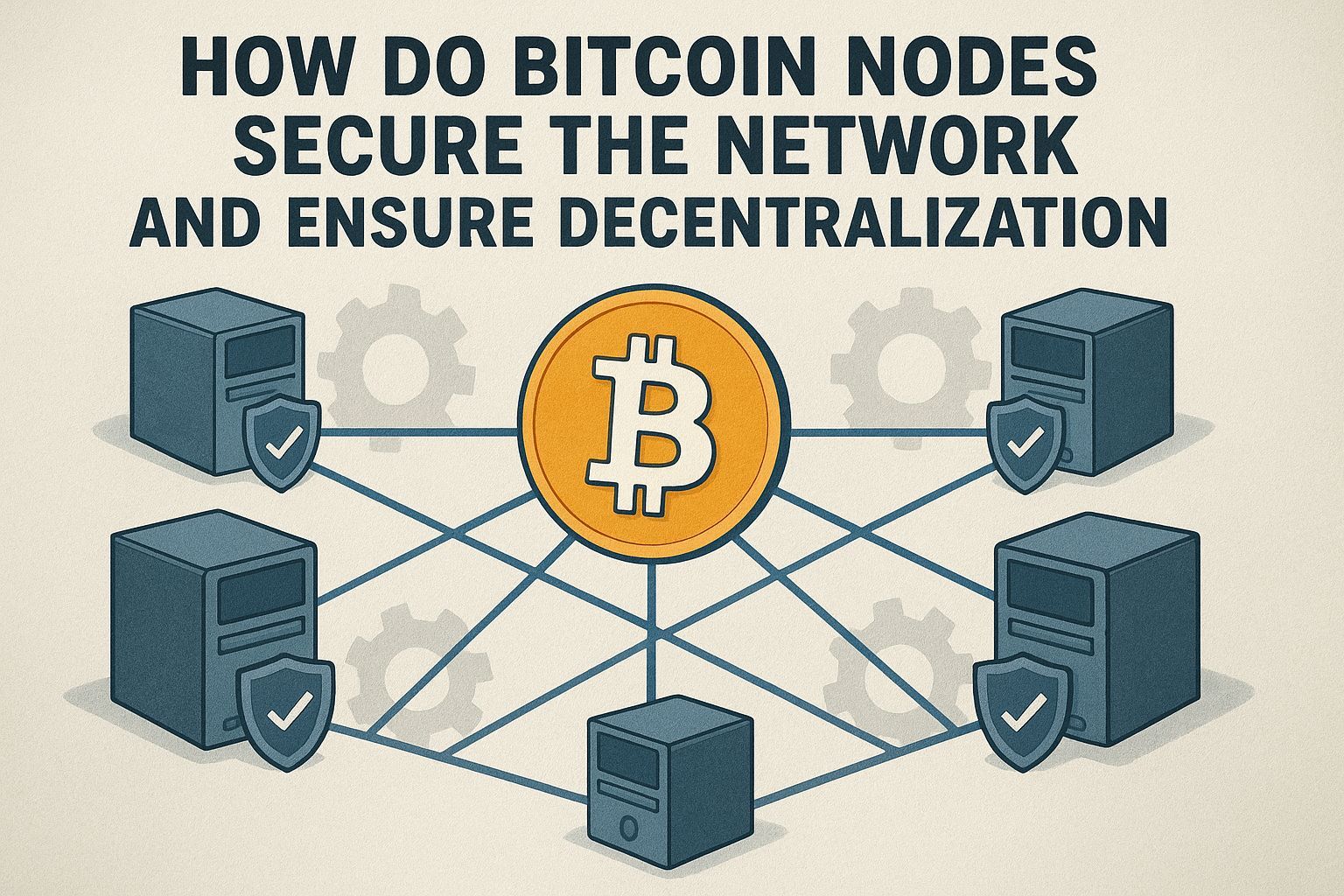
The Unsung Heroes Keeping Bitcoin Honest: How Nodes Actually Secure the Network
Why Bitcoin’s Real Power Isn’t in the Price-It’s in the Nodes
Here’s the thing about Bitcoin that most people get completely wrong: the network’s strength doesn’t come from some fancy algorithm or a single genius engineer. It comes from thousands of independent nodes scattered across the globe, each one acting as a guardian that refuses to be corrupted[1][2][3]. These nodes are the actual backbone of Bitcoin’s security and decentralization-and they’re doing something traditional finance can’t even dream of pulling off.
Think of it this way. Your bank keeps your money in a vault, right? That vault is a single point of failure. One breach, one disgruntled employee, one natural disaster, and everything’s at risk. Bitcoin’s different. It doesn’t have a vault. Instead, it has thousands of vaults, spread across different continents, each one independently verifying that nobody’s cheating the system[1]. An attacker would need to simultaneously compromise multiple geographically dispersed nodes to even think about manipulating the network-and that’s practically impossible[1].
Subscribe to our Social Media for Exclusive Crypto News and Insights 24/7!
Key Takeaways
- No Single Point of Failure: Decentralized nodes mean attackers can’t just breach one server to compromise the entire network[1]
- Consensus Through Math, Not Trust: Every transaction requires validation from multiple independent sources using complex cryptographic proofs[1][5]
- Economic Incentives Beat Hacking: Miners are financially rewarded for maintaining integrity, not attacking it[1]
- Privacy & Control in Your Hands: Running your own node means you verify transactions yourself without trusting third parties[2][4]
- The More Nodes, The Stronger: Each additional node makes Bitcoin more resistant to censorship and manipulation[2][3]
How Nodes Actually Validate Every Single Transaction
Let’s break down what’s happening under the hood. When someone sends Bitcoin, that transaction doesn’t just magically appear on the blockchain. It goes through a gauntlet. Nodes validate that transaction against the entire ruleset of the Bitcoin protocol[2][7]. Does the sender actually own those coins? Is the digital signature legit? Did someone try to double-spend? If anything’s fishy, the transaction gets rejected[2].
This validation process is continuous. Nodes are constantly communicating with each other, exchanging data, and making sure everyone’s got the same version of the blockchain[3]. It’s like having thousands of independent accountants all cross-checking the same ledger simultaneously. And here’s the kicker-they’re using mathematical proof, not trust[5]. You don’t need to believe a node is honest; you can verify it yourself[5].
The blockchain grows, blocks get confirmed, and each block is recorded across thousands of nodes[1]. Once that happens? The record’s practically immutable[5]. Trying to alter transaction history would mean simultaneously changing copies across thousands of machines in different time zones. Good luck with that.
The Decentralization Difference: Why Bitcoin Isn’t a Middleman

This is where it gets interesting. In traditional banking, centralization is the business model. Your bank controls your money, decides when you can access it, and takes a cut along the way. Bitcoin inverts that entire equation[2].
When you run your own node, you’re not trusting anyone else to verify your transactions[2][4]. You’re not asking permission. You’re not paying a fee to some corporation to move your money around. You’re verifying the entire history yourself-all 500+ gigabytes of blockchain data[5]. It’s financial sovereignty, plain and simple[4].
And this matters for the whole network, not just you. Each additional node makes Bitcoin more resilient to attacks and censorship[2][3][4]. Want to shut down Bitcoin? You’d need to simultaneously take down thousands of nodes worldwide, coordinated perfectly across different countries with different laws. It’s not happening. That’s decentralization working exactly as designed[3].
The Economic Model That Makes Attacks Unprofitable

Here’s something brilliant about how Bitcoin’s structured: attacking it doesn’t make financial sense[1]. Miners who validate transactions are economically motivated to keep the network healthy because that’s where their rewards come from[1]. You earn Bitcoin by playing by the rules. You get nothing by breaking them-except losses[1].
The proof-of-work mechanism distributes computational power across the network[1]. No single entity can hoard enough power to take control. Participants must invest serious resources-electricity, hardware, cooling systems-just to compete. That creates a natural barrier against attacks[1]. The system transforms security from a technical problem into a self-sustaining economic ecosystem where honest participation is literally more profitable than malicious activity[1].
What Happens When You Run Your Own Node

So what does it actually mean to run a node? You download the entire blockchain, verify every transaction from the genesis block onward, and enforce the protocol rules yourself[7]. Sounds heavy? It is. But here’s what you get in return:
Privacy: When you broadcast transactions through your own node, outside observers can’t easily tell which transactions are yours[2]. Compare that to using a third-party wallet service-they see everything[2][4].
Security: You’re not trusting some exchange or custodian with your private keys[2]. You’re verifying everything independently[4]. No third party, no risk of them getting hacked[2].
Contributing to the Network: Every node strengthens Bitcoin’s overall resilience[2][3][4]. You’re literally making the network harder to attack, more resistant to censorship, and more decentralized[2][4]. People run nodes out of duty to the protocol-they want to ensure that everyone can make censorship-resistant, peer-to-peer transactions[2].
There’s something almost activist about it. You’re participating in a system that can’t be shut down by governments, corporations, or bad actors[3].
The Network’s Collective Power: Why Full Nodes Matter Most
Not all nodes are created equal. Full nodes are the heavyweights[3]. They store the entire blockchain and independently verify every transaction and block[3]. Lightweight nodes (SPV nodes) exist too-they only store block headers and rely on full nodes for validation[3]. But full nodes? They’re what make Bitcoin actually secure[3].
Without enough full nodes scattered worldwide, a bad actor could theoretically create false blocks or manipulate transactions[3]. With thousands of independent full nodes? It’s virtually impossible[3]. The robustness of the network directly correlates with the number of active full nodes[3].
Research from MIT has shown that distributed networks inherently resist manipulation and attack attempts[1]. Academic work from ACM demonstrates that decentralization provides cryptographic security beyond conventional protection methods[1]. The science backs it up-decentralization isn’t just ideology; it’s engineered resilience.
The Real Trade-off: Resources vs. Sovereignty
Let’s be real: running a full node isn’t frictionless. It requires storage space (500+ GB and growing), bandwidth, and electricity[3][5]. Your computer needs to be online regularly to stay synchronized with the network[3]. It’s a commitment.
But here’s the perspective shift: if you care about financial sovereignty and Bitcoin’s survival as a decentralized network, those resources aren’t a cost-they’re an investment[3]. You’re literally paying for the ability to verify your own transactions and contribute to a system that can’t be censored[4][7].
For casual users, there are lighter options like SPV nodes that don’t require as much storage[3]. But if you’re serious about Bitcoin’s mission? You want a full node running.
The Lightning Network Connection: Nodes All the Way Down
Interestingly, Bitcoin’s Layer 2 solution-the Lightning Network-depends on nodes too[5]. A Lightning node must run a Bitcoin node to monitor the blockchain for channel-related transactions[5]. When you open or close a payment channel on Lightning, that final settlement broadcasts to the main blockchain, secured by-you guessed it-the network of Bitcoin nodes[5].
It’s nodes securing the foundation, nodes securing the second layer. The architecture compounds its own security.
What This Means for Bitcoin’s Future
The more nodes, the stronger Bitcoin gets[3]. Period. It’s not complicated. The more people running independent verification, the more resistant the network becomes to attacks, censorship, and manipulation[3]. That’s why node count matters to serious Bitcoin analysts and developers[3].
This is fundamentally different from traditional systems. You can’t bribe your way into controlling Bitcoin because there’s no central authority to bribe. You can’t regulate it away because it’s not under one jurisdiction. You can’t shut it down because it exists on thousands of machines you don’t control. The nodes make that possible[1][3][7].
For crypto-savvy investors, understanding nodes transforms how you think about Bitcoin’s value proposition. It’s not just digital gold-it’s a permission-less financial network secured by mathematical proof and economic incentives, with redundancy built into every layer. That’s why Bitcoin’s still standing after 15+ years while countless other projects have failed.
- https://www.blockwaresolutions.com/blog/top-benefits-of-decentralization-for-bitcoin-crypto-in-2025/
- https://www.bitpay.com/blog/bitcoin-nodes
- https://21bitcoin.app/en/blog/what-is-a-bitcoin-node
- https://www.youtube.com/watch?v=KMbcly-5KZg
- https://lightspark.com/glossary/node
- https://fc18.ifca.ai/preproceedings/75.pdf
- https://blog.blockstream.com/education/nodes/what-is-the-role-of-a-bitcoin-node/