
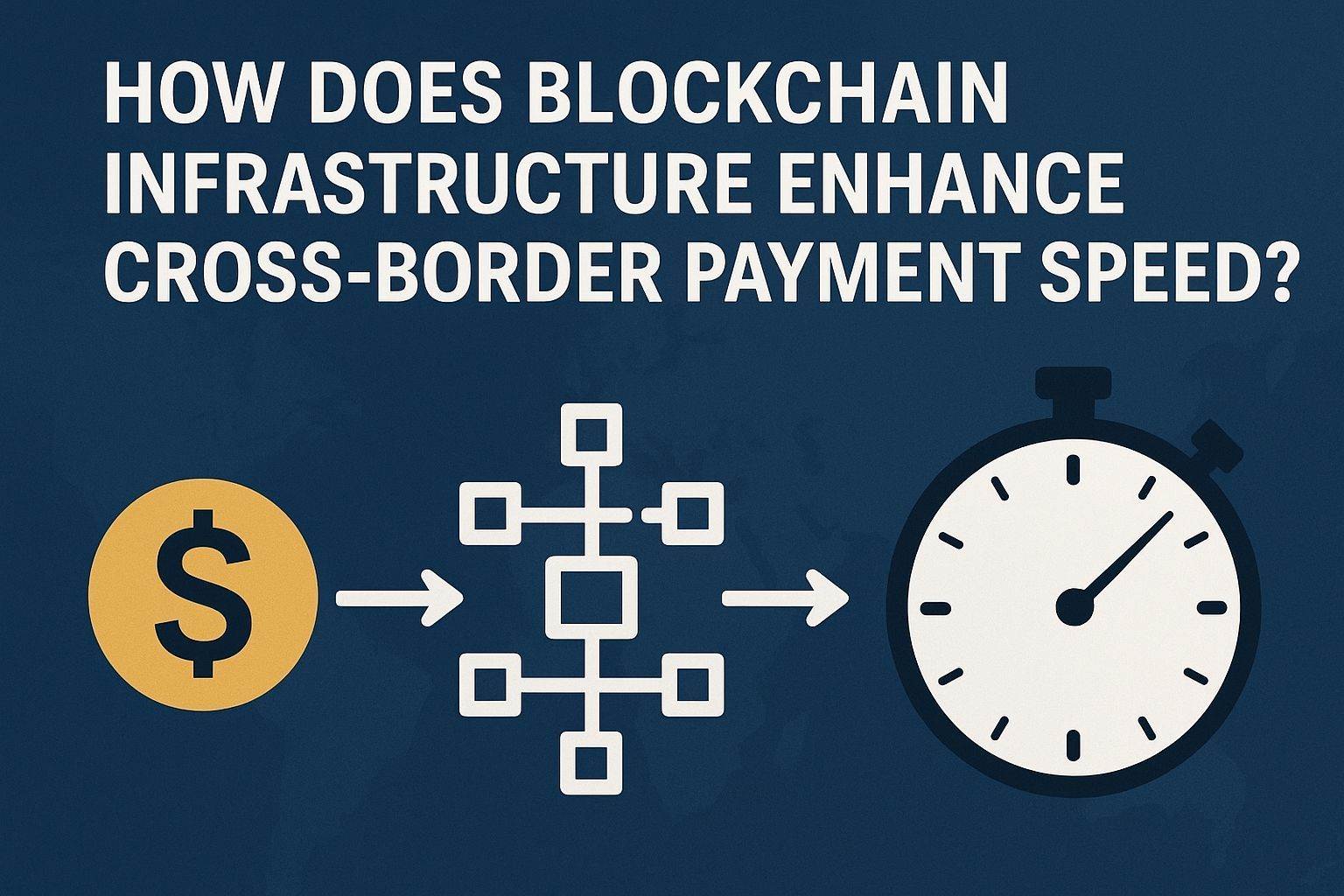
Cross-Border Cash: From Snail Mail to Warp Speed
Blockchain infrastructure enhances cross-border payment speed by slashing settlement times from days to seconds, ditching clunky correspondent banks, and enabling 24/7 global transfers with ironclad transparency. Forget waiting for SWIFT’s batch processing-blockchain’s distributed ledgers and smart routing make it happen near-instantly, even across time zones and holidays.[1][2][5]
Key Takeaways
- Market Boom: Cross-border payments hit $345B by 2033, with 16.6B A2A transactions in 2026 alone-up 11% YoY.[1][7]
- Blockchain Edge: Stablecoins and networks like Ripple’s ODL cut costs under $0.1/tx, deliver atomic settlement, and run 24/7.[4][5]
- Speed Stats: 89% of SWIFT payments reach destination banks in <1 hour, but blockchain pushes for true instant anywhere.[2]
- Bank Wake-Up: 40% of banks risk 5% market share loss to blockchain if they stick to legacy rails.[4]
Subscribe to our Social Media for Exclusive Crypto News and Insights 24/7!
You know that gut punch when a payment “clears” in three days? Yeah, that’s legacy banking’s love letter to inefficiency. Blockchain flips the script. Picture this: instead of pinging pong through four correspondent banks, funds zip via direct rails-local payout networks, ISO 20022 messaging, and blockchain’s immutable timestamps. J.P. Morgan’s crew nails it: “89% arrive within an hour,” but they’re eyeing blockchain for that final leap to instant, any-size transfers worldwide.[2] It’s not hype; it’s math. Real-time gross settlement (RTGS) plus blockchain? Domestic payments already generate $173B extra output by 2026. Scale that borderless, and you’re talking reinvested capital before your coffee’s cold.[2]
Ditching the Middlemen: How Blockchain Rails Actually Work
Traditional flows? Nostradamus-level unpredictable. Cutoffs, weekends, FX headaches. Blockchain? Always on. No clearing houses, no settlement windows-just continuous, peer-to-peer settlement.
- Smart Routing Magic: API orchestration picks the fastest path-local rails where possible, blockchain bridges elsewhere. Reduces “stuck” payments, boosts straight-through processing (STP).[1][3]
- Stablecoin Sprint: These bad boys moved $27T in value, grabbing 1% of US/UK remittances. Near-zero fees, yields on hold, cryptographic security. Banks sweating yet?[4]
- Provenance Power: Every tx traceable on a universal ledger. Flag sketchy funds instantly-no more black-box banking.[4]
Ripple’s ODL? Cut costs and settlement times big time. “Streamlining debits, credits, and liquidity… in a fast and economical way,” where SWIFT couldn’t.[4] Whales aren’t sleeping; they’re rotating into these rails.
Real-World Wins: From Theory to Treasury Flex
Remember 2025’s wallet wars? PayPal World linked Venmo, UPI, Mercado Pago-over 5B wallets going cross-border.[6] Zota’s take: Businesses ditching three-day waits because “consumers no longer understand why.”[3] Atomic settlement means suppliers paid real-time, zero credit risk. Imagine holding liquidity through a weekend crunch-blockchain treasury ops make it chill, per J.P. Morgan’s Naveen Mallela: “Enables dynamic management… especially when liquidity is constrained.”[2]
Sarcasm alert: Banks ignoring this? Like betting against the internet in ’95. Zeeve warns 40% could lose 5% share to stablecoins offering < $0.1 fees, 24/7 ops, and smart-contract smarts.[4] Historical parallel? SWIFT’s old unstructured messages caused payment pile-ups. Enter ISO 20022’s “rich data”-fewer errors, plummeting manual interventions.[3]
The Friction Fighters: Compliance Without the Drag
Automated AML? Faster screening, lower false positives. No more every-tx manual review slowing legit flows.[1] Blockchain adds programmable compliance-transparency on steroids. TRM Labs notes crypto’s crime trends, but regulated rails keep it clean: illicit wallets hit $158B in 2025, yet legit blockchain payments thrive with built-in checks.[8]
Swift’s even launching a 2026 consumer scheme for “fast, predictable” payments.[9] But blockchain’s the turbo-full visibility, real-time tracking, no support tickets from “where’s my money?” blackouts.[1]
Hey, savvy degen-you seeing the play? Cross-border’s not “faster” anymore; it’s instant, invisible value transfer. Banks blend with ISO 20022 or get Zeeve’d. Global spend to $320T in 7 years-who’s building on blockchain first wins.[4]
- https://www.digipay.guru/blog/transparency-speed-and-security-in-cross-border-payments/
- https://www.jpmorgan.com/payments/payments-unbound/volume-3/cross-border-payment-modernization
- https://zota.com/blog/payments/cross-border-payment-trends/
- https://www.zeeve.io/blog/can-your-bank-survive-2026-cross-border-payment-market-without-blockchain/
- https://bvnk.com/blog/blockchain-payments
- https://www.fxcintel.com/research/reports/ct-2026-predictions
- https://thepaymentsassociation.org/article/cross-border-payments-2026-friction-reform/
- https://www.trmlabs.com/reports-and-whitepapers/2026-crypto-crime-report
- https://www.swift.com/payments/new-standard-cross-border-consumer-originated-payments






