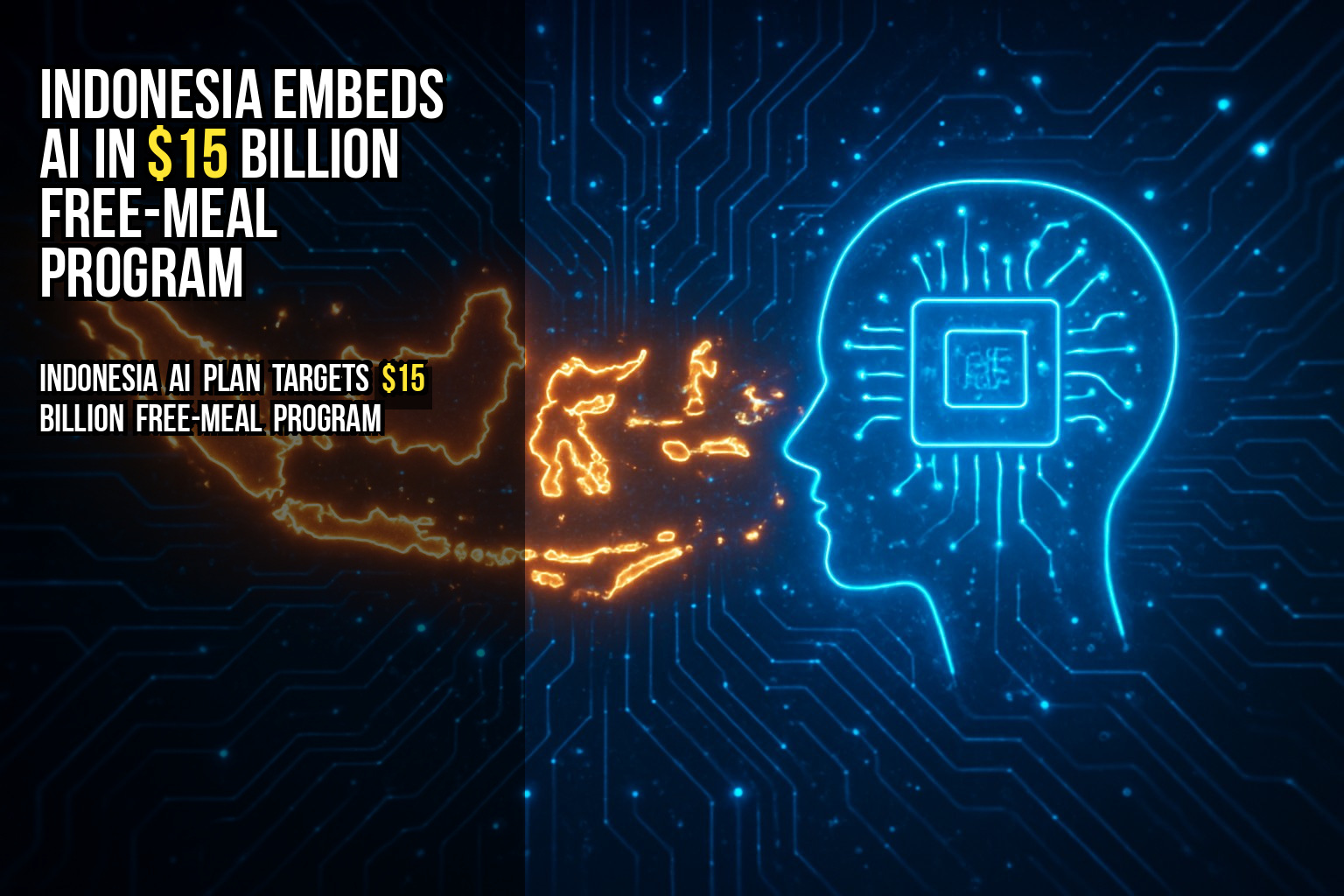
Indonesia AI plan targets $15 billion free-meal program
Indonesia is moving to embed artificial intelligence into its flagship free-meal programme, a $15 billion initiative that remains one of the country’s biggest budget items and a central policy test for President Prabowo Subianto.[1][5] A presidential regulation draft seen by Reuters says the plan would use AI to help design region-specific menus, monitor kitchen hygiene, forecast demand and detect irregularities, underscoring how the government is trying to tighten oversight of a fast-scaling welfare programme.[1]
Key Metrics
- Indonesia’s free-meal programme carries a $15 billion allocation this year, making it one of the largest state spending lines in the region.[1][5]
- The draft regulation would apply AI to menu design, hygiene monitoring and demand prediction, which could improve operational control across a vast distribution network.[1]
- The government is targeting coverage of about 83 million people, roughly 30% of the population, by year-end.[5][6]
- Indonesia spent 51.5 trillion rupiah on the programme in 2025, then expanded funding significantly this year.[5][6]
- The roadmap spans 2026 to 2029, indicating the AI push is being planned as a multi-year policy framework rather than a short-term trial.[2]
- The draft also links AI adoption to broader goals, including a government view that the strategy could help lift GDP by 12% by 2030.[1]
Subscribe to our Social Media for Exclusive Crypto News and Insights 24/7!
Indonesia AI plan moves from policy to execution

The Reuters-reported draft is the clearest sign yet that Indonesia intends to push artificial intelligence deeper into public administration, not just into private-sector pilots.[1] In the free-meal scheme, the technology is intended to reduce waste, flag anomalies and support faster intervention when kitchens or supply chains fall out of line.[1]
That matters because the programme is already large enough to influence procurement, logistics and public-sector contracting across the country.[5][6] Market participants view the move as a sign that Jakarta is trying to use automation to defend a politically important programme that has drawn scrutiny for its cost and operational complexity.[3][5]
What the free-meal programme covers
| Item | Verified data | Direct implication |
|---|---|---|
| 2026 allocation | $15 billion | The programme is now a major fiscal commitment.[1][5] |
| Coverage target | 83 million people | Operational mistakes can scale quickly across a nationwide rollout.[5][6] |
| Budget share | Just over 6% of the national budget | The programme is large enough to affect broader fiscal priorities.[6] |
| Timeframe for AI roadmap | 2026-2029 | The AI push is intended as a medium-term governance overhaul.[2] |
Indonesia’s nutrition agency has said the programme is meant to reach nearly 83 million beneficiaries by the end of the year, while Bloomberg has reported that the budget strain is already visible.[5][3] The scale is also shaping the surrounding economy, with the supply chain now involving tens of thousands of small businesses and a wide network of kitchens and logistics providers.[6]
Why the AI embed matters for market structure
The immediate relevance is not crypto-specific, but the policy direction is clear: Indonesia is normalising AI as an operating layer inside state programmes that handle money, food and data at scale.[1][2] Data suggests that approach could strengthen government monitoring capacity, while also creating new demand for software, systems integration and compliance tooling around public procurement.[1][2]
For investors, the main signal is that Indonesia is willing to spend and reorganise to protect a politically sensitive programme.[3][5] That can support vendors tied to public-sector digitalisation, but it also raises execution risk if AI systems are deployed unevenly across ministries and regions.[2] Analysts note that any failure to improve controls would increase pressure on the programme’s budget at a time when it is already absorbing a large share of national spending.[5][6]
Risks and uncertainty
The biggest uncertainty is implementation. The draft is still a regulation proposal, and Reuters’ reporting indicates it awaits President Prabowo Subianto’s signature.[2] That leaves room for delays, revisions or uneven rollout across ministries and regional governments.[2]
A second risk is political. The free-meal programme is a signature policy, but Bloomberg has reported that its cost is already straining the budget.[3] If AI does not materially reduce waste, improve hygiene or sharpen demand forecasting, the technology layer could add complexity without easing fiscal pressure.[1][5] Interpretation based on available data: the government’s AI push may improve oversight, but it does not remove the underlying challenge of running one of the world’s largest meal-distribution programmes at scale.[1][5][6]
- https://economictimes.indiatimes.com/tech/technology/indonesia-plans-to-embed-ai-in-key-programmes-including-15-billion-free-meal-drive-document-shows/articleshow/131904583.cms
- https://www.mexc.com/news/1165064
- https://www.bloomberg.com/news/features/2026-04-13/handing-out-15-billion-of-free-meals-strains-indonesia-s-budget
- https://www.businesstimes.com.sg/international/asean/handing-out-us15-billion-of-free-meals-strains-indonesias-budget
- https://www.youtube.com/watch?v=u6Qwd_UdhQw
- https://www.linkedin.com/posts/bloomberg-news_why-indonesias-15-billion-free-lunch-program-activity-7465175041094307841-Jyy-