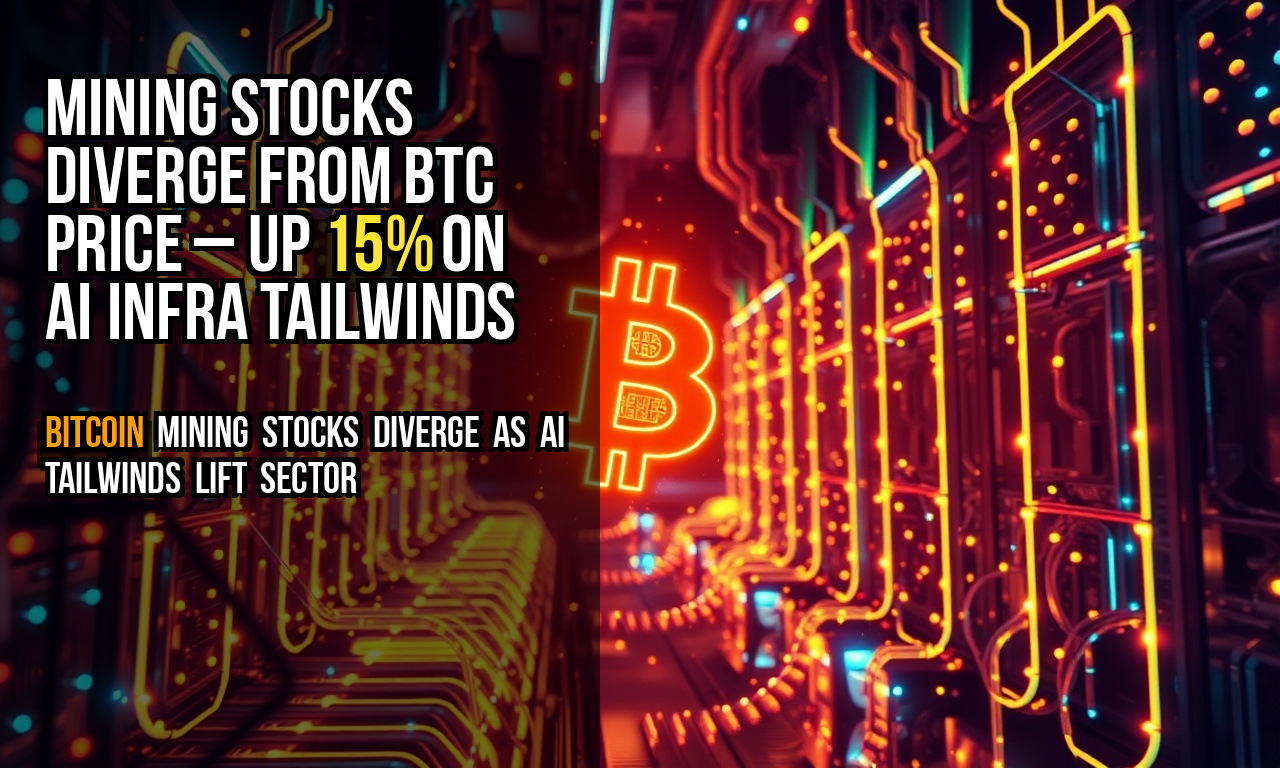
Bitcoin mining stocks diverge as AI tailwinds lift sector
Bitcoin mining stocks rose sharply on Tuesday as investors continued to price in AI infrastructure demand, even as the broader crypto market remained tied more closely to bitcoin’s own direction. The move highlighted a widening gap between mining equities and BTC price action, with some miners up as much as 15% on AI-related tailwinds[1][3][8].
Key Metrics
- Cipher Mining and IREN rose 7% in pre-market trading after the $38 billion Oracle-OpenAI data center financing was reported, signaling investor interest in AI-exposed miners[1].
- Bitfarms jumped 12% on the same session, showing that smaller miners with power-intensive assets are also drawing AI-driven flows[1].
- TeraWulf gained as much as 17% after a Kentucky data center site update, underscoring how infrastructure news can move miner stocks independently of BTC[3].
- Hut 8, IREN and Riot Platforms finished the session up more than 5%, indicating sector-wide participation rather than a single-name rally[3].
- The catalyst was a reported $38 billion debt package for Oracle-linked data centers, one of the largest AI infrastructure financings on record[1].
- Analysts note that the market is increasingly treating some miners as data-center and power assets, not just bitcoin production vehicles[2].
Subscribe to our Social Media for Exclusive Crypto News and Insights 24/7!
Mining stocks rally on AI infrastructure demand
The primary driver was not bitcoin itself, but a wave of enthusiasm around AI infrastructure. Bloomberg reported that banks were preparing a $38 billion debt sale to fund two data centers for Oracle’s partnership with OpenAI under the Stargate initiative, and that news coincided with a rally in mining-related equities[1].
That mattered because several miners already own large power contracts, data-center footprints and grid access that can be repurposed for high-performance computing. Cointelegraph reported that publicly traded Bitcoin miners advanced as optimism around AI infrastructure improved the sector outlook, with names such as TeraWulf, Hut 8, IREN and Riot all participating in the move[3].
| Company | Reported move | Catalyst cited | Market read-through |
|---|---|---|---|
| Cipher Mining | +7% | AI infrastructure financing news | Investor rotation into AI-linked power assets[1] |
| IREN | +7% | AI infrastructure financing news | Miner valued partly as compute infrastructure[1] |
| Bitfarms | +12% | Broad miner re-rating | Smaller miners also benefitting from the theme[1] |
| TeraWulf | +17% intraday | Kentucky data center update | Infrastructure optionality driving bid[3] |
Why the mining stocks trade is diverging from BTC price
The divergence reflects a changing investor lens. Coinspaid Media said miners are increasingly moving into AI and high-performance computing because crypto mining economics remain volatile, while contract-based data-center revenue can be more predictable[2].
That shift has already shown up in corporate strategy. Coinspaid Media cited Core Scientific’s pivot toward AI-related computing infrastructure and its large contract base as an example of how the business model is evolving beyond pure bitcoin production[2]. The same article said Riot Platforms has been evaluating capacity reallocation, while competition for electricity and data-center sites is intensifying[2].
| Theme | Bitcoin mining model | AI infrastructure model |
|---|---|---|
| Revenue profile | Tied to BTC price, network difficulty and power costs[2] | More contract-based and predictable[2] |
| Core assets | Hashrate, low-cost electricity, mining hardware[2] | Power, data-center space and cooling capacity[2] |
| Investor appeal | Direct crypto exposure | Exposure to AI build-out and compute demand[1][2][3] |
Market participants view that as a key reason some mining stocks are no longer trading in lockstep with BTC. The shares are increasingly being judged on infrastructure utility, not only on block rewards or hashprice.
Market structure implications
The move matters for market structure because it blurs the line between crypto miners and broader digital infrastructure companies. Bloomberg’s reporting on the Oracle-OpenAI financing showed that capital is still flowing aggressively into AI data centers, and miners with pre-built power access are positioned to compete for that demand[1].
That creates a two-track market. One track remains tied to bitcoin price action and mining margins. The other is being re-rated against AI compute demand, grid capacity and data-center monetization. Cointelegraph’s report that several miners rallied together suggests the AI trade is broad enough to influence sector pricing, not just isolated stocks[3].
Risks and uncertainty remain
The re-rating is not guaranteed to hold. If AI infrastructure spending slows or financing gets tighter, the market may reverse part of the move that has lifted miners[1][3]. There is also execution risk: converting mining sites into competitive AI infrastructure requires capital, customer demand and reliable power economics, and not every miner has the balance sheet or site quality to make that transition[2].
Another uncertainty is valuation. The recent rally has been driven by expectations ahead of cash flow realization, which means stocks could remain volatile if investors decide the AI optionality is priced too aggressively. For now, the clearer signal is that mining equities are being pulled by a new driver, and that driver is no longer just bitcoin[1][2][3].
- https://www.indexbox.io/blog/ai-and-hpc-mining-stocks-rally-on-record-38b-infrastructure-financing/
- https://coinspaidmedia.com/business/why-mining-companies-are-moving-ai-infrastructure/
- https://bingx.com/en/news/post/bitcoin-mining-stocks-rally-as-ai-infrastructure-optimism-lifts-sector-outlook
- https://tradingview.com/news/cointelegraph:002495209094b:0-bitcoin-mining-stocks-jump-as-ai-infrastructure-boom-boosts-sector-outlook/